

Here is what researchers reported on ketamine and low-dose LSD in acute pain. In a trial of 449 people with severe injury pain, paramedic-given ketamine and morphine gave similar pain-relief scores (SPID 3.5 vs 3.4) , with ketamine matching morphine, and in an emergency department trial of 90 patients, pain scores fell from 8.6 to 4.1 with ketamine and from 8.5 to 3.9 with morphine. Adding low-dose ketamine to morphine raised median pain-relief scores to 7.0 and 7.8 from 4.0. A Cochrane review of 130 trials found ketamine reduced pain at rest after surgery, and in 24 healthy volunteers low-dose LSD significantly increased cold-water pain tolerance.
Key studies
Study 1. Ketamine or morphine given by paramedics in 449 people with severe pain after injury (Smyth, 2025)
Paramedic-given ketamine and morphine gave similar pain relief (SPID 3.5 vs 3.4, no significant difference) in 449 people with severe injury pain!
In a double-blind randomized trial in two UK ambulance services, 449 people aged 16 or over with severe pain after an injury received either ketamine (219 people) or morphine (230 people) from their paramedic. Researchers reported pain-relief (SPID) scores of 3.5 for ketamine and 3.4 for morphine, so ketamine matched morphine, serious adverse events in 4 (2%) ketamine and 8 (3%) morphine patients, and no treatment-related deaths! The authors concluded that ketamine did not provide superior analgesia than morphine, and noted that many patients still experienced pain on arrival at hospital.
“The SPID score was 3.5 (SD 2.8) for ketamine and 3.4 (SD 3.0) for morphine.”
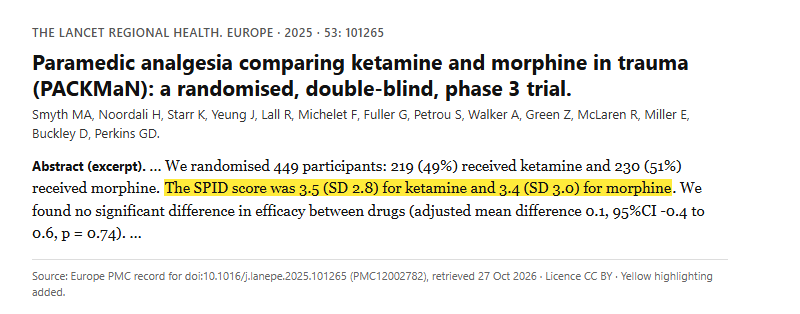
Abstract of the published study (text from Europe PMC), key sentence highlighted in yellow. Source: Smyth MA, Noordali H, Starr K, et al. Paramedic analgesia comparing ketamine and morphine in trauma (PACKMaN): a randomised, double-blind, phase 3 trial. Lancet Reg Health Eur. 2025;53:101265. https://doi.org/10.1016/j.lanepe.2025.101265
Study 2. Ketamine or morphine in 90 adults with acute pain in an emergency department (Motov, 2015)
Pain scores fell from 8.6 to 4.1 (ketamine) and 8.5 to 3.9 (morphine) at 30 minutes in 90 emergency patients, with no significant difference between them!
In a prospective, randomized, double-blind trial, 90 emergency department patients aged 18 to 55 with moderate to severe acute abdominal, flank or musculoskeletal pain received either low-dose intravenous ketamine or morphine. Researchers reported that pain scores fell from 8.6 to 4.1 with ketamine and from 8.5 to 3.9 with morphine at 30 minutes, with no difference in the need for rescue pain medication, no serious adverse events, and more minor adverse effects in the ketamine group at 15 minutes! They concluded that subdissociative ketamine provides analgesic effectiveness comparable to that of intravenous morphine for short-term acute pain in the emergency department.
“provides analgesic effectiveness and apparent safety comparable to that of intravenous morphine”
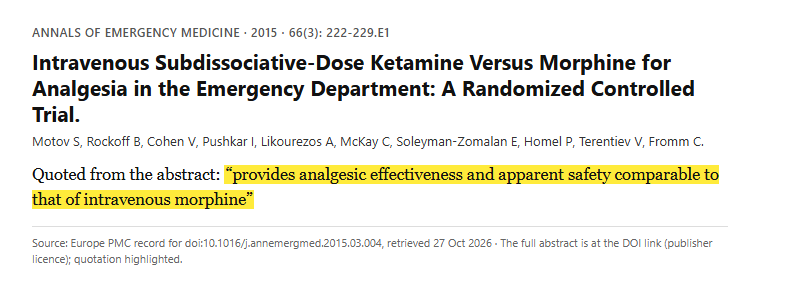
Abstract of the published study (text from Europe PMC), key sentence highlighted in yellow. Source: Motov S, Rockoff B, Cohen V, et al. Intravenous Subdissociative-Dose Ketamine Versus Morphine for Analgesia in the Emergency Department: A Randomized Controlled Trial. Ann Emerg Med. 2015;66(3):222-229.e1. https://doi.org/10.1016/j.annemergmed.2015.03.004
Study 3. Low-dose LSD in 24 healthy volunteers given a cold-water pain test (Ramaekers, 2021)
Significantly longer cold-water pain tolerance and lower pain and unpleasantness ratings after the highest of three low doses of LSD in 24 healthy volunteers!
In a placebo-controlled laboratory study, 24 healthy volunteers received single low doses of LSD or placebo on separate occasions and then took a cold-water pain test at 1.5 and 5 hours. Researchers reported that the highest of the three low doses significantly increased the time participants could tolerate exposure to cold (3°C) water and decreased their ratings of pain and unpleasantness, while LSD elevated mean blood pressure within the normal range and slightly increased ratings of dissociation, anxiety and somatization! They described this as evidence of a protracted analgesic effect at a dose low enough to avoid a psychedelic experience.
“The present study provides evidence of a protracted analgesic effect of LSD at a dose that is low enough to avoid a psychedelic experience.”
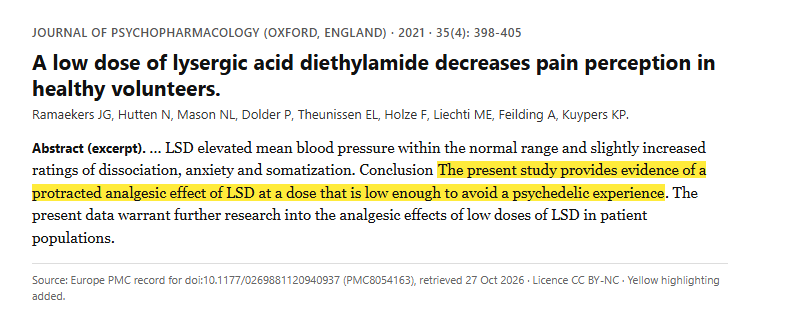
Abstract of the published study (text from Europe PMC), key sentence highlighted in yellow. Source: Ramaekers JG, Hutten N, Mason NL, et al. A low dose of lysergic acid diethylamide decreases pain perception in healthy volunteers. J Psychopharmacol. 2021;35(4):398-405. https://doi.org/10.1177/0269881120940937
Study 4. Low-dose ketamine added to morphine in 60 adults with acute pain in an emergency department (Beaudoin, 2014)
Median pain-relief (SPID) scores of 7.0 and 7.8 with low-dose ketamine added to morphine, versus 4.0 with morphine alone (p < 0.02)!
In a double-blind, randomized, placebo-controlled trial at a large urban emergency department, 60 adults aged 18 to 65 with acute moderate to severe pain received morphine plus placebo, or morphine plus one of two low ketamine doses. Researchers reported that over the two hours after treatment, median pain-relief scores were higher in both ketamine groups (7.0 and 7.8) than with morphine alone (4.0; p < 0.02), while similar numbers of patients needed rescue pain medication (35% with morphine alone, 20% in each ketamine group; p = 0.48) and more people in the ketamine groups reported dysphoria and dizziness! They concluded that low-dose ketamine is a viable analgesic adjunct to morphine for moderate to severe acute pain.
“Over the 2-hour poststudy medication administration period, the SPIDs were higher (greater pain relief) for the ketamine study groups than the control group”
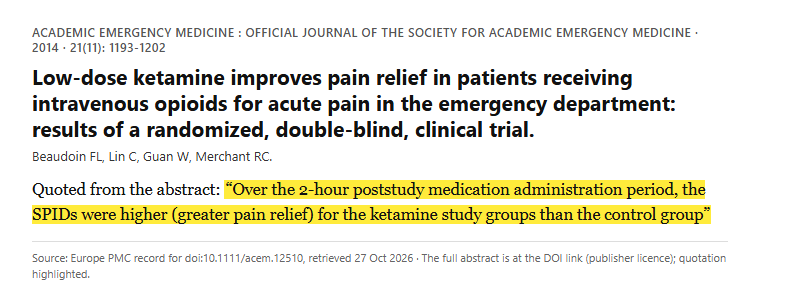
Abstract of the published study (text from Europe PMC), key sentence highlighted in yellow. Source: Beaudoin FL, Lin C, Guan W, Merchant RC. Low-dose ketamine improves pain relief in patients receiving intravenous opioids for acute pain in the emergency department: results of a randomized, double-blind, clinical trial. Acad Emerg Med. 2014;21(11):1193-1202. https://doi.org/10.1111/acem.12510
Related reading
- Brinck EC, Tiippana E, Heesen M, et al. Perioperative intravenous ketamine for acute postoperative pain in adults. Cochrane Database Syst Rev. 2018;12:CD012033. https://doi.org/10.1002/14651858.cd012033.pub4 — A Cochrane review of 130 randomized trials with 8,341 participants reporting that ketamine given around surgery reduced opioid consumption by 19% over 24 hours and reduced pain at rest (by 5 mm on a 100 mm scale, high-quality evidence), with central nervous system adverse events little different from control.
- Schwenk ES, Viscusi ER, Buvanendran A, et al. Consensus Guidelines on the Use of Intravenous Ketamine Infusions for Acute Pain Management From the American Society of Regional Anesthesia and Pain Medicine, the American Academy of Pain Medicine, and the American Society of Anesthesiologists. Reg Anesth Pain Med. 2018;43(5):456-466. https://doi.org/10.1097/aap.0000000000000806 — Consensus guidelines from U.S. pain and anesthesia societies concluding that evidence supports ketamine for acute pain in a variety of contexts, as a stand-alone treatment and as an adjunct to opioids, and calling for larger studies.
Related pages on this site
Chronic Pain · Pain · Cluster Headache and Migraine · Fibromyalgia · Physical Well Being · Medication Safety Screening
This page summarizes published research for education only. It is not medical advice. Any change to a medication remains the decision of that person’s own prescriber.
Keep reading
All Educational Resources · About This Archive · For Practicum Supervisors