

Here is what researchers reported on psychedelics and pain. In a repeat round of psilocybin, cluster headache attacks fell from 18.4 to 9.8 per week. In migraine, weekly migraine days fell by 1.65 after psilocybin versus 0.15 after placebo. In a five-person fibromyalgia pilot, pain severity and sleep disturbance showed clinically meaningful improvements one month after psilocybin-assisted therapy, and in an early survey of 53 people with cluster headache, 22 of 26 psilocybin users reported it aborted attacks. A recent review describes promising preliminary outcomes while noting that the studies so far are small.
Key studies
Study 1. Repeat psilocybin pulse regimen in 10 adults with cluster headache (Schindler, 2024)
Cluster attacks dropped from 18.4 to 9.8 per week (p = 0.013) in a repeat round of psilocybin!
A randomized trial of psilocybin in cluster headache had shown a nonsignificant reduction in attack frequency, so researchers ran a blinded extension phase in which 10 adults returned at least six months later for another psilocybin pulse regimen (three sessions, five days apart) and kept headache diaries. They reported that in the three weeks after the start of the pulse, cluster attack frequency was significantly reduced from 18.4 to 9.8 attacks per week (p = 0.013), a reduction of approximately 50% regardless of how each person responded in the first round! They also reported that psilocybin was well tolerated, without unexpected or serious adverse events.
“In the three weeks after the start of the pulse, cluster attack frequency was significantly reduced from baseline”
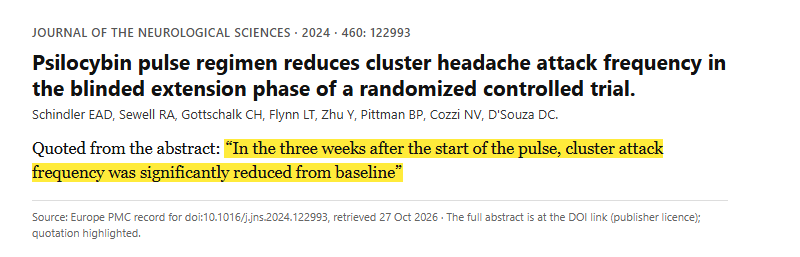
Abstract of the published study (text from Europe PMC), key sentence highlighted in yellow. Source: Schindler EAD, Sewell RA, Gottschalk CH, et al. Psilocybin pulse regimen reduces cluster headache attack frequency in the blinded extension phase of a randomized controlled trial. J Neurol Sci. 2024;460:122993. https://doi.org/10.1016/j.jns.2024.122993
Study 2. Psilocybin in 10 adults with migraine (Schindler, 2021)
Weekly migraine days fell by 1.65 after psilocybin versus 0.15 after placebo (p = 0.003)!
In an exploratory double-blind, placebo-controlled cross-over study, 10 adults with migraine received psilocybin and a placebo in two test sessions spaced two weeks apart and kept headache diaries. Researchers reported that over the two weeks after a single administration, the reduction in weekly migraine days was significantly greater after psilocybin (1.65 days per week) than after placebo (0.15 days per week; p = 0.003)! They described psilocybin as well tolerated, with no unexpected or serious adverse events, and suggested an enduring therapeutic effect in migraine after a single administration.
“This exploratory study suggests there is an enduring therapeutic effect in migraine headache after a single administration of psilocybin.”
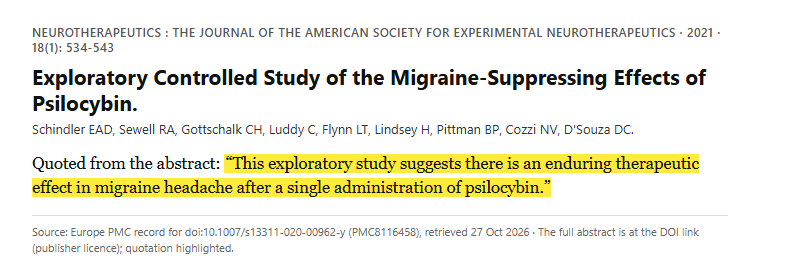
Abstract of the published study (text from Europe PMC), key sentence highlighted in yellow. Source: Schindler EAD, Sewell RA, Gottschalk CH, et al. Exploratory Controlled Study of the Migraine-Suppressing Effects of Psilocybin. Neurotherapeutics. 2021;18(1):534-543. https://doi.org/10.1007/s13311-020-00962-y
Study 3. Psilocybin and LSD reported by 53 people with cluster headache (Sewell, 2006)
22 of 26 psilocybin users reported it aborted cluster attacks, and 18 of 19 reported longer remission periods!
The authors interviewed 53 cluster headache patients who had used psilocybin or LSD to treat their condition. Researchers reported that 22 of 26 psilocybin users said psilocybin aborted attacks, 25 of 48 psilocybin users and 7 of 8 LSD users reported cluster period termination, and 18 of 19 psilocybin users and 4 of 5 LSD users reported remission period extension!
“Twenty-two of 26 psilocybin users reported that psilocybin aborted attacks”
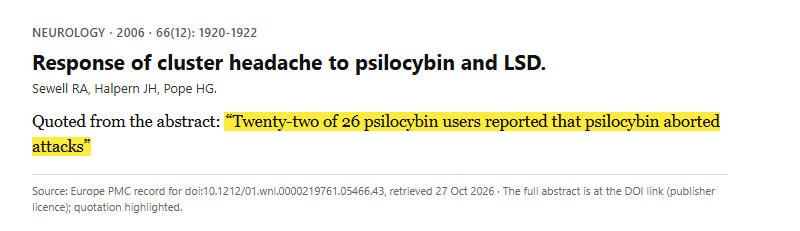
Abstract of the published study (text from Europe PMC), key sentence highlighted in yellow. Source: Sewell RA, Halpern JH, Pope HG. Response of cluster headache to psilocybin and LSD. Neurology. 2006;66(12):1920-1922. https://doi.org/10.1212/01.wnl.0000219761.05466.43
Study 4. Psilocybin-assisted therapy in 5 adults with fibromyalgia (Aday, 2025)
All 5 adults with fibromyalgia reported feeling improved after psilocybin-assisted therapy, and pain severity (d = −2.1) and sleep disturbance (d = −2.5) showed clinically meaningful improvement one month after the second session!
In an open-label pilot trial, researchers offered psilocybin-assisted therapy (PAT: two psilocybin sessions with preparation and integration therapy) to five adults with fibromyalgia (FM). The primary outcome was safety: they reported transient elevations of blood pressure or heart rate during dosing, transient headaches in four of five participants, and no serious adverse events. One month after the second session, participants reported clinically meaningful improvements in pain severity (d = −2.1), pain interference (d = −1.8) and sleep disturbance (d = −2.5)! On the Patient Global Impression of Change, one participant reported being “very much improved,” two “much improved” and two “minimally improved,” and the authors said this establishes a basis for larger randomized controlled trials.
“Using the Patient Global Impression of Change, one participant reported their symptoms "very much improved," two reported "much improved," and two reported "minimally improved."”
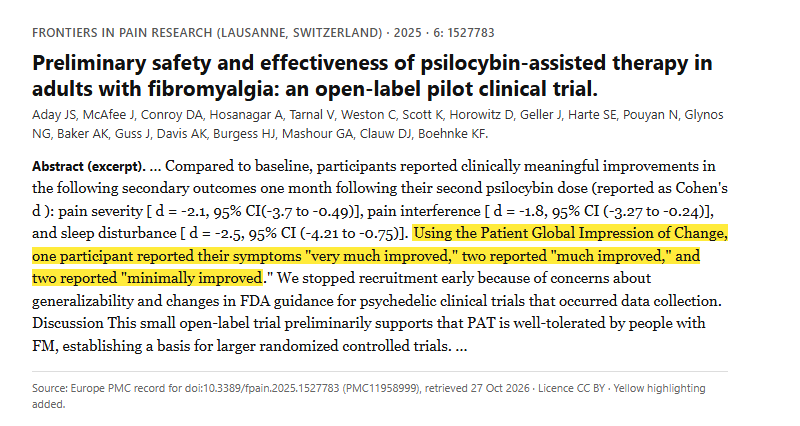
Abstract of the published study (text from Europe PMC), key sentence highlighted in yellow. Source: Aday JS, McAfee J, Conroy DA, et al. Preliminary safety and effectiveness of psilocybin-assisted therapy in adults with fibromyalgia: an open-label pilot clinical trial. Front Pain Res (Lausanne). 2025;6:1527783. https://doi.org/10.3389/fpain.2025.1527783
Related reading
- Boehnke KF, Pouyan N, Aday JS. Classic Psychedelics for Chronic Pain: A Critical Review of the Literature and Practical Advice for Clinicians. Drugs. 2026;86(8):1307-1324. https://doi.org/10.1007/s40265-026-02339-5 — Reviews preliminary signals of benefit across fibromyalgia, migraine, cluster headache and other chronic pain syndromes, with practical guidance for clinicians, and notes the field is limited by small samples, functional unblinding and a lack of large randomized trials.
- Jevotovsky DS, Chopra H, Pak DJ, et al. Psilocybin and chronic neuropathic pain: a systematic review. Reg Anesth Pain Med. 2025;50(11):845-857. https://doi.org/10.1136/rapm-2024-105532 — A systematic review of 28 studies that found potential for psilocybin as a treatment option for chronic pain relief and called that potential encouraging, while noting that most included studies were of low or very low quality.
Related pages on this site
Acute Pain · Pain · Cluster Headache and Migraine · Fibromyalgia · Physical Well Being · Medication Safety Screening
This page summarizes published research for education only. It is not medical advice. Any change to a medication remains the decision of that person’s own prescriber.
Keep reading
All Educational Resources · About This Archive · For Practicum Supervisors