

Psychedelics are transforming how researchers see the brain! Studies reported that psilocybin caused more than threefold greater change in brain connectivity than methylphenidate, with one effect lasting weeks, and that DMT produced robust increases in global connectivity in 20 healthy volunteers. PET scans showed psilocybin occupying up to 72% of the brain’s serotonin 2A receptors, closely tied to how intense the experience felt, and a brain-imaging trial of psilocybin therapy for depression reported large improvements in depressive symptoms. Encouraging to see careful research continuing to map how these substances work.
Key studies
Study 1. Psilocybin therapy or escitalopram in 46 people with major depression (Wall, 2025)
Large improvements in depressive symptoms with psilocybin therapy, and brain responses to emotional faces showed no change or a slight increase!
In a randomized trial comparing two treatments for major depression, 25 people received psilocybin therapy and 21 received six weeks of the antidepressant escitalopram, with equal psychological support throughout, and fMRI recorded brain responses to emotional faces before and after treatment. Researchers reported large improvements in depressive symptoms in the psilocybin group, with brain responses to emotional faces showing no change or a slight increase. The authors noted that the reduced emotional responsiveness often seen with SSRIs may not occur in psychedelic therapy!
“Despite large improvements in depressive symptoms in the psilocybin group, psilocybin therapy had only a minor effect on brain responsiveness to emotional stimuli.”
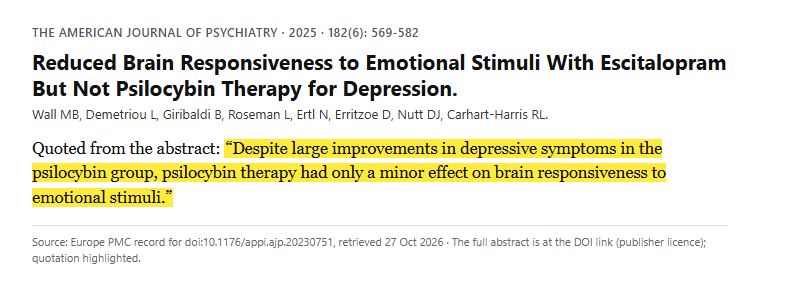
Abstract of the published study (text from Europe PMC), key sentence highlighted in yellow. Source: Wall MB, Demetriou L, Giribaldi B, Roseman L, Ertl N, Erritzoe D, et al. Reduced Brain Responsiveness to Emotional Stimuli With Escitalopram But Not Psilocybin Therapy for Depression. The American journal of psychiatry. 2025;182(6):569-582. https://doi.org/10.1176/appi.ajp.20230751
Study 2. Psilocybin in 7 healthy adults (Siegel, 2024)
Psilocybin caused more than threefold greater change in brain connectivity than methylphenidate, and one effect lasted weeks!
Seven healthy adults, all with some past psychedelic experience, had around 18 MRI sessions each, before, during and for three weeks after taking psilocybin and, in a randomized crossover design, the stimulant methylphenidate for comparison. Researchers reported that psilocybin acutely caused more than threefold greater change in the brain’s functional connectivity than methylphenidate, strongest in the default mode network, and that individual differences in these changes were strongly linked to the subjective psychedelic experience. They also reported a persistent decrease in connectivity between the anterior hippocampus and the default mode network lasting for weeks, which the authors suggested may be a correlate of the proplasticity and therapeutic effects of psychedelics!
“Psilocybin massively disrupted functional connectivity (FC) in cortex and subcortex, acutely causing more than threefold greater change than methylphenidate.”
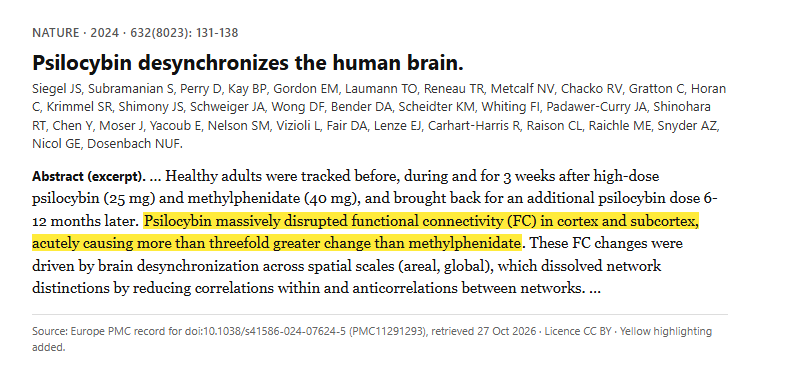
Abstract of the published study (text from Europe PMC), key sentence highlighted in yellow. Source: Siegel JS, Subramanian S, Perry D, Kay BP, Gordon EM, Laumann TO, et al. Psilocybin desynchronizes the human brain. Nature. 2024;632(8023):131-138. https://doi.org/10.1038/s41586-024-07624-5
Study 3. DMT in 20 healthy volunteers (Timmermann, 2023)
DMT produced robust increases in global brain connectivity in 20 healthy volunteers!
Twenty healthy volunteers with previous psychedelic experience received intravenous DMT and, on a separate day, placebo, in a single-blind, placebo-controlled design, while brain activity was recorded with EEG and fMRI at the same time. Researchers reported robust increases in global functional connectivity, network disintegration and desegregation, and a compression of the principal cortical gradient under DMT. These changes lined up with brain areas rich in serotonin 2A receptors, which the authors described as a predominant action of DMT on the brain’s transmodal association pole!
“Here, fMRI results revealed robust increases in global functional connectivity (GFC), network disintegration and desegregation, and a compression of the principal cortical gradient under DMT.”
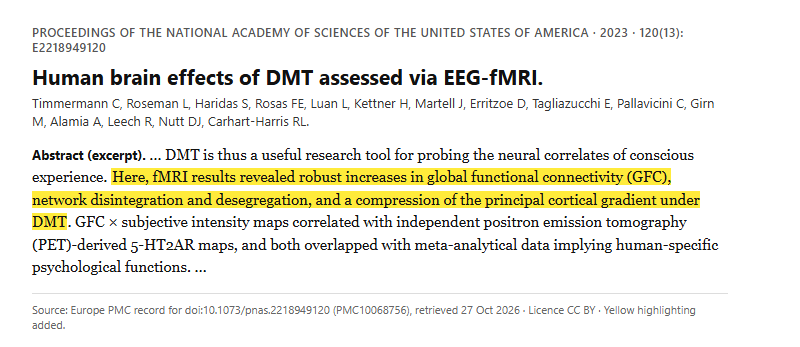
Abstract of the published study (text from Europe PMC), key sentence highlighted in yellow. Source: Timmermann C, Roseman L, Haridas S, Rosas FE, Luan L, Kettner H, et al. Human brain effects of DMT assessed via EEG-fMRI. Proceedings of the National Academy of Sciences of the United States of America. 2023;120(13):e2218949120. https://doi.org/10.1073/pnas.2218949120
Study 4. Psilocybin in 8 healthy volunteers (Madsen, 2019)
Psilocybin occupied up to 72% of the brain’s serotonin 2A receptors in 8 healthy volunteers!
Eight healthy volunteers had PET scans, which can show how much of a receptor a drug occupies, before and after a single oral dose of psilocybin, along with blood tests and ratings of how intense the experience felt. Researchers reported that psilocybin occupied up to 72% of the brain’s serotonin 2A receptors and that both occupancy and blood levels of psilocin, its active form, were closely linked to the intensity of the experience. The authors said this strongly supports stimulation of serotonin 2A receptors as a key determinant of the psychedelic experience!
“Psilocybin intake resulted in dose-related 5-HT2AR occupancies up to 72%”
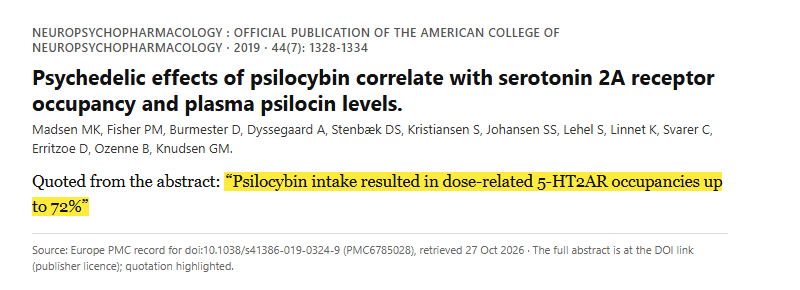
Abstract of the published study (text from Europe PMC), key sentence highlighted in yellow. Source: Madsen MK, Fisher PM, Burmester D, Dyssegaard A, Stenbæk DS, Kristiansen S, et al. Psychedelic effects of psilocybin correlate with serotonin 2A receptor occupancy and plasma psilocin levels. Neuropsychopharmacology. 2019;44(7):1328-1334. https://doi.org/10.1038/s41386-019-0324-9
Related reading
- Shinozuka K, Jerotic K, Mediano P, Zhao AT, Preller KH, Carhart-Harris R, et al. Synergistic, multi-level understanding of psychedelics: three systematic reviews and meta-analyses of their pharmacology, neuroimaging and phenomenology. Translational psychiatry. 2024;14(1):485. https://doi.org/10.1038/s41398-024-03187-1 — Three systematic reviews and meta-analyses pooling imaging and other studies, reporting that psychedelics significantly strengthen between-network connectivity.
- Beneš M, Páleníček T, Horáček J. What fMRI studies say about the nature of the psychedelic effect: a scoping review. Frontiers in neuroscience. 2025;19:1606798. https://doi.org/10.3389/fnins.2025.1606798 — A scoping review of fMRI studies of serotonergic psychedelics that describes a general picture of de-differentiation with the default mode network at its core.
Related pages on this site
Inflammation and the Immune System · Personality and Traits · Creativity · Social Connection and Relationships · Wellness of the 'Well' · Spiritual Wellness · Wellness of the Planet
This page summarizes published research for education only. It is not medical advice. Any change to a medication remains the decision of that person’s own prescriber.
Keep reading
All Educational Resources · About This Archive · For Practicum Supervisors