


Psychedelics and human connection: exciting numbers are arriving! A meta-analysis of 27 placebo-controlled studies (592 participants) found a moderate-to-large effect (d = 0.86) of MDMA on feeling loving, talkative and friendly. Psilocybin significantly improved emotional empathy in 51 people with major depression, for at least two weeks. And all 6 couples completed MDMA-facilitated couples therapy, with big gains in relationship adjustment and happiness. Encouraging to see research on how people relate to one another, with more studies arriving all the time!
Key studies
Study 1. Psilocybin in 51 people with major depression (Jungwirth, 2025)
Psilocybin brought significant gains in emotional empathy compared with placebo in 51 people with major depression, lasting at least two weeks!
In a randomized, placebo-controlled trial, 51 people with mild to moderate major depression received a single dose of psilocybin or a placebo within a four-week psychological support program, and took an empathy test before and up to two weeks afterward. Researchers reported that the psilocybin group showed significant improvements in explicit emotional empathy, driven by an increase in empathy toward positive stimuli, for at least two weeks! The authors said the study highlights the potential of psychedelics to enhance social cognition in people living with depression.
“Patients who received psilocybin showed significant improvements in explicit emotional empathy driven by an increase in empathy towards positive stimuli compared to the placebo group”
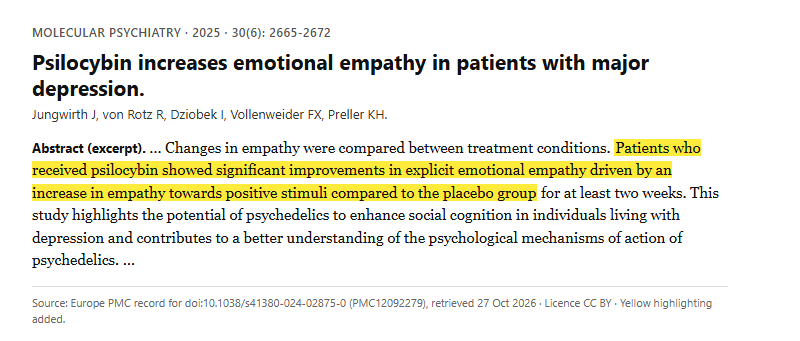
Abstract of the published study (text from Europe PMC), key sentence highlighted in yellow. Source: Jungwirth J, von Rotz R, Dziobek I, Vollenweider FX, Preller KH. Psilocybin increases emotional empathy in patients with major depression. Molecular psychiatry. 2025;30(6):2665-2672. https://doi.org/10.1038/s41380-024-02875-0
Study 2. Psilocybin therapy or escitalopram in 52 people with major depression (Watts, 2022)
Connectedness rose significantly in 1,226 people after a planned psychedelic experience (p < 0.0001), and psilocybin therapy brought greater connectedness gains than escitalopram (p = 0.009) in a randomized trial!
Researchers developed the Watts Connectedness Scale, which measures feeling connected to self, others and the wider world, and tested it in online surveys of 1,226 people before and after a planned psychedelic experience, plus a double-blind randomized trial in major depression. Researchers reported significant post-psychedelic increases in total connectedness scores (p < 0.0001) and on each subscale in the surveys! In the trial, psilocybin therapy (27 people) was associated with greater increases in connectedness than six weeks of escitalopram (25 people).
“Significant post-psychedelic increases were observed for total connectedness scores”
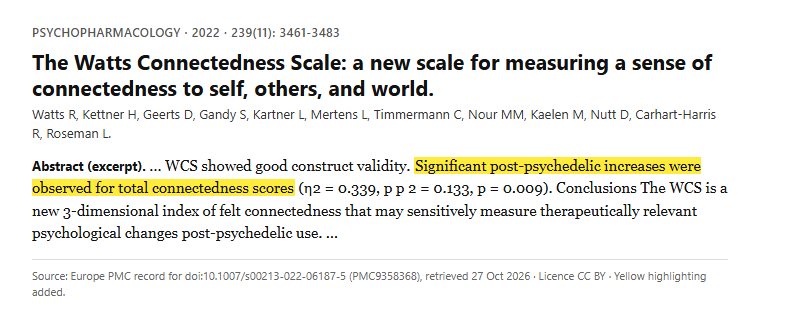
Abstract of the published study (text from Europe PMC), key sentence highlighted in yellow. Source: Watts R, Kettner H, Geerts D, Gandy S, Kartner L, Mertens L, et al. The Watts Connectedness Scale: a new scale for measuring a sense of connectedness to self, others, and world. Psychopharmacology. 2022;239(11):3461-3483. https://doi.org/10.1007/s00213-022-06187-5
Study 3. MDMA-assisted therapy in 12 autistic adults with social anxiety (Danforth, 2018)
Rapid and durable improvement in social anxiety for autistic adults after MDMA-assisted therapy, significantly greater than placebo, with a very large effect (d = 1.4) and similar results at six months!
In a double-blind pilot trial, 12 autistic adults with marked to very severe social anxiety were randomized to MDMA (8 people) or placebo (4 people) during two psychotherapy sessions, with further non-drug therapy sessions. Researchers reported significantly greater improvement in social anxiety scores with MDMA than with placebo one month after the second session (P = 0.037), with a very large effect size (d = 1.4), and similar positive results at six months (P = 0.036)! The authors concluded that the pilot demonstrated rapid and durable improvement in social anxiety symptoms and supports expansion of research into larger samples.
“This pilot trial demonstrated rapid and durable improvement in social anxiety symptoms in autistic adults following MDMA-assisted psychotherapy.”
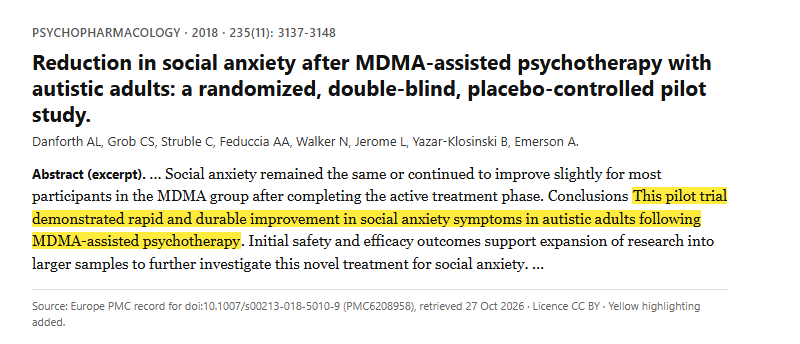
Abstract of the published study (text from Europe PMC), key sentence highlighted in yellow. Source: Danforth AL, Grob CS, Struble C, Feduccia AA, Walker N, Jerome L, et al. Reduction in social anxiety after MDMA-assisted psychotherapy with autistic adults: a randomized, double-blind, placebo-controlled pilot study. Psychopharmacology. 2018;235(11):3137-3148. https://doi.org/10.1007/s00213-018-5010-9
Study 4. MDMA-facilitated couples therapy in 6 couples where one partner had PTSD (Monson, 2020)
All 6 couples completed treatment, with big gains in relationship adjustment and happiness (d = 0.64 to 2.79) and in PTSD symptoms (d = 1.85 to 3.59)!
In a pilot study, 6 couples in which one partner had PTSD took part in a condensed 15-session course of cognitive-behavioral conjoint (couples) therapy over seven weeks, with two sessions in which both partners took MDMA. Researchers reported that all couples completed treatment, with significant improvements in PTSD symptoms (effect sizes d = 1.85 to 3.59) and in patient and partner-rated relationship adjustment and happiness (d = 0.64 to 2.79)! The authors said MDMA holds promise as a facilitator of couples therapy to achieve more robust and broad effects on individual and relational functioning.
“In addition, there were significant improvements in patient and partner-rated relationship adjustment and happiness (d =.64-2.79).”
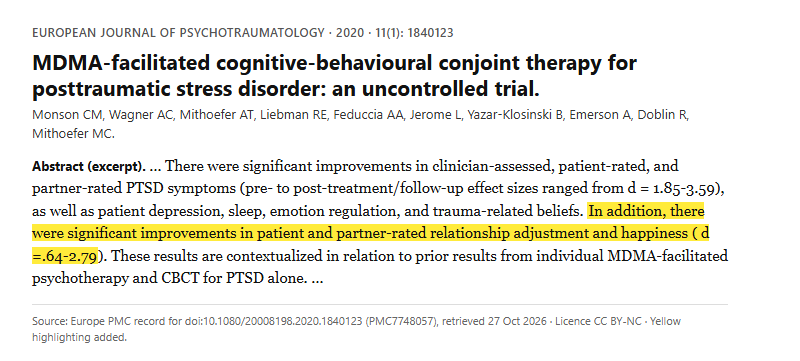
Abstract of the published study (text from Europe PMC), key sentence highlighted in yellow. Source: Monson CM, Wagner AC, Mithoefer AT, Liebman RE, Feduccia AA, Jerome L, et al. MDMA-facilitated cognitive-behavioural conjoint therapy for posttraumatic stress disorder: an uncontrolled trial. European journal of psychotraumatology. 2020;11(1):1840123. https://doi.org/10.1080/20008198.2020.1840123
Related reading
- Regan A, Margolis S, de Wit H, Lyubomirsky S. Does ±3,4-methylenedioxymethamphetamine (ecstasy) induce subjective feelings of social connection in humans? A multilevel meta-analysis. PloS one. 2021;16(10):e0258849. https://doi.org/10.1371/journal.pone.0258849 — Pools 27 placebo-controlled studies (592 participants): a moderate-to-large effect (d = 0.86) of MDMA on self-reported sociability, such as feeling loving, talkative and friendly!
- Peled-Avron L, Aday JS, Pantoni MM, Hamilton HK, Woolley JD. A meta-analytic analysis of the acute effects of MDMA on empathy and emotion recognition in humans. Scientific reports. 2025;15(1):42955. https://doi.org/10.1038/s41598-025-25610-3 — A meta-analysis reporting that MDMA administration enhances emotional empathy.
Related pages on this site
Brain Imaging Research · Inflammation and the Immune System · Personality and Traits · Creativity · Wellness of the 'Well' · Spiritual Wellness · Wellness of the Planet
This page summarizes published research for education only. It is not medical advice. Any change to a medication remains the decision of that person’s own prescriber.
Keep reading
All Educational Resources · About This Archive · For Practicum Supervisors