

Psychedelic therapy is showing exciting personality results! In 84 adults with alcohol use disorder, psilocybin-assisted therapy brought significantly lower neuroticism and higher extraversion and openness, measured at week 36. In 59 people with depression, psilocybin therapy lowered neuroticism, and it was still lower at six months. And in 20 people with treatment-resistant depression, neuroticism fell while extraversion and openness rose. Encouraging to see personality changes in a direction consistent with improved mental health, with more studies arriving all the time!
Key studies
Study 1. Psilocybin therapy or escitalopram in 59 people with major depression (Weiss, 2024)
Psilocybin therapy lowered neuroticism (B = -0.63) and raised openness and conscientiousness at six weeks, with neuroticism still lower at six months!
In a double-blind randomized trial, 59 people with moderate-to-severe major depression received psilocybin therapy (30 people) or six weeks of the antidepressant escitalopram (29 people), and completed personality questionnaires at the start, at six weeks and at six months. Researchers reported that psilocybin therapy was associated with lower neuroticism, impulsiveness and disagreeableness and higher absorption, conscientiousness and openness at six weeks, with neuroticism and disagreeableness still lower at six months! The authors concluded that personality changes were in a direction consistent with improved mental health.
“Personality changes across both conditions were in a direction consistent with improved mental health.”
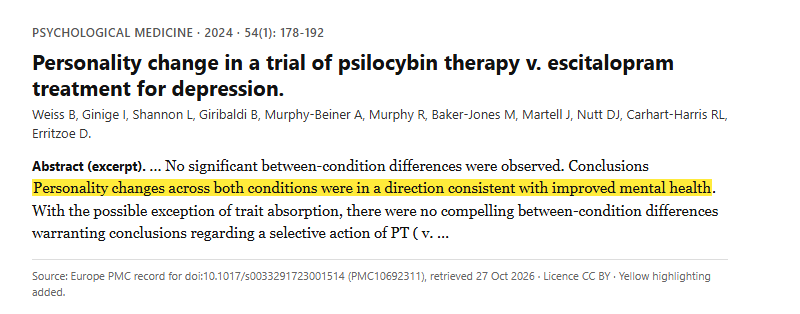
Abstract of the published study (text from Europe PMC), key sentence highlighted in yellow. Source: Weiss B, Ginige I, Shannon L, Giribaldi B, Murphy-Beiner A, Murphy R, et al. Personality change in a trial of psilocybin therapy v. escitalopram treatment for depression. Psychological medicine. 2024;54(1):178-192. https://doi.org/10.1017/s0033291723001514
Study 2. Psilocybin-assisted therapy in 84 adults with alcohol use disorder (Pagni, 2025)
In 84 adults with alcohol use disorder, psilocybin-assisted therapy brought significantly lower neuroticism and higher extraversion and openness than placebo, measured at week 36!
In a secondary analysis of a double-blind trial, 84 adults with alcohol use disorder received two medication sessions of psilocybin (44 people) or an active placebo, diphenhydramine (40 people), alongside 12 weekly psychotherapy sessions, and personality was measured at the start and at week 36. Researchers reported that, compared with the placebo group, the psilocybin group showed significant reductions in neuroticism and increases in extraversion and openness! They also reported that decreases in impulsiveness were associated with lower drinking afterward, and the authors concluded that the therapy elicited durable shifts in personality.
“Relative to the placebo group, the psilocybin group showed significant reductions in neuroticism and increases in extraversion and openness.”
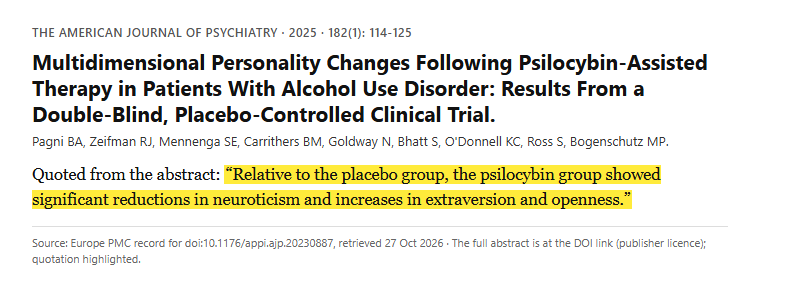
Abstract of the published study (text from Europe PMC), key sentence highlighted in yellow. Source: Pagni BA, Zeifman RJ, Mennenga SE, Carrithers BM, Goldway N, Bhatt S, et al. Multidimensional Personality Changes Following Psilocybin-Assisted Therapy in Patients With Alcohol Use Disorder: Results From a Double-Blind, Placebo-Controlled Clinical Trial. The American journal of psychiatry. 2025;182(1):114-125. https://doi.org/10.1176/appi.ajp.20230887
Study 3. Psilocybin therapy in 20 people with treatment-resistant depression (Erritzoe, 2018)
Neuroticism fell while extraversion and openness rose after psilocybin therapy in 20 people with treatment-resistant depression, measured at three months!
In a study of 20 patients with moderate or severe unipolar treatment-resistant depression who received psilocybin with psychological support, researchers measured personality before treatment and at a 3-month follow-up. Researchers reported that neuroticism scores significantly decreased while extraversion increased, and that openness also significantly increased, in the direction of the normative data! The changes in neuroticism and extraversion were both predicted by how insightful participants found the psilocybin session.
“Neuroticism scores significantly decreased while Extraversion increased following psilocybin therapy.”
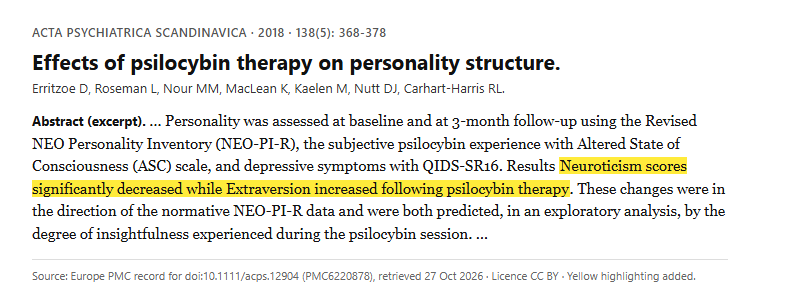
Abstract of the published study (text from Europe PMC), key sentence highlighted in yellow. Source: Erritzoe D, Roseman L, Nour MM, MacLean K, Kaelen M, Nutt DJ, Carhart-Harris RL. Effects of psilocybin therapy on personality structure. Acta psychiatrica Scandinavica. 2018;138(5):368-378. https://doi.org/10.1111/acps.12904
Related reading
- Solaja I, Haldane K, Mason N, Weiss B, Xu X, Xu M, et al. Who are you after psychedelics? A systematic review and a meta-analysis of the magnitude of long-term effects of serotonergic psychedelics on cognition/creativity, emotional processing and personality. Neuroscience and biobehavioral reviews. 2024;158:105570. https://doi.org/10.1016/j.neubiorev.2024.105570 — A meta-analysis of 10 controlled studies (304 participants) on lasting changes in cognition, emotion and personality, finding faster reaction times for disgust and sadness in the psychedelic groups.
- Bouso JC, Dos Santos RG, Alcázar-Córcoles MÁ, Hallak JEC. Serotonergic psychedelics and personality: A systematic review of contemporary research. Neuroscience and biobehavioral reviews. 2018;87:118-132. https://doi.org/10.1016/j.neubiorev.2018.02.004 — A systematic review of 18 studies reporting that psychedelics given in controlled settings may increase Openness and Self-Transcendence.
Related pages on this site
Brain Imaging Research · Inflammation and the Immune System · Creativity · Social Connection and Relationships · Wellness of the 'Well' · Spiritual Wellness · Wellness of the Planet
This page summarizes published research for education only. It is not medical advice. Any change to a medication remains the decision of that person’s own prescriber.
Keep reading
All Educational Resources · About This Archive · For Practicum Supervisors