

Psychedelic-assisted therapy is showing early promise for eating disorders! Researchers reported significant improvements in eating disorder symptoms in 21 women with anorexia nervosa after psilocybin sessions with talk therapy (p < 0.0001), and suggested psilocybin therapy is safe, tolerable and acceptable in 10 women with anorexia nervosa. All 5 adults with binge eating disorder in a pilot study reported fewer binge-eating episodes through week 14, and in an exploratory analysis of a randomized, placebo-controlled trial of MDMA-assisted therapy for severe PTSD, eating disorder symptom scores fell significantly more than with placebo. Encouraging to see careful research continuing.
Key studies
Study 1. MDMA-assisted therapy and eating disorder symptoms in 89 adults with severe PTSD (Brewerton, 2022)
Eating disorder symptom scores fell significantly more after MDMA-assisted therapy than after placebo (p = .03) in a randomized, double-blind trial!
Within a randomized, double-blind, placebo-controlled trial of MDMA-assisted therapy for severe PTSD, researchers used a pre-specified exploratory measure, the Eating Attitudes Test (EAT-26), in 89 participants. They reported that among the 82 who completed the study, total EAT-26 scores fell significantly more after MDMA-assisted therapy than after therapy with placebo (p = .03), with significant reductions in women with higher baseline scores (p = .0012 and p = .0478), and the authors called MDMA-assisted therapy for this overlap promising.
“MDMA-AT significantly reduced ED symptoms compared to therapy with placebo among participants with severe PTSD.”
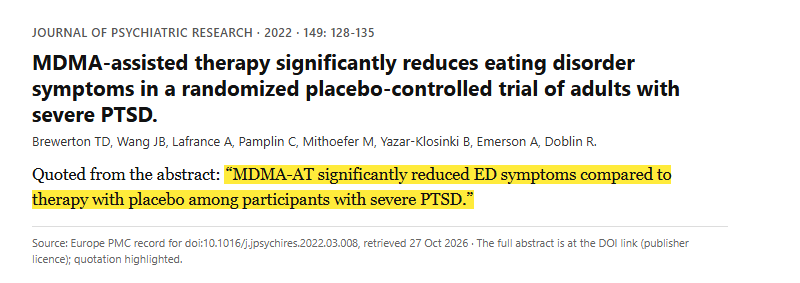
Abstract of the published study (text from Europe PMC), key sentence highlighted in yellow. Source: Brewerton TD, Wang JB, Lafrance A, et al. MDMA-assisted therapy significantly reduces eating disorder symptoms in a randomized placebo-controlled trial of adults with severe PTSD. J Psychiatr Res. 2022;149:128-135. https://doi.org/10.1016/j.jpsychires.2022.03.008
Study 2. Psilocybin therapy in 21 women with anorexia nervosa (Douglass, 2026)
Eating disorder symptoms improved significantly in 21 women with anorexia nervosa (p < 0.0001, d = 0.98) at 6 months after psilocybin therapy!
Researchers gave 21 women with anorexia nervosa three psilocybin sessions over six weeks, alongside talk therapy and their usual treatment, in a single-blind pilot study that compared each person with their own starting point. They reported significant improvements in eating disorder symptoms (p < 0.0001, d = 0.98 at 6 months) and in motivation to change (p = 0.0017, d = 0.65 at 12 months) and that psilocybin was well tolerated by all participants; two serious adverse events, both from one participant, were also reported during follow-up, and improvement varied from person to person.
“Relative to baseline, participants displayed significant improvements in their eating disorder symptoms”
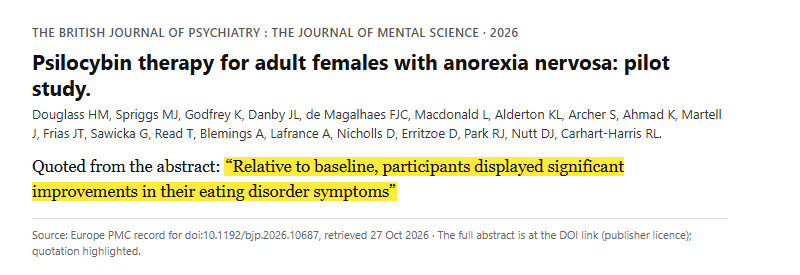
Abstract of the published study (text from Europe PMC), key sentence highlighted in yellow. Source: Douglass HM, Spriggs MJ, Godfrey K, et al. Psilocybin therapy for adult females with anorexia nervosa: pilot study. Br J Psychiatry. Published online July 8, 2026:1-9. https://doi.org/10.1192/bjp.2026.10687
Study 3. Psilocybin therapy in 10 women with anorexia nervosa (Peck, 2023)
Psilocybin therapy was safe, tolerable and acceptable for women with anorexia nervosa in a first open-label study of 10 women, with all adverse events mild and transient!
In an open-label feasibility study, 10 adult women with anorexia nervosa received a single psilocybin session with psychological support! Researchers reported no clinically significant changes in ECG, vital signs or suicidality, all adverse events were mild and transient, and the women’s own perceptions suggested the treatment was acceptable for most. The authors called the results a promising finding.
“Results suggest that psilocybin therapy is safe, tolerable and acceptable for female AN, which is a promising finding given physiological dangers and problems with treatment engagement.”
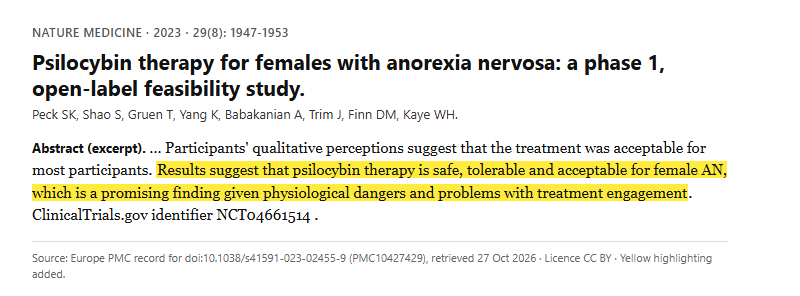
Abstract of the published study (text from Europe PMC), key sentence highlighted in yellow. Source: Peck SK, Shao S, Gruen T, et al. Psilocybin therapy for females with anorexia nervosa: a phase 1, open-label feasibility study. Nat Med. 2023;29(8):1947-1953. https://doi.org/10.1038/s41591-023-02455-9
Study 4. Psilocybin-assisted therapy in 5 adults with binge eating disorder (Dallery, 2026)
All 5 adults with binge eating disorder reported fewer binge-eating episodes, sustained through week 14!
Researchers gave a single psilocybin session within Acceptance and Commitment Therapy-based psychotherapy to 5 adults with binge eating disorder in an open-label pilot study, following them for 14 weeks. They reported fewer self-reported binge-eating episodes in all five participants, sustained through week 14, along with improvements in depression and anxiety, and no serious adverse events.
“Reductions in self-reported binge eating frequency were observed across all participants and sustained through week 14.”
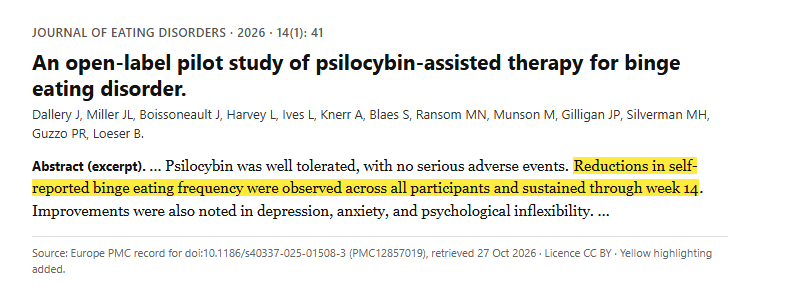
Abstract of the published study (text from Europe PMC), key sentence highlighted in yellow. Source: Dallery J, Miller JL, Boissoneault J, et al. An open-label pilot study of psilocybin-assisted therapy for binge eating disorder. J Eat Disord. 2026;14(1):41. https://doi.org/10.1186/s40337-025-01508-3
Related reading
- Bevione F, Lacidogna MC, Lavalle R, et al. Psilocybin in the treatment of eating disorders: a systematic review of the literature and registered clinical trials. Eat Weight Disord. 2025;30(1):58. https://doi.org/10.1007/s40519-025-01771-y — A systematic review in which two studies met the inclusion criteria; the authors concluded that the initial evidence shows psilocybin might be safe and well tolerated in anorexia nervosa, and identified six registered clinical trials.
- Morris R, Gundogan A, Lawrence V, et al. Understanding experiences of psychedelic treatments for eating disorders: a meta-synthesis of qualitative studies. BMC Med. 2026;24(1):392. https://doi.org/10.1186/s12916-026-04929-2 — A meta-synthesis of eight qualitative studies in which psychedelic experiences were described as possible catalysts for transformation, with improved emotion processing and connection with the body and self; the authors also note a higher risk of adverse side effects with low weight.
Related pages on this site
Borderline Personality Disorder · Personality Disorders · Schizophrenia · Medication Safety Screening
This page summarizes published research for education only. It is not medical advice. Any change to a medication remains the decision of that person’s own prescriber.
Keep reading
All Educational Resources · About This Archive · For Practicum Supervisors