

Careful research is opening a new chapter on psychedelics and schizophrenia! In a meta-analysis within a review of 131 publications, researchers reported psychedelic-induced psychosis in 0.002% of population-study participants and 0.6% of randomized-trial participants, and suggested schizophrenia might not be a definite exclusion criterion for future trials. In 273,466 people, another study reported the link between hallucinogen-related admissions and later psychosis became nonsignificant after accounting for clinical history, and a 2026 review suggests therapeutic applications may exist for some symptoms in stable patients. A large Ontario study (see Related reading) reports a link in the other direction, so the first review's call for a conservative approach stays central. Encouraging to see this research moving forward.
Key studies
Study 1. Psychedelics and psychosis risk in a review of 131 publications (Sabé, 2025)
In a meta-analysis of nine studies, psychedelic-induced psychosis was reported in 0.6% of randomized-trial participants (and 0.002% in population studies), within a review of 131 publications!
Researchers systematically reviewed 131 publications on LSD, psilocybin, mescaline, DMT and MDMA, including 35 randomized controlled trials. In a meta-analysis of nine studies they reported psychedelic-induced psychosis in 0.002% in population studies, 0.2% in uncontrolled trials and 0.6% in randomized trials, and suggested that schizophrenia might not be a definite exclusion criterion for future trials in treatment-resistant depression and negative symptoms; they also reported that 3.8% of people with schizophrenia in uncontrolled trials developed long-lasting psychotic symptoms and recommended a conservative approach while more evidence is gathered.
“Meta-analysis of nine studies showed an incidence of psychedelic-induced psychosis at 0.002% in population studies, 0.2% in UCTs, and 0.6% in RCTs.”
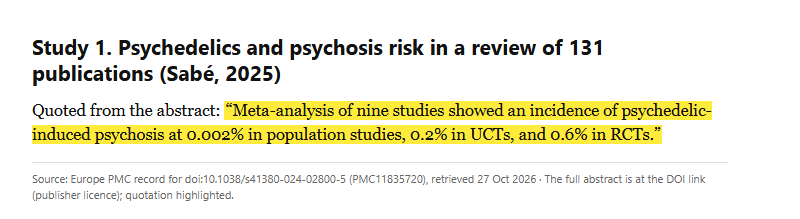
Abstract of the published study (text from Europe PMC), key sentence highlighted in yellow. Source: Sabé M, Sulstarova A, Glangetas A, et al. Reconsidering evidence for psychedelic-induced psychosis: an overview of reviews, a systematic review, and meta-analysis of human studies. Mol Psychiatry. 2025;30(3):1223-1255. https://doi.org/10.1038/s41380-024-02800-5
Study 2. Hallucinogen-related hospital visits in 273,466 people receiving substance use treatment (Steinle, 2026)
The link between hallucinogen-related admissions and psychosis became nonsignificant (HR 0.97) after accounting for clinical history, in 273,466 people receiving substance use treatment!
Researchers analyzed 2015 to 2019 US insurance claims for 273,466 people in substance use treatment who had a substance-related emergency visit or hospital stay, comparing hallucinogen-related admissions with admissions for other substances. They reported that the association with later psychosis became nonsignificant once clinical characteristics were taken into account (hazard ratio 0.97, 95% CI 0.95-1.00), even though raw rates were higher before adjustment (16.4% vs 6.6%), and concluded the apparent link seems largely explained by existing psychiatric conditions rather than a direct effect.
“Apparent associations between hallucinogen use and psychosis appear largely attributable to baseline psychiatric comorbidities rather than direct causal effects.”
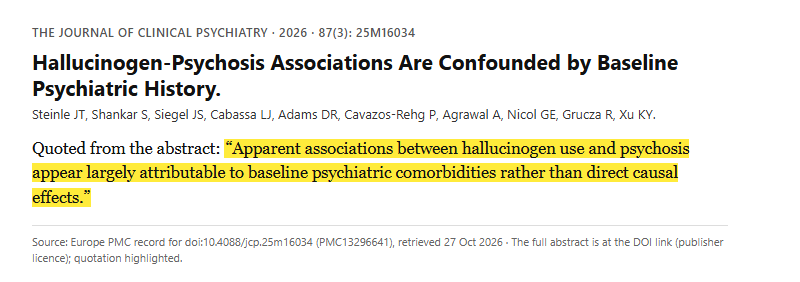
Abstract of the published study (text from Europe PMC), key sentence highlighted in yellow. Source: Steinle JT, Shankar S, Siegel JS, et al. Hallucinogen-Psychosis Associations Are Confounded by Baseline Psychiatric History. J Clin Psychiatry. 2026;87(3):25m16034. https://doi.org/10.4088/jcp.25m16034
Study 3. Psychedelics and schizophrenia spectrum disorders: reevaluating risk and therapeutic potential (Brar, 2026)
A 2026 review suggests potential therapeutic applications may exist for negative symptoms and depression in carefully selected, stable patients!
In a 2026 narrative review, researchers examined the historical, phenomenological and neural-mechanism links between psychedelics and schizophrenia spectrum disorders, finding both overlap and important qualitative differences that challenge the uniform "psychotomimetic" label. They reported that these distinctions suggest potential therapeutic applications may exist for carefully selected symptoms (negative symptoms, depression) in stable patients using controlled approaches, and they provided recommendations on managing psychosis-related risk.
“phenomenological and mechanistic distinctions suggest that potential therapeutic applications may exist for carefully selected symptoms (negative symptoms, depression) in stable patients”
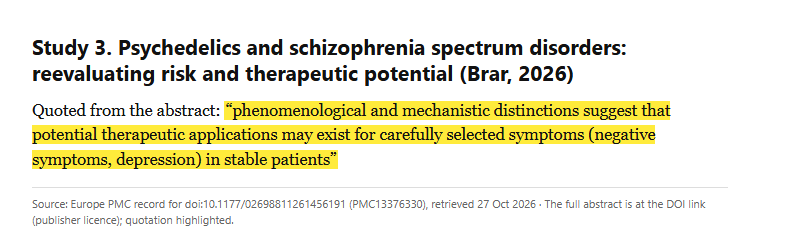
Abstract of the published study (text from Europe PMC), key sentence highlighted in yellow. Source: Brar PS, Price RB, Ross S, et al. The intersection between psychedelics and schizophrenia spectrum disorders: Reevaluating risk and therapeutic potential. J Psychopharmacol. 2026;40(7):1037-1053. https://doi.org/10.1177/02698811261456191
Related reading
- Myran DT, Pugliese M, Xiao J, et al. Emergency Department Visits Involving Hallucinogen Use and Risk of Schizophrenia Spectrum Disorder. JAMA Psychiatry. 2025;82(2):142-150. https://doi.org/10.1001/jamapsychiatry.2024.3532 — A population-wide Ontario study of 9,244,292 residents aged 14 to 65 with no history of psychosis: in this observational analysis, hallucinogen-related emergency visits were associated with a higher risk of a later schizophrenia spectrum diagnosis.
- Wolf G, Singh S, Blakolmer K, et al. Could psychedelic drugs have a role in the treatment of schizophrenia? Rationale and strategy for safe implementation. Mol Psychiatry. 2023;28(1):44-58. https://doi.org/10.1038/s41380-022-01832-z — A 2023 perspective considering whether psychedelics could have a role in easing negative symptoms of schizophrenia, with strategies to reduce the risk of inducing or worsening psychosis.
Related pages on this site
Borderline Personality Disorder · Personality Disorders · Eating Disorders · Medication Safety Screening
This page summarizes published research for education only. It is not medical advice. Any change to a medication remains the decision of that person’s own prescriber.
Keep reading
All Educational Resources · About This Archive · For Practicum Supervisors