

Psychedelic and ketamine research is opening new doors for personality disorders! In the first randomized trial of ketamine in borderline personality disorder, researchers reported more improvement in social and work functioning in the ketamine group at day 14 (p = 0.03). In other studies, researchers reported depression scores falling significantly (Cohen d = 1.41) in nine adults after a single psilocybin session, and self-harm episodes in people with borderline personality disorder falling from a mean of 30.8 to 2.4 over six months in a real-world study of esketamine. Encouraging to see careful research beginning on these questions.
Key studies
Study 1. Ketamine in 22 adults with borderline personality disorder (Fineberg, 2023)
In the first randomized trial of ketamine in borderline personality disorder, the ketamine group showed more improvement in social and work functioning than the comparison group at day 14 (p = 0.03)!
In a double-blind pilot trial, researchers randomly assigned 22 adults with borderline personality disorder to one infusion of ketamine (10 people) or the psychoactive comparison drug midazolam (12 people). They reported that the ketamine group showed more improvement in social and work functioning than the midazolam group at day 14 (p = 0.03), that infusions were well tolerated in both groups, and that the authors saw reason for optimism that ketamine will be well tolerated in larger studies and may provide clinical benefit for mood symptoms and related impairments.
“This pilot study provides the first randomized controlled evidence of the effects of antidepressant-dosed ketamine in people with BPD.”
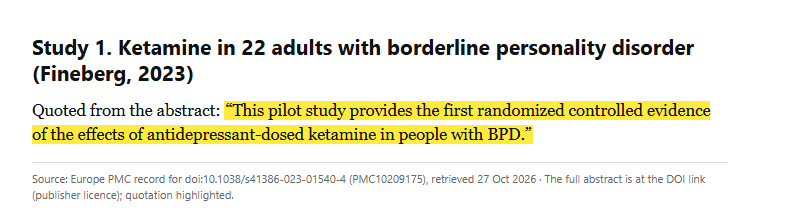
Abstract of the published study (text from Europe PMC), key sentence highlighted in yellow. Source: Fineberg SK, Choi EY, Shapiro-Thompson R, et al. A pilot randomized controlled trial of ketamine in Borderline Personality Disorder. Neuropsychopharmacology. 2023;48(7):991-999. https://doi.org/10.1038/s41386-023-01540-4
Study 2. Psilocybin in 9 adults with borderline personality disorder and depression (Grant, 2026)
Depression scores fell from 28.56 to 17.22 (Cohen d = 1.41) in 9 adults with borderline personality disorder after a single psilocybin session!
In an open-label pilot study, researchers gave a single psilocybin session to 9 adults diagnosed with both borderline personality disorder and major depressive disorder, and followed them for four weeks. They reported a statistically significant improvement in depression, with average scores falling from 28.56 to 17.22 (Cohen d = 1.41, p = 0.003), and the authors suggested that borderline personality disorder does not appear to interfere with improvement in depression.
“MDD symptoms significantly changed from baseline to visit 5: baseline ( M =28.56, SD=4.53) and final visit ( M =17.22, SD=10.39)”
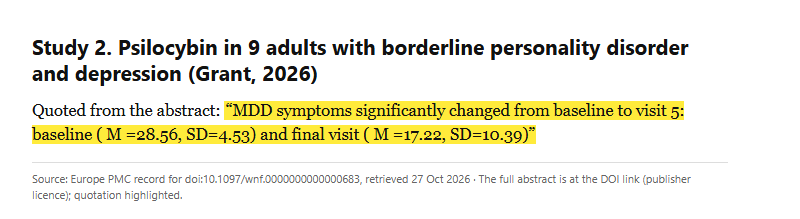
Abstract of the published study (text from Europe PMC), key sentence highlighted in yellow. Source: Grant JE, Boutouis S, O'Brien M, et al. An Open-Label Study of Single-Dose Psilocybin for Borderline Personality Disorder With Co-Occurring Major Depressive Disorder. Clin Neuropharmacol. 2026;49(4):163-169. https://doi.org/10.1097/wnf.0000000000000683
Study 3. Esketamine in 90 outpatients with treatment-resistant depression, 45 of them with borderline personality disorder (Raffone, 2026)
Self-harm episodes in people with borderline personality disorder fell from a mean of 30.8 to 2.4 over six months of esketamine care!
In a multicentre observational study, researchers followed 90 outpatients with treatment-resistant depression who received intranasal esketamine for six months, 45 with comorbid borderline personality disorder and 45 with no personality disorder. They reported that suicidal ideation, suicidal behavior and deliberate self-harm all decreased over time (all p < 0.001), with significant reductions from month 1 onwards, that self-harm episode frequency in the borderline group fell from a mean of 30.8 at baseline to 2.4 at six months, and that no serious adverse events or increases in suicidality were observed.
“Self-harm episode frequency showed a marked decrease in the BPD group (mean 30.8 at baseline to 2.4 at six months).”
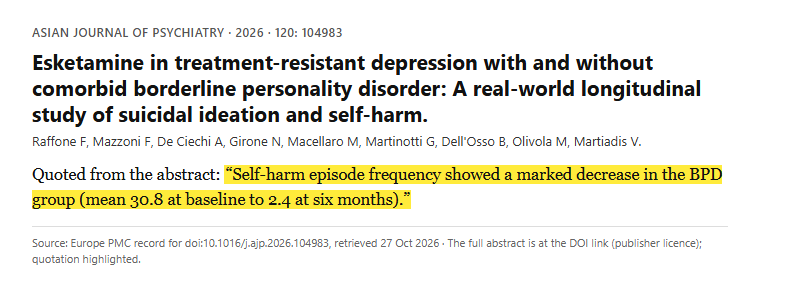
Abstract of the published study (text from Europe PMC), key sentence highlighted in yellow. Source: Raffone F, Mazzoni F, De Ciechi A, et al. Esketamine in treatment-resistant depression with and without comorbid borderline personality disorder: A real-world longitudinal study of suicidal ideation and self-harm. Asian J Psychiatr. 2026;120:104983. https://doi.org/10.1016/j.ajp.2026.104983
Related reading
- Marrocu A, Kettner H, Weiss B, et al. Psychiatric risks for worsened mental health after psychedelic use. J Psychopharmacol. 2024;38(3):225-235. https://doi.org/10.1177/02698811241232548 — An observational analysis pooling 807 people from naturalistic studies: 16% overall, and 31% of those reporting a past personality disorder diagnosis, showed a clinically meaningful decline in well-being four weeks after use; the authors hypothesize that psychological support and a good therapeutic alliance may be especially important in this population.
- Kasiviswanathan K, Nilaweera D, Morando M, et al. Making a case for using MDMA-assisted psychotherapy for borderline personality disorder and complex PTSD: a descriptive systematic review of the literature. Ther Adv Psychopharmacol. 2026;16:20451253251408626. https://doi.org/10.1177/20451253251408626 — A 2026 systematic review of 24 MDMA studies (335 participants). Although none directly assessed MDMA-assisted therapy for complex PTSD or borderline personality disorder, improvements in emotional regulation, interpersonal functioning, identity coherence and abandonment concerns were reported, and the authors suggest MDMA-assisted therapy may have applicability beyond PTSD, with potential benefits for borderline personality disorder.
- Carrithers BM, Roberts DE, Weiss BM, et al. Exploring serotonergic psychedelics as a treatment for personality disorders. Neuropharmacology. 2025;272:110413. https://doi.org/10.1016/j.neuropharm.2025.110413 — A 2025 review of how psychedelics may promote adaptive personality change; the authors note that rigorous research is lacking, that people with personality disorders are often excluded from modern psychedelic therapy trials, and make recommendations for approaching therapy in these more complex populations.
Related pages on this site
Borderline Personality Disorder · Eating Disorders · Schizophrenia · Medication Safety Screening
This page summarizes published research for education only. It is not medical advice. Any change to a medication remains the decision of that person’s own prescriber.
Keep reading
All Educational Resources · About This Archive · For Practicum Supervisors