

Mindset and surroundings matter, and the research is encouraging! Pooled data from 23 controlled studies, covering 409 psilocybin sessions in 261 healthy volunteers, showed that personality, mood and setting all contributed, with a high Absorption score and few recent psychological problems most strongly linked to pleasant, mystical-type experiences. In a music study, six of ten people chose overtone-based music for a third session, and mystical-experience scores tended to be higher with it. A review of 25 clinical studies and 763 participants found participant selection and a safe environment consistently described. Encouraging to see how much preparation and surroundings can support good experiences!
Key studies
Study 1. Music during psilocybin sessions in 10 people trying to quit smoking (Strickland, 2021)
Six of ten people chose overtone-based music for their third psilocybin session, and mystical-experience scores tended to be higher with it!
In a small randomized study within a psilocybin trial for quitting smoking, researchers gave each of 10 participants two sessions, one with Western classical music and one with overtone-based music in counterbalanced order, and then let each person choose the music for a third session! Researchers reported that mystical-experience scores tended to be higher in overtone-based sessions, that six of ten people chose that music, and that biologically confirmed smoking abstinence was 66.7% for those who chose the overtone-based playlist versus 50% for the other choice.
“Mystical experiences scores tended to be higher in overtone-based sessions than in Western classical sessions”
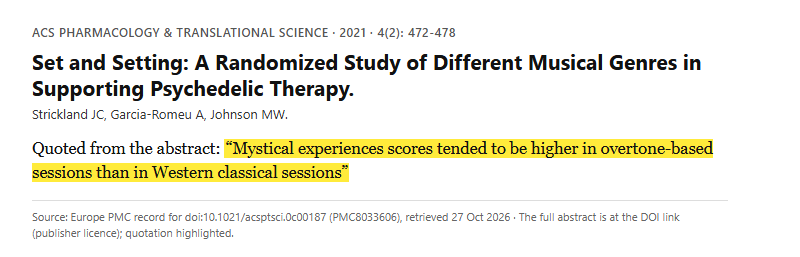
Abstract of the published study (text from Europe PMC), key sentence highlighted in yellow. Source: Strickland JC, Garcia-Romeu A, Johnson MW. Set and Setting: A Randomized Study of Different Musical Genres in Supporting Psychedelic Therapy. ACS Pharmacol Transl Sci. 2021;4(2):472-478. https://doi.org/10.1021/acsptsci.0c00187
Study 2. Psilocybin in 261 healthy volunteers across 23 controlled studies (Studerus, 2012)
Beyond dose, personality, mood and setting significantly shaped the effects of psilocybin across 409 psilocybin sessions in 261 healthy volunteers!
Researchers pooled data from 23 controlled experimental studies, covering 409 psilocybin sessions in 261 healthy volunteers, to see which of 24 factors shaped how people responded! Researchers reported that dose was the most important predictor, and that personality, mood just before the session, recent psychological wellbeing and the study setting also contributed: a high Absorption score, an emotionally excitable and active state beforehand and few recent psychological problems were most strongly associated with pleasant and mystical-type experiences. The results confirm that non-pharmacological variables play an important role in the effects of psilocybin!
“Although drug dose was clearly the most important predictor for all measured response variables, several non-pharmacological variables significantly contributed to the effects of psilocybin.”
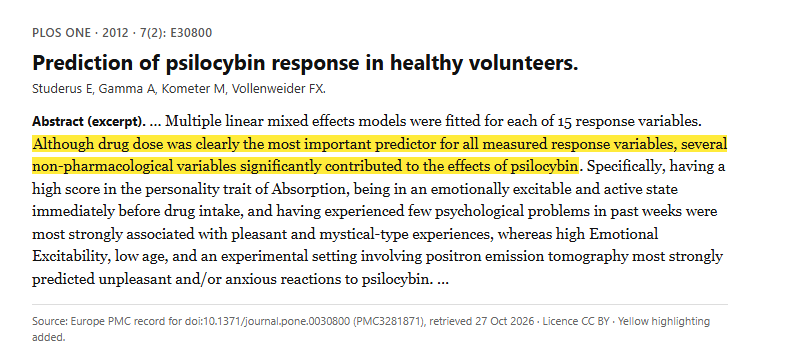
Abstract of the published study (text from Europe PMC), key sentence highlighted in yellow. Source: Studerus E, Gamma A, Kometer M, Vollenweider FX. Prediction of psilocybin response in healthy volunteers. PLoS One. 2012;7(2):e30800. https://doi.org/10.1371/journal.pone.0030800
Study 3. Ayahuasca or placebo in 30 experienced retreat participants (Uthaug, 2021)
Symptoms of depression, anxiety and stress fell after the ceremony in both groups of 30 retreat participants, and ayahuasca raised emotional empathy!
In a placebo-controlled observational study, researchers assessed 30 experienced participants at ayahuasca retreats in the Netherlands, Spain and Germany before and after a ceremony; 14 consumed ayahuasca and 16 received a placebo! Researchers reported that symptoms of depression, anxiety and stress fell in both groups after the ceremony, while a measure of emotional empathy to negative stimuli rose with ayahuasca. They concluded that improvements at ceremonies can come from the setting and mindset around the ceremony as well as from ayahuasca itself.
“There was a main treatment × time interaction on implicit emotional empathy, indicating that ayahuasca increased emotional empathy to negative stimuli.”
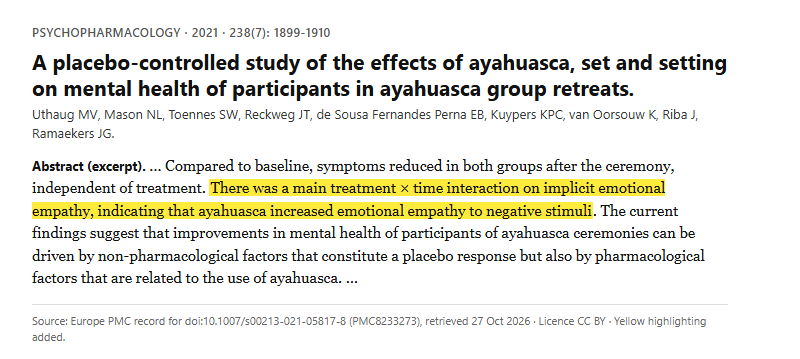
Abstract of the published study (text from Europe PMC), key sentence highlighted in yellow. Source: Uthaug MV, Mason NL, Toennes SW, et al. A placebo-controlled study of the effects of ayahuasca, set and setting on mental health of participants in ayahuasca group retreats. Psychopharmacology (Berl). 2021;238(7):1899-1910. https://doi.org/10.1007/s00213-021-05817-8
Study 4. Set and setting practices in 763 participants with psychiatric disorders across 25 studies (Estric, 2025)
Across 25 clinical studies and 763 participants, participant selection and the creation of a safe environment were consistently described!
In a systematic review, researchers screened 4,912 articles and examined 25 clinical studies of psychedelics in psychiatric disorders (13 randomized and 12 open-label, 763 participants in total) across 16 areas of set and setting, from participant selection and preparation to session monitors and the room! Researchers reported that participant selection and the creation of a safe environment were consistently present, and that many key elements were described in each study. The authors suggested that harmonizing these aspects would aid the interpretation of future studies.
“Participant selection and the creation of a safe environment were consistently present”
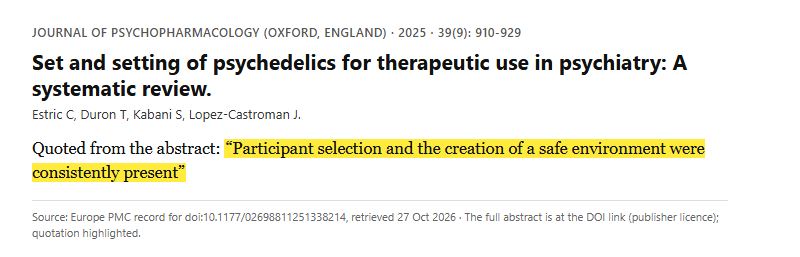
Abstract of the published study (text from Europe PMC), key sentence highlighted in yellow. Source: Estric C, Duron T, Kabani S, Lopez-Castroman J. Set and setting of psychedelics for therapeutic use in psychiatry: A systematic review. J Psychopharmacol. 2025;39(9):910-929. https://doi.org/10.1177/02698811251338214
Related reading
- Johnson M, Richards W, Griffiths R. Human hallucinogen research: guidelines for safety. J Psychopharmacol. 2008;22(6):603-620. https://doi.org/10.1177/0269881108093587 — Widely cited guidelines covering screening, preparation, a safe session room and support during sessions; the authors report persisting adverse reactions are rare when research follows them.
- Aday JS, Davis AK, Mitzkovitz CM, Bloesch EK, Davoli CC. Predicting Reactions to Psychedelic Drugs: A Systematic Review of States and Traits Related to Acute Drug Effects. ACS Pharmacol Transl Sci. 2021;4(2):424-435. https://doi.org/10.1021/acsptsci.1c00014 — A systematic review of 14 studies: people high in absorption, openness and acceptance, and in a state of surrender, were more likely to have positive and mystical-type experiences.
Related pages on this site
Brain Imaging Research · Inflammation and the Immune System · Personality and Traits · Creativity · Wellness of the 'Well' · Spiritual Wellness · Wellness of the Planet
This page summarizes published research for education only. It is not medical advice. Any change to a medication remains the decision of that person’s own prescriber.
Keep reading
All Educational Resources · About This Archive · For Practicum Supervisors