


Here is what researchers reported on psychedelics and quitting smoking. In a pilot randomized trial, 40.5% of people given psilocybin with cognitive behavioral therapy had biochemically verified abstinence at six months, versus 10.0% on the nicotine patch. In an earlier open-label pilot, 12 of 15 people (80%) showed seven-day abstinence at six-month follow-up, and in a survey of 358 people, 38% reported continuous smoking cessation after a psychedelic experience. Two systematic reviews describe preliminary therapeutic potential and call for stronger studies. It is research well worth following.
Key studies
Study 1. Psilocybin with cognitive behavioral therapy in 82 adults who smoked (Johnson, 2026)
40.5% of people given psilocybin plus CBT had biochemically verified abstinence at six months, versus 10.0% on the nicotine patch!
In a pilot randomized trial at Johns Hopkins Bayview Medical Center in Baltimore, 82 psychiatrically healthy adults who smoked received a 13-week cognitive behavioral therapy program plus either one session of psilocybin or 8 to 10 weeks of nicotine patch treatment; participants and investigators knew which treatment each person received. Researchers reported biochemically verified prolonged abstinence at six months in 17 people (40.5%) given psilocybin versus 4 people (10.0%) on the patch, and 7-day point prevalence abstinence of 52.4% versus 25.0%! No serious adverse events were attributed to psilocybin or the patch, and the authors reported that psilocybin abstinence rates were higher than typical treatments.
“At 6-month follow-up, 17 participants receiving psilocybin (40.5%) exhibited biochemically verified prolonged abstinence compared with 4 participants using the nicotine patch (10.0%)”
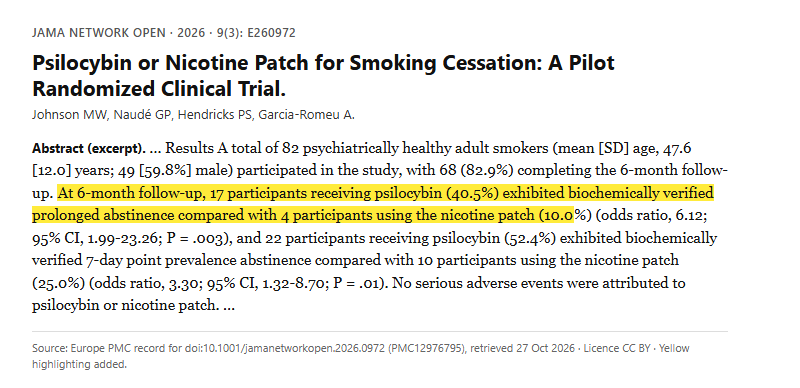
Abstract of the published study (text from Europe PMC), key sentence highlighted in yellow. Source: Johnson MW, Naudé GP, Hendricks PS, et al. Psilocybin or Nicotine Patch for Smoking Cessation: A Pilot Randomized Clinical Trial. JAMA Netw Open. 2026;9(3):e260972. https://doi.org/10.1001/jamanetworkopen.2026.0972
Study 2. Psilocybin within a smoking cessation program in 15 adults who smoked (Johnson, 2014)
12 of 15 (80%) people were not smoking at six months after psilocybin within a structured cessation program!
In an open-label pilot study, 15 psychiatrically healthy adults who had smoked for an average of 31 years, with a mean of six previous quit attempts, took part in a structured 15-week smoking cessation program that included psilocybin sessions. Researchers reported that 12 of the 15 (80%) showed seven-day point prevalence abstinence at six-month follow-up, checked with biomarkers and self-report! They noted this cessation rate substantially exceeds rates commonly reported for other therapies (typically under 35%).
“Biomarkers assessing smoking status, and self-report measures of smoking behavior demonstrated that 12 of 15 participants (80%) showed seven-day point prevalence abstinence at 6-month follow-up.”
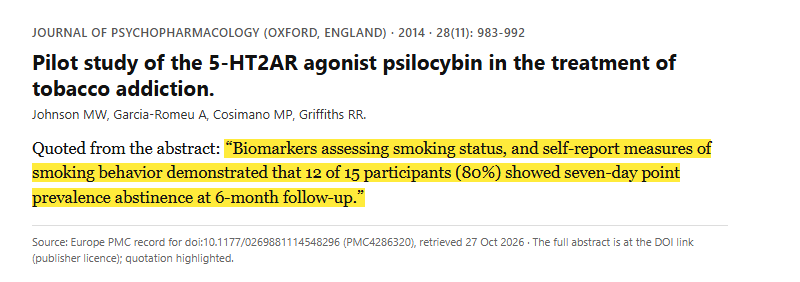
Abstract of the published study (text from Europe PMC), key sentence highlighted in yellow. Source: Johnson MW, Garcia-Romeu A, Cosimano MP, et al. Pilot study of the 5-HT2AR agonist psilocybin in the treatment of tobacco addiction. J Psychopharmacol. 2014;28(11):983-992. https://doi.org/10.1177/0269881114548296
Study 3. Naturalistic psychedelic use in 358 people who reported quitting or cutting down smoking (Johnson, 2017)
38% of 358 people reported continuous smoking cessation after a psychedelic experience, and 74% of those quitters reported more than 2 years of abstinence!
In a retrospective anonymous online survey of 358 people who said they had quit or reduced smoking after taking a psychedelic outside a research setting at least a year earlier, researchers reported that 38% described continuous smoking cessation, and 74% of those quitters reported more than two years of abstinence. Another 28% described a persisting reduction in smoking, and 62% of those reported more than two years of reduced smoking! A further 34% reported a temporary reduction before returning to baseline, and participants across all groups reported less severe withdrawal symptoms, such as depression and craving, than in previous quit attempts.
“Of the 358 participants, 38% reported continuous smoking cessation after psychedelic use”
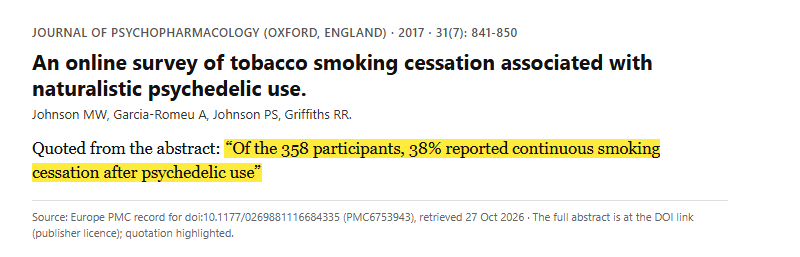
Abstract of the published study (text from Europe PMC), key sentence highlighted in yellow. Source: Johnson MW, Garcia-Romeu A, Johnson PS, et al. An online survey of tobacco smoking cessation associated with naturalistic psychedelic use. J Psychopharmacol. 2017;31(7):841-850. https://doi.org/10.1177/0269881116684335
Related reading
- Spoelstra SK, Schoevers RA, Venema SD, et al. Psychedelics as a potential treatment for tobacco use disorder: a systematic review. Discov Ment Health. 2024;4(1):37. https://doi.org/10.1007/s44192-024-00095-0 — Reviews 8 publications and reports that supportive evidence was suggested for psilocybin in tobacco use disorder, while describing the evidence as limited and calling for more research.
- Glenn DL, Choi SH, Zimmerman RS. A systematic review and narrative summary of the therapeutic potential of classic serotonergic psychedelics for smoking cessation and reduction. J Psychopharmacol. 2025;39(9):930-939. https://doi.org/10.1177/02698811251353251 — Finds that psilocybin, LSD and ayahuasca revealed preliminary therapeutic potential for facilitating smoking cessation across eight studies, and calls for stronger study designs.
Related pages on this site
Alcohol Use Disorder · Opioid Use Disorder · Substance Use Disorder · Harm Reduction in Practice
This page summarizes published research for education only. It is not medical advice. Any change to a medication remains the decision of that person’s own prescriber.
Keep reading
All Educational Resources · About This Archive · For Practicum Supervisors