

Psilocybin-assisted therapy is showing striking early results for alcohol use disorder! In a double-blind randomized trial of 95 adults, researchers reported heavy drinking on 9.7% of days in the psilocybin group versus 23.6% in the active placebo group over 32 weeks, with no serious adverse events in the psilocybin group. A six-trial meta-analysis (202 participants) reported significantly higher odds of maintaining abstinence (OR = 2.78), a French pilot reported 55% abstinence in the higher-dose group versus 11% in the comparison group at 12 weeks, and a meta-analysis of six LSD trials (536 participants) reported a beneficial effect on alcohol misuse. Encouraging to see careful research continuing.
Key studies
Study 1. Psilocybin-assisted psychotherapy in 95 adults with alcohol use disorder (Bogenschutz, 2022)
Heavy drinking days: 9.7% with psilocybin-assisted therapy vs 23.6% with active placebo over 32 weeks in a double-blind randomized trial!
In a double-blind randomized trial at two US academic centers, 95 adults with alcohol dependence were offered 12 weeks of psychotherapy and two day-long medication sessions with either psilocybin or an active placebo (diphenhydramine). Researchers reported heavy drinking on 9.7% of days in the psilocybin group and 23.6% in the placebo group over the 32-week double-blind period (mean difference 13.9%, p = .01), lower mean daily alcohol consumption in the psilocybin group, and no serious adverse events among participants who received psilocybin.
“Psilocybin administered in combination with psychotherapy produced robust decreases in percentage of heavy drinking days over and above those produced by active placebo and psychotherapy.”
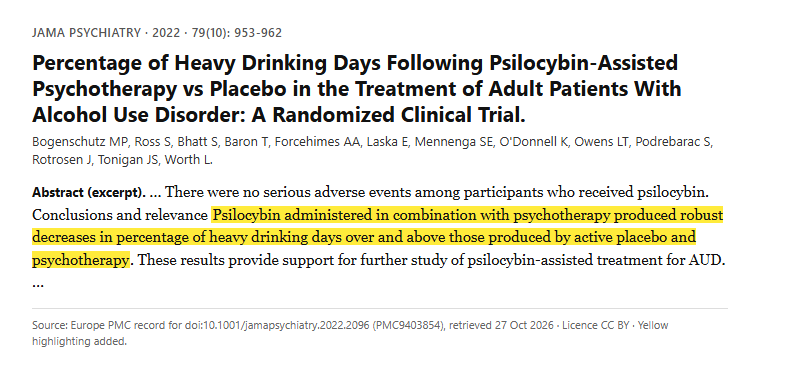
Abstract of the published study (text from Europe PMC), key sentence highlighted in yellow. Source: Bogenschutz MP, Ross S, Bhatt S, et al. Percentage of Heavy Drinking Days Following Psilocybin-Assisted Psychotherapy vs Placebo in the Treatment of Adult Patients With Alcohol Use Disorder: A Randomized Clinical Trial. JAMA Psychiatry. 2022;79(10):953-962. https://doi.org/10.1001/jamapsychiatry.2022.2096
Study 2. Psilocybin-assisted therapy for alcohol use disorder across six trials and 202 participants (Florineth, 2026)
Psilocybin-treated patients had 2.78 times the odds of maintaining abstinence compared with controls (OR = 2.78) in a six-trial meta-analysis!
In a 2026 systematic review and meta-analysis, researchers pooled six trials of psilocybin-assisted therapy for alcohol use disorder (202 participants, three of them randomized trials). They reported significant reductions across all drinking outcomes that were sustained at 4 to 28 weeks, moderate short-term advantages over controls for drinks per day (SMD = 0.48, p = 0.004), percent drinking days (SMD = 0.50, p = 0.009) and percent heavy drinking days (SMD = 0.39, p = 0.020), higher odds of maintaining abstinence (OR = 2.78, p = 0.029), and adverse events that were predominantly mild and transient; the authors described a favorable safety profile.
“Psilocybin-treated patients had significantly higher odds of maintaining abstinence compared to controls (OR = 2.78; p = 0.029).”
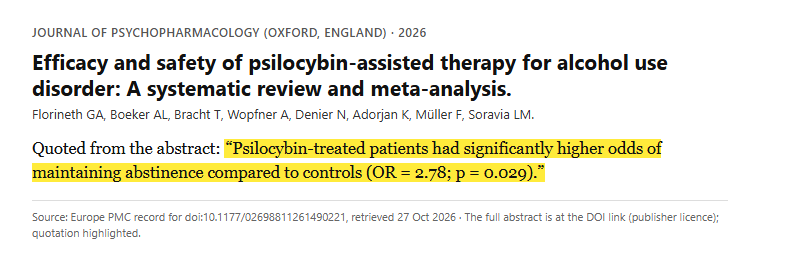
Abstract of the published study (text from Europe PMC), key sentence highlighted in yellow. Source: Florineth GA, Boeker AL, Bracht T, et al. Efficacy and safety of psilocybin-assisted therapy for alcohol use disorder: a systematic review and meta-analysis. J Psychopharmacol. Published online October 8, 2026. https://doi.org/10.1177/02698811261490221
Study 3. Psilocybin-assisted psychotherapy in 30 adults with alcohol use disorder and depressive symptoms (Luquiens, 2025)
55% of the higher-dose group were abstinent at 12 weeks vs 11% of the comparison group in a blinded trial of recently detoxified adults!
In a double-blind pilot trial in a French inpatient addiction treatment program, 30 recently detoxified adults with severe alcohol use disorder and depressive symptoms received two psilocybin-assisted psychotherapy sessions, three weeks apart, at either a higher dose (20 people) or a very low comparison dose (10 people), added to standard care. Researchers reported higher abstinence at 12 weeks in the higher-dose group (55% vs 11%, p = 0.043), with greater reductions in drinking days and craving frequency, and concluded that the approach appears feasible, acceptable and safe.
“Psilocybin-assisted psychotherapy appears feasible, acceptable, and safe in recently detoxified patients with comorbid alcohol use disorder and depression.”
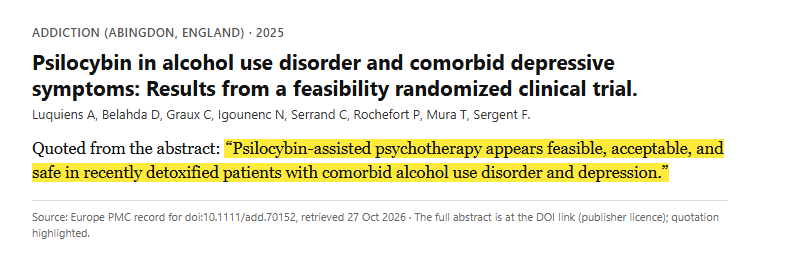
Abstract of the published study (text from Europe PMC), key sentence highlighted in yellow. Source: Luquiens A, Belahda D, Graux C, et al. Psilocybin in alcohol use disorder and comorbid depressive symptoms: results from a feasibility randomized clinical trial. Addiction. Published online July 24, 2025. https://doi.org/10.1111/add.70152
Study 4. LSD in 536 participants with alcoholism across six randomized trials (Krebs, 2012)
A pooled analysis of 536 participants across six randomized trials found a beneficial effect of LSD on alcohol misuse (OR = 1.96)!
In a meta-analysis of six randomized controlled trials with 536 participants in total, researchers reported evidence of a beneficial effect of LSD on alcohol misuse (odds ratio 1.96, 95% CI 1.36-2.84, p = 0.0003), with negligible variation between trials, and that a single dose of LSD within various alcoholism treatment programs was associated with a decrease in alcohol misuse.
“There was evidence for a beneficial effect of LSD on alcohol misuse (OR, 1.96; 95% CI, 1.36-2.84; p = 0.0003).”
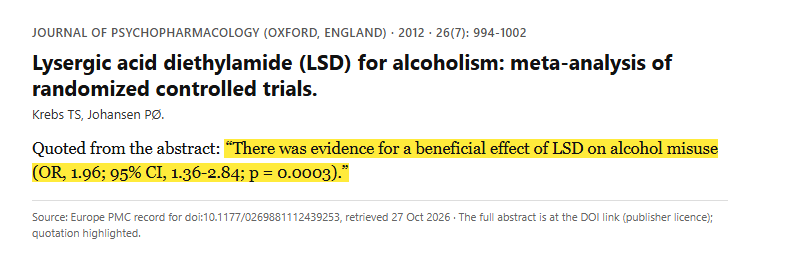
Abstract of the published study (text from Europe PMC), key sentence highlighted in yellow. Source: Krebs TS, Johansen PØ. Lysergic acid diethylamide (LSD) for alcoholism: meta-analysis of randomized controlled trials. J Psychopharmacol. 2012;26(7):994-1002. https://doi.org/10.1177/0269881112439253
Related reading
- Rieser NM, Bitar R, Halm S, et al. Psilocybin-assisted therapy for relapse prevention in alcohol use disorder: a phase 2 randomized clinical trial. EClinicalMedicine. 2025;82:103149. https://doi.org/10.1016/j.eclinm.2025.103149 — A Swiss randomized trial of 37 participants analyzed, in which craving and temptation to drink fell in both groups after dosing, with an additional reduction in the psilocybin group; abstinence and daily alcohol use did not differ significantly between groups at four weeks or six months.
Related pages on this site
Tobacco and Nicotine Use Disorder · Opioid Use Disorder · Substance Use Disorder · Harm Reduction in Practice
This page summarizes published research for education only. It is not medical advice. Any change to a medication remains the decision of that person’s own prescriber.
Keep reading
All Educational Resources · About This Archive · For Practicum Supervisors