

Here is what researchers reported on psychedelic-assisted approaches in opioid use disorder. In randomized trials of ketamine psychotherapy after heroin detoxification, people given a psychedelic dose had significantly greater abstinence over two years than those given a low, non-psychedelic dose, and 50% given repeated sessions stayed abstinent at one year versus 22.2% after a single session. In an observational ibogaine study, withdrawal scores fell from 31.0 to 14.0, and in Vancouver, psychedelic use was linked to significantly reduced odds of later daily opioid use. Reviews of ibogaine report serious cardiac adverse events and call for careful screening.
Key studies
Study 1. Ketamine psychotherapy in 70 people with heroin dependence after detoxification (Krupitsky, 2002)
Significantly greater abstinence over two years and a longer-lasting reduction in craving for heroin after ketamine psychotherapy in 70 people!
In a double-blind randomized trial, 70 people who had completed detoxification from heroin received ketamine psychotherapy (KPT): existentially oriented psychotherapy combined with either a high, psychedelic dose or a low, non-psychedelic dose of ketamine. Researchers reported that the high-dose group had a significantly greater rate of abstinence within the first two years of follow-up, a greater and longer-lasting reduction in craving for heroin, and a greater positive change in nonverbal unconscious emotional attitudes! The high dose produced a full psychedelic experience as measured on the Hallucinogen Rating Scale.
“High dose KPT produced a significantly greater rate of abstinence in heroin addicts within the first two years of follow-up”
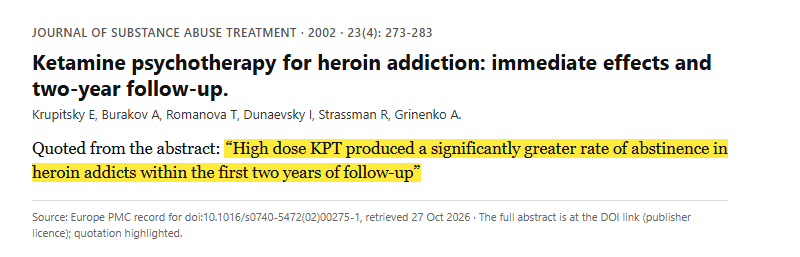
Abstract of the published study (text from Europe PMC), key sentence highlighted in yellow. Source: Krupitsky E, Burakov A, Romanova T, et al. Ketamine psychotherapy for heroin addiction: immediate effects and two-year follow-up. J Subst Abuse Treat. 2002;23(4):273-283. https://doi.org/10.1016/s0740-5472(02)00275-1
Study 2. Single versus repeated ketamine-assisted psychotherapy in 59 people with heroin dependence (Krupitsky, 2007)
50% (13 of 26) stayed abstinent at one year with repeated ketamine-assisted psychotherapy, versus 22.2% (6 of 27) with a single session!
After one ketamine-assisted psychotherapy (KPT) session before discharge from an addiction treatment hospital, 59 detoxified inpatients with heroin dependence were randomly assigned to two addiction counselling sessions plus two more KPT sessions, or to the counselling sessions alone. Researchers reported that at one year 13 of 26 people (50%) in the repeated-session group remained abstinent, compared with 6 of 27 (22.2%) in the single-session group, a significantly higher rate of abstinence, although the groups did not differ in depression, anxiety or craving for heroin! They concluded that three sessions of ketamine-assisted psychotherapy are more effective than a single session for the treatment of heroin addiction.
“It was concluded that three sessions of ketamine-assisted psychotherapy are more effective than a single session for the treatment of heroin addiction.”
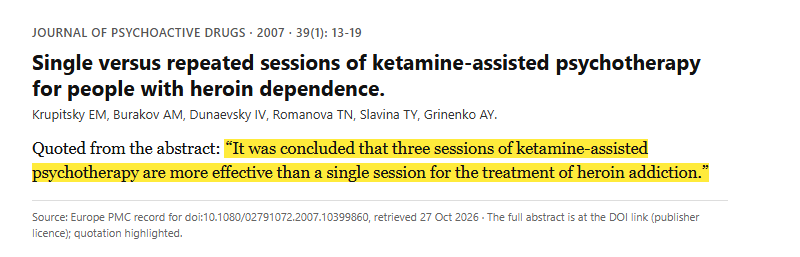
Abstract of the published study (text from Europe PMC), key sentence highlighted in yellow. Source: Krupitsky EM, Burakov AM, Dunaevsky IV, et al. Single versus repeated sessions of ketamine-assisted psychotherapy for people with heroin dependence. J Psychoactive Drugs. 2007;39(1):13-19. https://doi.org/10.1080/02791072.2007.10399860
Study 3. Ibogaine detoxification in 30 people with opioid dependence (Brown, 2018)
15 of 30 (50%) reported no opioid use in the previous 30 days at one month after ibogaine detoxification, and withdrawal scores fell from 31.0 to 14.0!
In an observational study with no comparison group, 30 people with opioid dependence received ibogaine for detoxification and were followed at 1, 3, 6, 9 and 12 months. Researchers reported that withdrawal scores (SOWS) fell from 31.0 to 14.0 after treatment (p < 0.001), that 15 people (50%) reported no opioid use in the previous 30 days at the one-month follow-up, and that drug-use scores stayed improved relative to baseline at every follow-up from 1 to 12 months! They concluded ibogaine was associated with substantive effects on opioid withdrawal symptoms and drug use in people for whom other treatments had been unsuccessful.
“At 1-month posttreatment follow-up, 15 subjects (50%) reported no opioid use during the previous 30 days.”
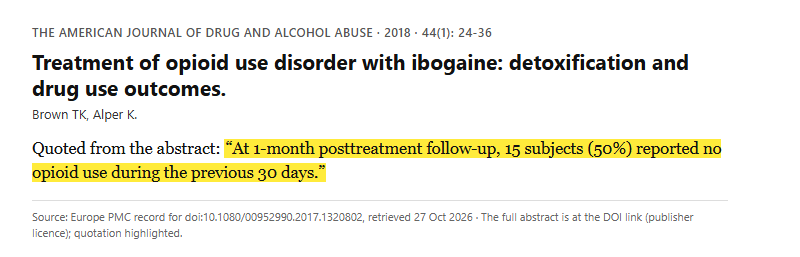
Abstract of the published study (text from Europe PMC), key sentence highlighted in yellow. Source: Brown TK, Alper K. Treatment of opioid use disorder with ibogaine: detoxification and drug use outcomes. Am J Drug Alcohol Abuse. 2018;44(1):24-36. https://doi.org/10.1080/00952990.2017.1320802
Study 4. Naturalistic psychedelic use in 3,813 people who use drugs in Vancouver (Argento, 2022)
Significantly reduced odds (adjusted odds ratio 0.45) of later daily illicit opioid use with psychedelic use among 3,813 people who use drugs in Vancouver!
Researchers analyzed data collected from 2006 to 2018 in three prospective community cohorts of people who use drugs in Vancouver, Canada, with 3,813 participants at baseline. After adjusting for a range of potential confounders, they reported that recent psychedelic use was independently associated with significantly reduced odds of subsequent daily illicit opioid use (adjusted odds ratio 0.45; 95% CI 0.29 to 0.70)! The authors said confirmation in other settings is required, and that the findings align with growing evidence that psychedelic use may be associated with detectable reductions in later substance use.
“psychedelic use remained independently associated with a significantly reduced odds of subsequent daily opioid use”
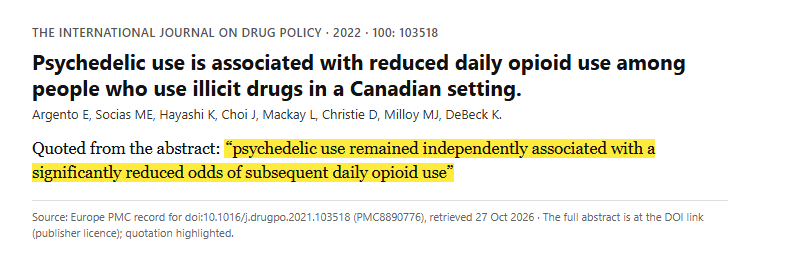
Abstract of the published study (text from Europe PMC), key sentence highlighted in yellow. Source: Argento E, Socias ME, Hayashi K, et al. Psychedelic use is associated with reduced daily opioid use among people who use illicit drugs in a Canadian setting. Int J Drug Policy. 2022;100:103518. https://doi.org/10.1016/j.drugpo.2021.103518
Related reading
- Weleff J, Pulido-Saavedra A, Aghaei AM, et al. The therapeutic effects of psychedelics for opioid use disorder: A systematic review of clinical studies. Psychiatry Res. 2025;348:116446. https://doi.org/10.1016/j.psychres.2025.116446 — A systematic review of clinical studies that found few completed studies, mostly of ibogaine or ketamine and often of weak design, and calls for higher-quality future trials.
- Ona G, Rocha JM, Bouso JC, et al. The adverse events of ibogaine in humans: an updated systematic review of the literature (2015-2020). Psychopharmacology (Berl). 2022;239(6):1977-1987. https://doi.org/10.1007/s00213-021-05964-y — Reviews 18 studies of ibogaine adverse events, mainly cardiac (the most common was QTc prolongation), and calls for phase I trials and effective screening methods.
Related pages on this site
Alcohol Use Disorder · Tobacco and Nicotine Use Disorder · Substance Use Disorder · Harm Reduction in Practice
This page summarizes published research for education only. It is not medical advice. Any change to a medication remains the decision of that person’s own prescriber.
Keep reading
All Educational Resources · About This Archive · For Practicum Supervisors