

Research is opening promising doors for young people! A systematic review reported that ketamine reduced depressive symptoms in adolescents with treatment-resistant depression, and in an open-label study average depression scores fell 42.5%, with five adolescents (38%) meeting criteria for clinical response! Among 16,255 Swedish adolescent twins, psychedelic use was associated with reduced psychotic symptoms after adjusting for other drug use. Ongoing and planned trials, mostly in adolescents aged 16 and older, are exploring anorexia nervosa, autism, obsessive-compulsive disorder, resistant depression and severe PTSD. Encouraging to see researchers calling for rigorous, well-safeguarded trials for young people.
Key studies
Study 1. Ketamine and esketamine for treatment-resistant depression and suicidality in adolescents, a systematic review (Pardossi, 2024)
Ketamine reduced depressive symptoms in adolescents with treatment-resistant depression, and esketamine also treated suicidal ideation, a systematic review reports!
In a 2024 systematic review, researchers examined ketamine and esketamine (dissociative medicines that are not classic psychedelics) for major depression with suicidal ideation and treatment-resistant depression in adolescents. They reported that ketamine has shown efficacy in reducing depressive symptoms in adolescents with treatment-resistant depression, that esketamine has shown efficacy in reducing depressive symptoms and treating suicidal ideation, and that both have demonstrated favorable safety and tolerability profiles. The authors wrote that prompt, effective treatment can reduce self-harm and suicide risks, open a window for longer-term interventions and improve adolescents’ quality of life.
“Esketamine has shown efficacy in reducing depressive symptoms and treating suicidal ideation in adolescents.”
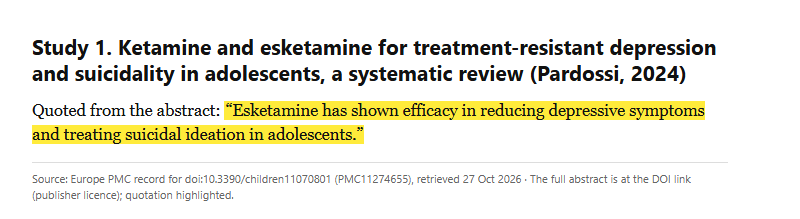
Abstract of the published study (text from Europe PMC), key sentence highlighted in yellow. Source: Pardossi S, Fagiolini A, Scheggi S, et al. A Systematic Review on Ketamine and Esketamine for Treatment-Resistant Depression and Suicidality in Adolescents: A New Hope? Children (Basel). 2024;11(7):801. https://doi.org/10.3390/children11070801
Study 2. Psychedelic use in 16,255 Swedish adolescent twins (Simonsson, 2024)
Among 16,255 adolescent twins, psychedelic use was associated with reduced psychotic symptoms after adjusting for other drug use!
Researchers used survey data from 16,255 twins in the Swedish Twin Registry; at age 15, 541 reported having used psychedelics. After adjusting for other drug use, they reported that psychedelic use was associated with reduced psychotic symptoms in both standard regression analyses and co-twin control analyses. The authors concluded that, after adjusting for other drug use, naturalistic use of psychedelics may be associated with lower rates of psychotic symptoms among adolescents.
“When adjusting for substance-specific and substance-aggregated drug use, psychedelic use was associated with reduced psychotic symptoms”
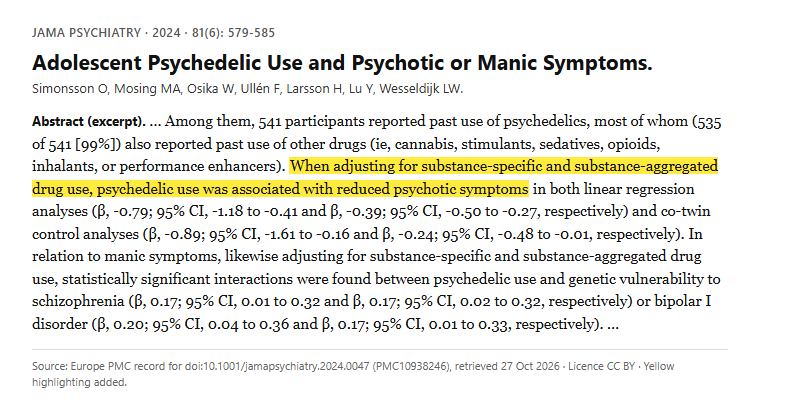
Abstract of the published study (text from Europe PMC), key sentence highlighted in yellow. Source: Simonsson O, Mosing MA, Osika W, et al. Adolescent Psychedelic Use and Psychotic or Manic Symptoms. JAMA Psychiatry. 2024;81(6):579-585. https://doi.org/10.1001/jamapsychiatry.2024.0047
Study 3. Intravenous ketamine in 13 adolescents with treatment-resistant depression (Cullen, 2018)
Average depression scores fell 42.5% in adolescents with treatment-resistant depression after ketamine, 38% met criteria for clinical response, and three responders were still in remission at the 6-week follow-up!
In an open-label study, researchers gave six intravenous ketamine infusions over two weeks to adolescents aged 12 to 18 with treatment-resistant depression; 13 completed the protocol. They reported an average 42.5% decrease on the Children’s Depression Rating Scale-Revised (p = 0.0004), five adolescents (38%) meeting criteria for clinical response, three responders in sustained remission at 6-week follow-up, and infusions that were generally well tolerated. The authors said the results demonstrate the potential role for ketamine in treating adolescents with treatment-resistant depression.
“Five (38%) adolescents met criteria for clinical response.”
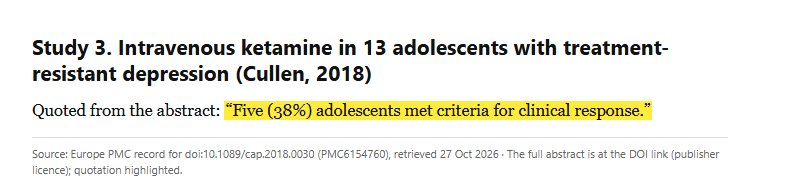
Abstract of the published study (text from Europe PMC), key sentence highlighted in yellow. Source: Cullen KR, Amatya P, Roback MG, et al. Intravenous Ketamine for Adolescents with Treatment-Resistant Depression: An Open-Label Study. J Child Adolesc Psychopharmacol. 2018;28(7):437-444. https://doi.org/10.1089/cap.2018.0030
Related reading
- Crocq MA, Auby P. The renaissance of research on psychedelics in child and adolescent psychopharmacology. Child Adolesc Psychiatry Ment Health. 2026;20(1):59. https://doi.org/10.1186/s13034-026-01069-6 — A 2026 review of ongoing and planned trials, mostly in adolescents aged 16 and older, with potential targets including anorexia nervosa, autism, OCD, resistant depression and severe PTSD.
- Armanino-Irigaray M, Catalán A, Aymerich C, et al. Unusual experiences and early-onset psychosis associated to hallucinogen use in adolescents: a systematic review and meta-analysis. Child Adolesc Psychiatry Ment Health. 2026;20(1):56. https://doi.org/10.1186/s13034-026-01060-1 — A 2026 meta-analysis reporting that in community samples, links between hallucinogen use and psychotic or manic symptoms were weak and inconsistent and largely attenuated after adjusting for other drug use and genetic vulnerability.
Related pages on this site
Veterans · Older Adults · Autism · ADHD · PTSD · End of Life Distress
This page summarizes published research for education only. It is not medical advice. Any change to a medication remains the decision of that person’s own prescriber.
Keep reading
All Educational Resources · About This Archive · For Practicum Supervisors