

Psychedelics are transforming the conversation about veterans’ mental health! In a randomized, double-blind trial of 26 veterans and first responders, average PTSD severity (CAPS-IV) fell from 87.1 to 38.8 at 12 months after MDMA-assisted psychotherapy. An open-label psilocybin pilot reported that 75% of 12 veterans with treatment-resistant PTSD had a treatment response and were in remission, and another reported 60% response and 53% remission in 15 veterans with severe treatment-resistant depression! In 30 Special Operations veterans, magnesium-ibogaine therapy was followed by significant improvements in PTSD, depression and anxiety. Encouraging to see careful research continuing for people who have served!
Key studies
Study 1. MDMA-assisted psychotherapy in 26 veterans and first responders with PTSD (Mithoefer, 2018)
Average PTSD severity fell from 87.1 to 38.8 (CAPS-IV) at 12 months after MDMA-assisted psychotherapy in veterans and first responders!
In a phase 2, randomized, double-blind trial at a US outpatient clinic, researchers assigned 26 veterans and first responders, such as firefighters and police officers, with chronic PTSD to one of three MDMA dose groups, the lowest serving as an active control, given in two sessions alongside psychotherapy! Researchers reported that the two active-dose groups had significantly greater decreases in PTSD symptom severity than the control group at the primary endpoint (p = 0.001), with large effect sizes (Cohen’s d of 2.8 and 1.1). They also reported that PTSD symptoms were significantly reduced at the 12-month follow-up compared with baseline (mean CAPS-IV total score 38.8 versus 87.1; p < 0.0001), and the authors concluded that active-dose MDMA with psychotherapy was effective and well tolerated in reducing PTSD symptoms.
“PTSD symptoms were significantly reduced at the 12-month follow-up compared with baseline after all groups had full-dose MDMA”
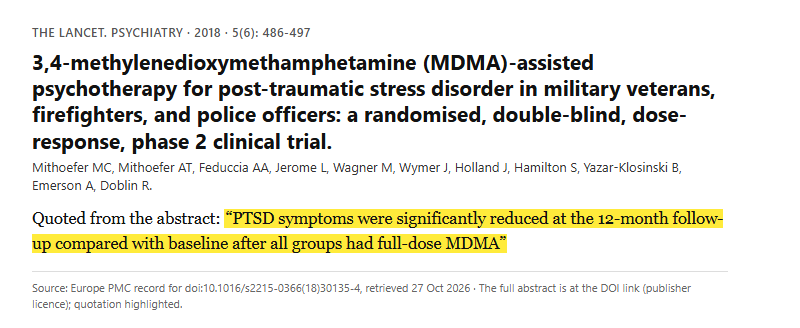
Abstract of the published study (text from Europe PMC), key sentence highlighted in yellow. Source: Mithoefer MC, Mithoefer AT, Feduccia AA, et al. 3,4-methylenedioxymethamphetamine (MDMA)-assisted psychotherapy for post-traumatic stress disorder in military veterans, firefighters, and police officers: a randomised, double-blind, dose-response, phase 2 clinical trial. Lancet Psychiatry. 2018;5(6):486-497. https://doi.org/10.1016/s2215-0366(18)30135-4
Study 2. Ketamine in 158 veterans and service members with PTSD (Abdallah, 2022)
In 158 veterans and service members, standard-dose ketamine eased depression (MADRS) significantly more than placebo!
In a multi-center, double-blind, placebo-controlled trial, researchers randomized 158 veterans and service members whose PTSD had not responded to antidepressants to eight intravenous infusions, twice weekly, of placebo or one of two doses of ketamine, a dissociative anesthetic rather than a classic psychedelic! Researchers reported that the standard dose eased depression symptoms (MADRS) significantly more than placebo, and that secondary analyses suggested rapid antidepressant effects. They also reported good tolerability across doses.
“The standard ketamine dose ameliorated depression measured by the MADRS significantly more than placebo”
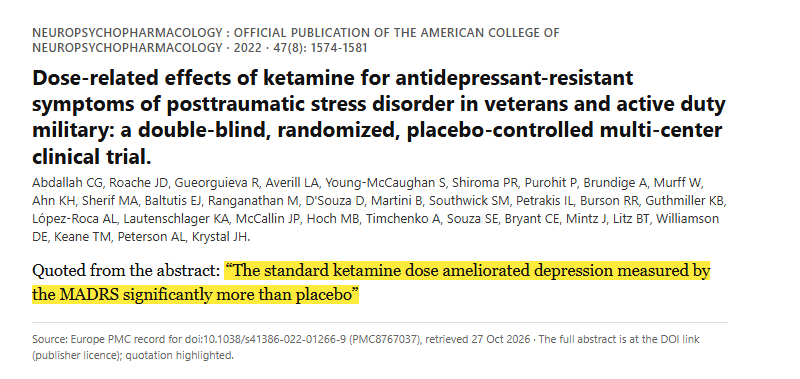
Abstract of the published study (text from Europe PMC), key sentence highlighted in yellow. Source: Abdallah CG, Roache JD, Gueorguieva R, et al. Dose-related effects of ketamine for antidepressant-resistant symptoms of posttraumatic stress disorder in veterans and active duty military: a double-blind, randomized, placebo-controlled multi-center clinical trial. Neuropsychopharmacology. 2022;47(8):1574-1581. https://doi.org/10.1038/s41386-022-01266-9
Study 3. Magnesium-ibogaine in 30 male Special Operations veterans with traumatic brain injuries (Cherian, 2024)
Significant improvements in functioning in 30 veterans, immediately and one month after magnesium-ibogaine therapy, with gains in processing speed and executive function and no unexpected or serious adverse events!
In a prospective observational study, researchers followed 30 male Special Operations Forces veterans, most with mild traumatic brain injury, who received ibogaine together with magnesium, alongside other complementary treatments, under a set protocol! Researchers reported significant improvements in functioning on a World Health Organization disability scale right after treatment and one month later, with no unexpected or serious adverse events. Neuropsychological testing showed improvement after treatment, particularly in processing speed and executive function, with no detrimental changes observed.
“Neuropsychological testing (NPT) revealed areas of improvement after treatment, particularly in processing speed and executive function, without any detrimental changes observed.”
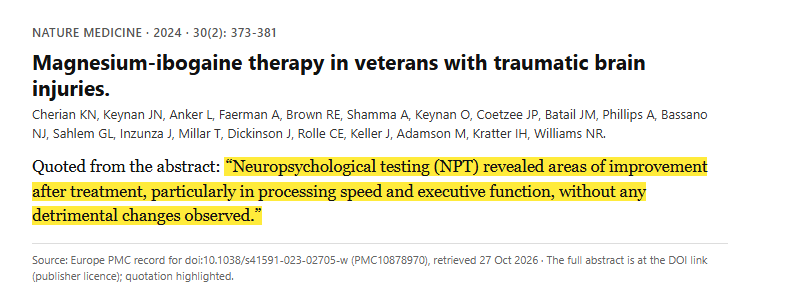
Abstract of the published study (text from Europe PMC), key sentence highlighted in yellow. Source: Cherian KN, Keynan JN, Anker L, et al. Magnesium-ibogaine therapy in veterans with traumatic brain injuries. Nat Med. 2024;30(2):373-381. https://doi.org/10.1038/s41591-023-02705-w
Study 4. Psilocybin-assisted therapy in 12 veterans with severe, treatment-resistant PTSD (Armstrong, 2026)
75% of 12 veterans with severe, treatment-resistant PTSD had a treatment response and were in remission from PTSD after psilocybin-assisted therapy!
In an open-label pilot trial, 12 U.S. military veterans with severe, treatment-resistant PTSD received preparation therapy, two psilocybin dosing sessions and follow-up therapy at a research center in Columbus, Ohio! Researchers reported a large (d = 2.30) and significant (p < 0.001) reduction in clinician-rated PTSD symptoms from baseline through one-month follow-up (mean difference 27.5; 95% CI 19.9 to 35.1), with 75% having a treatment response and in remission from PTSD. They also reported clinician adherence ratings of 98% across all study visits, and the authors concluded that psilocybin-assisted therapy shows preliminary clinical improvement for PTSD and may offer therapeutic relief for veterans with severe treatment-resistant PTSD.
“Veterans showed large improvements in PTSD symptoms, and many no longer met criteria for PTSD after one month.”
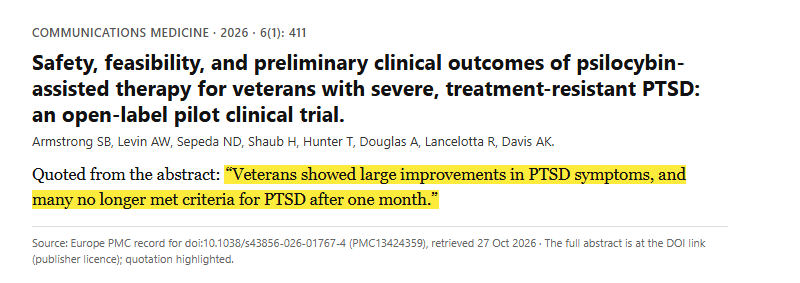
Abstract of the published study (text from Europe PMC), key sentence highlighted in yellow. Source: Armstrong SB, Levin AW, Sepeda ND, et al. Safety, feasibility, and preliminary clinical outcomes of psilocybin-assisted therapy for veterans with severe, treatment-resistant PTSD: an open-label pilot clinical trial. Commun Med (Lond). 2026;6(1):411. https://doi.org/10.1038/s43856-026-01767-4
Related reading
- Wolfgang AS, Hoge CW. Psychedelic-Assisted Therapy in Military and Veterans Healthcare Systems: Clinical, Legal, and Implementation Considerations. Curr Psychiatry Rep. 2023;25(10):513-532. https://doi.org/10.1007/s11920-023-01446-4 — A 2023 review of psychedelic-assisted therapy in military and veterans’ health care, reporting that MDMA- and psilocybin-assisted therapy have shown promising outcomes in efficacy, tolerability and durability for PTSD and depression, amid considerable national interest.
- Ellis S, Bostian C, Feng W, et al. Single-dose psilocybin for U.S. military Veterans with severe treatment-resistant depression - A first-in-kind open-label pilot study. J Affect Disord. 2025;369:381-389. https://doi.org/10.1016/j.jad.2024.09.133 — A first-in-kind open-label pilot in which 60% of 15 veterans with severe treatment-resistant depression met response criteria and 53% met remission criteria at week 3; the authors described a surprising response and remission.
Related pages on this site
Older Adults · Adolescents · Autism · ADHD · PTSD · End of Life Distress
This page summarizes published research for education only. It is not medical advice. Any change to a medication remains the decision of that person’s own prescriber.
Keep reading
All Educational Resources · About This Archive · For Practicum Supervisors