

Psychedelic research is reaching later life, with exciting early results! In the first data on psilocybin in any neurodegenerative disease, 12 people with Parkinson’s disease had depression and anxiety scores that improved to a clinically meaningful degree and stayed improved three months later! In a placebo-controlled study, 48 healthy volunteers aged 55 to 75 took LSD with no impairment in thinking, balance or body-position sense! Adults aged 60 and over showed well-being improvements similar to younger adults after guided group sessions, and a systematic review concluded that psychedelic-assisted psychotherapy can be safe and well tolerated in older adults. Encouraging to see careful research continuing, with later life in view.
Key studies
Study 1. Low-dose LSD in 48 healthy older volunteers (Family, 2020)
48 healthy older volunteers took low-dose LSD in a placebo-controlled study with no impairment in thinking, balance or body-position sense!
In a phase 1, double-blind, placebo-controlled randomized study, 48 healthy volunteers aged 55 to 75 (average age about 63) received a placebo or one of three very low doses of LSD on six occasions over about three weeks. Researchers reported that LSD was well tolerated and that assessments of cognition, balance and body-position sense revealed no impairment. They said the results support further clinical development of LSD for Alzheimer’s disease.
“Assessments of cognition, balance, and proprioception revealed no impairment.”
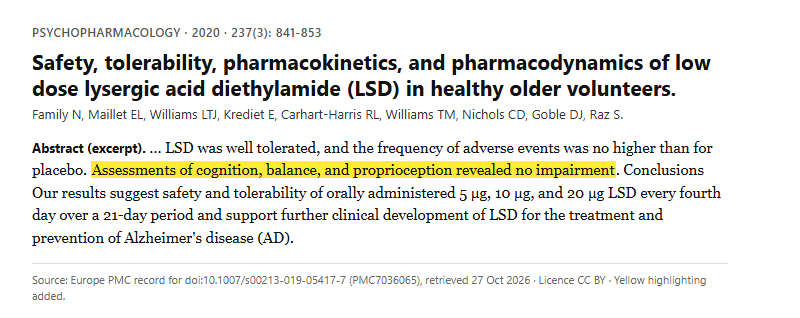
Abstract of the published study (text from Europe PMC), key sentence highlighted in yellow. Source: Study 1. Low-dose LSD in 48 healthy older volunteers (Family, 2020) https://doi.org/10.1007/s00213-019-05417-7
Study 2. Psilocybin therapy in 12 people with Parkinson’s disease (Bradley, 2025)
First-ever data on psilocybin in a neurodegenerative disease: no worsening of Parkinson’s symptoms, and depression and anxiety scores improved to a clinically meaningful degree for three months!
In an open-label pilot trial, researchers gave psilocybin with psychotherapy (two dosing sessions) to 12 people with mild to moderate Parkinson’s disease and depression and/or anxiety, average age about 63. They reported no worsening of Parkinson’s symptoms and, on the contrary, improvement in both non-motor and motor symptom scores and in some thinking tests, sustained for one month.
“We observed no worsening of PD symptomology measured by the Movement Disorder Society Unified Parkinson's Disease Rating Scale (MDS-UPDRS).”
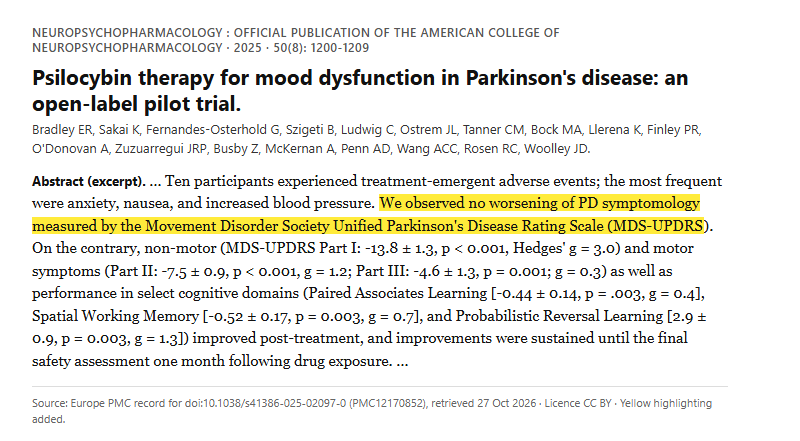
Abstract of the published study (text from Europe PMC), key sentence highlighted in yellow. Source: Study 2. Psilocybin therapy in 12 people with Parkinson’s disease (Bradley, 2025) https://doi.org/10.1038/s41386-025-02097-0
Study 3. Psilocybin-assisted group therapy in 18 older men who are long-term AIDS survivors (Anderson, 2020)
18 older long-term AIDS survivors had a clinically meaningful drop in demoralization by the 3-month follow-up after psilocybin-assisted group therapy!
Researchers ran an open-label pilot of psilocybin-assisted group therapy (8 to 10 group sessions plus one psilocybin session) for 18 gay men who were older long-term AIDS survivors with moderate to severe demoralization, average age about 59. They reported a clinically meaningful change in demoralization from baseline to the 3-month follow-up. The authors said the study demonstrated feasibility, relative safety and potential efficacy, and that groups may be an effective and efficient way to deliver psychotherapy before and after psilocybin.
“We detected a clinically meaningful change in demoralization from baseline to 3-month follow-up”
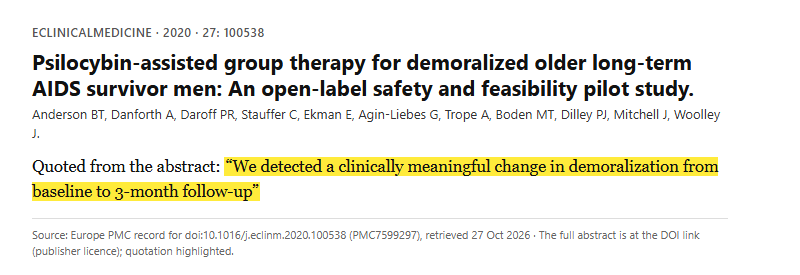
Abstract of the published study (text from Europe PMC), key sentence highlighted in yellow. Source: Study 3. Psilocybin-assisted group therapy in 18 older men who are long-term AIDS survivors (Anderson, 2020) https://doi.org/10.1016/j.eclinm.2020.100538
Study 4. Guided psychedelic group sessions in 62 older and 62 younger adults (Kettner, 2024)
62 adults aged 60 and over showed well-being improvements similar to younger adults after guided psychedelic group sessions!
In a prospective observational study, researchers followed 62 adults aged 60 or older and 62 matched younger adults using surveys from two weeks before to six months after a guided psychedelic group session. They reported that the older adults showed post-psychedelic well-being improvements similar to those of the younger adults, and that relational experiences before and after the sessions predicted those improvements. The authors concluded that guided psychedelic group sessions enhance well-being in older adults, in line with prior studies in younger adults.
“Older adults reported well-being improvements similar to a matched sample of younger adults following participation in a psychedelic retreat”
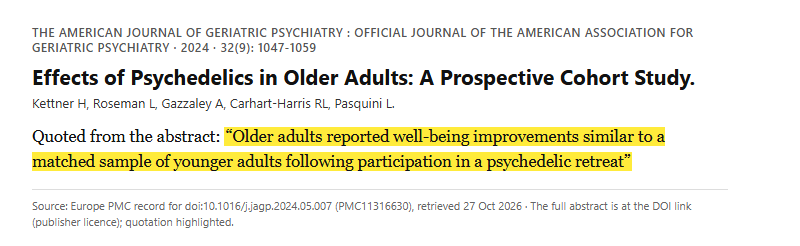
Abstract of the published study (text from Europe PMC), key sentence highlighted in yellow. Source: Study 4. Guided psychedelic group sessions in 62 older and 62 younger adults (Kettner, 2024) https://doi.org/10.1016/j.jagp.2024.05.007
Related reading
- Bouchet, L., Sager, Z., Yrondi, A., Nigam, K. B., Anderson, B. T., Ross, S., Petridis, P. D., & Beaussant, Y. (2024). Older adults in psychedelic-assisted therapy trials: A systematic review. Journal of Psychopharmacology, 38(1), 33–48. https://doi.org/10.1177/02698811231215420 — Concluded that existing data suggest psychedelic-assisted psychotherapy can be safe and well tolerated in older adults, and called for more rigorous investigation.
- Konstantinou, G. N., Rosenblat, J., Hales, S., Husain, M. I., & Blumberger, D. M. (2026). Psilocybin in late-life mental health: Addressing depression, loneliness, and existential anxiety. General Hospital Psychiatry, 98, 54–63. https://doi.org/10.1016/j.genhosppsych.2025.12.005 — Reviews psilocybin’s potential for late-life depression, loneliness and existential anxiety, with sustained improvements seen in clinical trials in general adult samples.
Related pages on this site
Veterans · Adolescents · Autism · ADHD · PTSD · End of Life Distress
This page summarizes published research for education only. It is not medical advice. Any change to a medication remains the decision of that person’s own prescriber.
Keep reading
All Educational Resources · About This Archive · For Practicum Supervisors