

Psychedelic research on social anxiety in autistic adults has early results worth celebrating! In a double-blind, placebo-controlled pilot trial, MDMA-assisted therapy brought rapid and durable improvement in social anxiety, with a very large effect size (d = 1.4) and similar positive results at the six-month follow-up. In an online survey of 233 autistic adults, 82% attributed less psychological distress, 78% less social anxiety and 70% more social engagement to one impactful psychedelic experience, and in a survey of 261, 77.8% were willing to try psychedelics for mental health! Encouraging to see autistic adults’ own experiences taken seriously.
Key studies
Study 1. MDMA-assisted therapy in 12 autistic adults with social anxiety (Danforth, 2018)
MDMA-assisted therapy brought autistic adults rapid and durable improvement in social anxiety, with a very large effect (d = 1.4) that held at 6 months!
In a double-blind, placebo-controlled pilot trial, researchers randomly assigned 12 autistic adults with marked to very severe social anxiety to MDMA-assisted therapy (8 people) or placebo (4 people) across two eight-hour sessions about a month apart, with 3 non-drug therapy sessions after each. They reported significantly greater improvement in social anxiety for the MDMA group (P = 0.037), with a very large effect size (d = 1.4), and similar positive results at the six-month follow-up (P = 0.036). Social anxiety stayed the same or continued to improve slightly for most participants in the MDMA group after the treatment phase.
“This pilot trial demonstrated rapid and durable improvement in social anxiety symptoms in autistic adults following MDMA-assisted psychotherapy.”
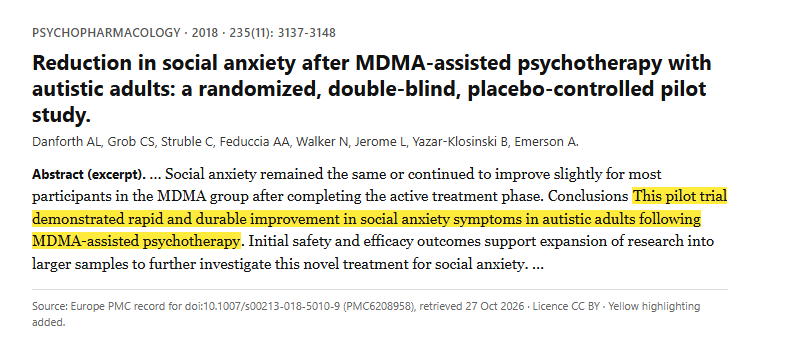
Abstract of the published study (text from Europe PMC), key sentence highlighted in yellow. Source: Danforth AL, Grob CS, Struble C, et al. Reduction in social anxiety after MDMA-assisted psychotherapy with autistic adults: a randomized, double-blind, placebo-controlled pilot study. Psychopharmacology (Berl). 2018;235(11):3137-3148. https://doi.org/10.1007/s00213-018-5010-9
Study 2. Self-chosen psychedelic use in 233 autistic adults (Stroud, 2025)
82% of 233 autistic adults attributed less distress, 78% less social anxiety and 70% more social engagement to one impactful psychedelic experience!
Researchers ran an online survey of 233 self-selected autistic adults about their most impactful psychedelic experience. They reported that the majority attributed reductions in psychological distress (82%) and social anxiety (78%) and increases in social engagement (70%) to that experience. The only substantial predictor of reduced distress was increased psychological flexibility.
“The majority of participants attributed reductions in psychological distress (82%) and social anxiety (78%)”
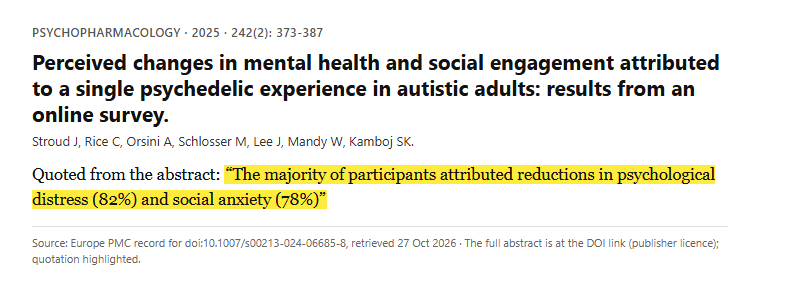
Abstract of the published study (text from Europe PMC), key sentence highlighted in yellow. Source: Stroud J, Rice C, Orsini A, et al. Perceived changes in mental health and social engagement attributed to a single psychedelic experience in autistic adults: results from an online survey. Psychopharmacology (Berl). 2025;242(2):373-387. https://doi.org/10.1007/s00213-024-06685-8
Study 3. Views on and use of psychedelics in 261 autistic adults (Afsharnia, 2025)
77.8% of 261 autistic adults surveyed were willing to try psychedelics for mental health, and 69.7% reported past use!
Researchers ran a cross-sectional online survey of English-speaking autistic adults; 424 started it and 261 completed it, and nearly half lived in Canada. They reported that participants generally viewed psychedelics positively, with 77.8% willing to try them for mental health and 69.7% reporting past use, most commonly psilocybin mushrooms. Participants with prior experience reported greater perceived knowledge and lower perceived risks, and the authors noted strong interest in psychedelics as potential treatments for mental health.
“Participants generally viewed psychedelics positively, with 77.8% expressing a willingness to try them”
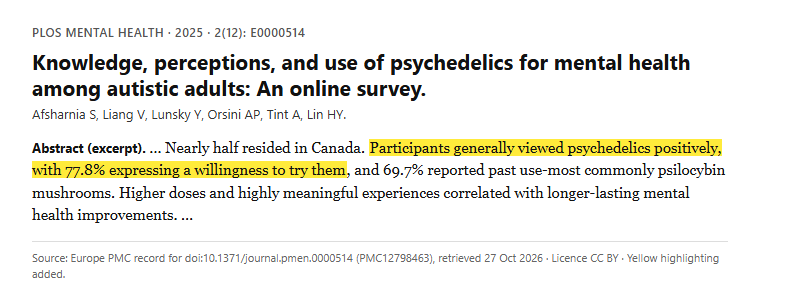
Abstract of the published study (text from Europe PMC), key sentence highlighted in yellow. Source: Afsharnia S, Liang V, Lunsky Y, et al. Knowledge, perceptions, and use of psychedelics for mental health among autistic adults: An online survey. PLOS Ment Health. 2025;2(12):e0000514. https://doi.org/10.1371/journal.pmen.0000514
Related reading
- Markopoulos A, Inserra A, De Gregorio D, et al. Evaluating the Potential Use of Serotonergic Psychedelics in Autism Spectrum Disorder. Front Pharmacol. 2021;12:749068. https://doi.org/10.3389/fphar.2021.749068 — A review highlighting psychedelics’ prosocial effects and the positive behavioural outcomes of 1960s and 1970s studies in autistic children, including enhanced mood and social behaviour.
- Moreno-Chaparro J, Castañeda-Millán G, Eslava Schmalbach J. Psilocybin Use in the Autism Spectrum Disorder: A Scoping Review. Clin Neuropharmacol. 2025;48(5):151-157. https://doi.org/10.1097/wnf.0000000000000653 — A scoping review of four psilocybin studies, grouping results into increased empathy and sociability and reduced symptoms, with a therapeutic signal in some people not associated with toxic or disruptive effects.
Related pages on this site
Veterans · Older Adults · Adolescents · ADHD · PTSD · End of Life Distress
This page summarizes published research for education only. It is not medical advice. Any change to a medication remains the decision of that person’s own prescriber.
Keep reading
All Educational Resources · About This Archive · For Practicum Supervisors