

Psychedelics are opening a new chapter for bipolar II depression! In an open-label trial at Sheppard Pratt, 11 of 15 people reached remission three weeks after a single psilocybin session. A pilot of 14 adults reported MADRS improvements of -12.7 after the first session and -18.6 after a second among the nine who had one, with no serious adverse events. A 23-study review reported that psychedelics appear relatively safe in controlled clinical settings, and 541 people with bipolar disorder who had used psilocybin said it was more helpful than harmful. People with bipolar disorder are often excluded from psilocybin trials, so careful, monitored research is just getting started. Encouraging to see it continuing, with safety as the first question.
Key studies
Study 1. Hypomania and mania after psychedelics or MDMA in 23 human studies (Eskinazi, 2026)
A review of 23 studies reported that psychedelics appear relatively safe in controlled clinical settings, with manic symptoms typically acute and self-limited!
Researchers systematically reviewed 23 human studies, including clinical trials, health-registry cohorts and surveys, on hypomania or mania after psychedelics or MDMA, and reported that psychedelics appear to remain relatively safe in controlled clinical settings! Dysphoria/euphoria, hypomania or mania were seen at a rate of 5.8% in controlled trials of psilocybin-assisted psychotherapy for major depressive disorders, manic symptoms were typically acute and self-limited, and registry cohorts showed little evidence of a hallucinogen-specific signal for a later bipolar diagnosis. Higher risks were seen with bipolar I disorder, family vulnerability, use of several substances and unsupervised use, a good reminder of why screened, supervised care matters.
“When present, manic symptoms were typically acute and self-limited.”
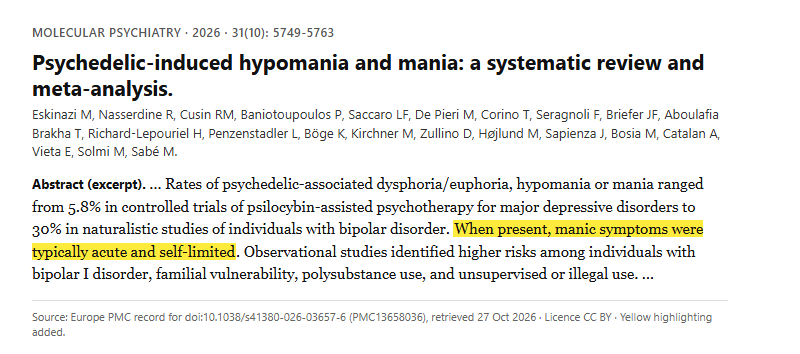
Abstract of the published study (text from Europe PMC), key sentence highlighted in yellow. Source: Eskinazi M, Nasserdine R, Cusin RM, et al. Psychedelic-induced hypomania and mania: a systematic review and meta-analysis. Mol Psychiatry. 2026;31(10):5749-5763. https://doi.org/10.1038/s41380-026-03657-6
Study 2. Psilocybin therapy in 14 adults with bipolar II depression (Downey, 2026)
Bipolar II depression scores improved significantly (-12.7 after one psilocybin session, and -18.6 after a second in the nine who had one), with no serious adverse events!
Researchers reported that in an open-label, single-arm pilot of 14 adults with bipolar II depression given psilocybin with psychotherapy and proactive monitoring, MADRS depression scores improved significantly after the first session (-12.7; P < .001), with four participants (28.5%) reaching remission, and improved further 21 days after a second session for the nine who received one (-18.6; P < .001)! Quality-of-life scores improved at 90 days (P = .004), no serious adverse events were reported, the three notable psychiatric events (suicidal ideation or hypomania) resolved with support, and the authors suggested psilocybin therapy may be safe, tolerable and preliminarily efficacious.
“Following the 10 mg session, MADRS scores improved significantly (-12.7 [2.7], P <.001), with 4 participants (28.5%) meeting remission criteria”
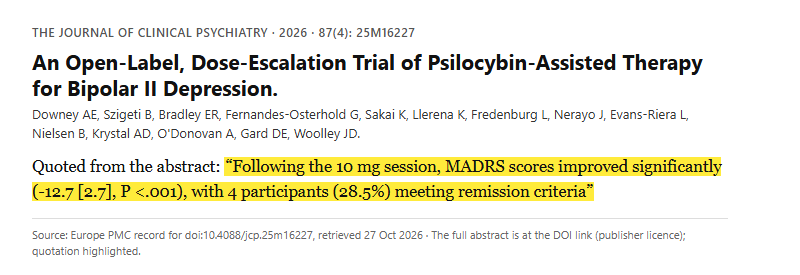
Abstract of the published study (text from Europe PMC), key sentence highlighted in yellow. Source: Downey AE, Szigeti B, Bradley ER, et al. An Open-Label, Dose-Escalation Trial of Psilocybin-Assisted Therapy for Bipolar II Depression. J Clin Psychiatry. 2026;87(4):25m16227. https://doi.org/10.4088/jcp.25m16227
Study 3. Single-dose psilocybin with psychotherapy in 15 people with treatment-resistant bipolar II depression (Aaronson, 2024)
11 of 15 people with bipolar II depression reached remission three weeks after a single psilocybin session in an open-label trial!
Researchers reported that in a 12-week open-label, nonrandomized trial at Sheppard Pratt Hospital, 15 adults with treatment-resistant bipolar II depression were given a single psilocybin session with psychotherapy, and all had lower MADRS scores at week 3, with a mean change of -24.00 points (Cohen d = 4.08; P < .001)! At week 3, 12 participants met the response criterion and 11 met the remission criterion, lower scores held at every tested time point through the study end point, and mania ratings (YMRS) and suicidality ratings (CSSRS) did not change significantly from baseline.
“At week 3, 12 participants met the response criterion (50% decrease in MADRS), and 11 met remission criterion (MADRS score ≤10).”
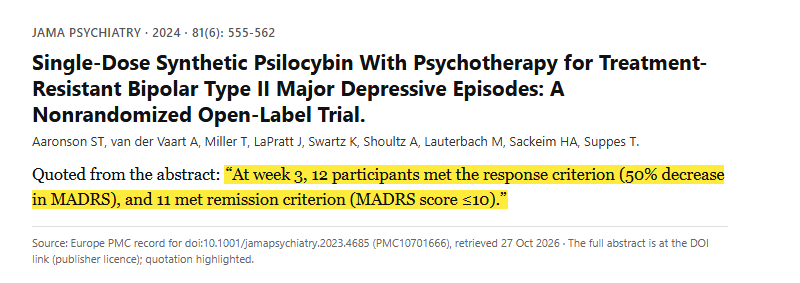
Abstract of the published study (text from Europe PMC), key sentence highlighted in yellow. Source: Aaronson ST, van der Vaart A, Miller T, et al. Single-Dose Synthetic Psilocybin With Psychotherapy for Treatment-Resistant Bipolar Type II Major Depressive Episodes: A Nonrandomized Open-Label Trial. JAMA Psychiatry. 2024;81(6):555-562. https://doi.org/10.1001/jamapsychiatry.2023.4685
Study 4. Self-reported psilocybin use in 541 people with bipolar disorder (Morton, 2023)
541 people with bipolar disorder said psilocybin use was more helpful than harmful in an international online survey!
Researchers ran an international online survey of 541 people who reported a diagnosis of bipolar disorder and had used psilocybin (“magic mushrooms”), and reported that respondents, even those who experienced adverse effects, indicated that psilocybin use was more helpful than harmful! Use of emergency medical services was rare (3.3%), and the survey elaborated on perceived benefits.
“Respondents (even those who experienced adverse effects) indicated that psilocybin use was more helpful than harmful.”
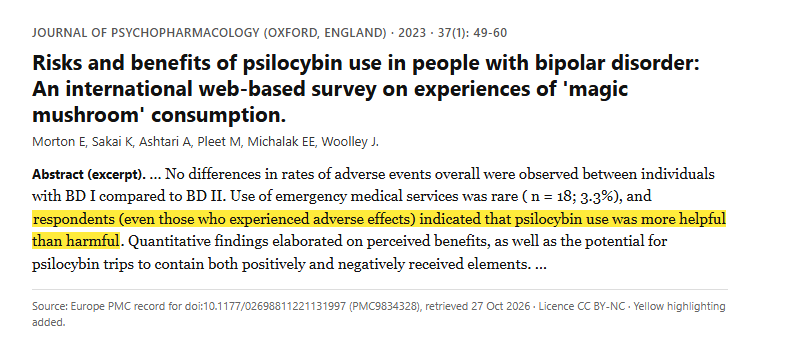
Abstract of the published study (text from Europe PMC), key sentence highlighted in yellow. Source: Morton E, Sakai K, Ashtari A, Pleet M, Michalak EE, Woolley J. Risks and benefits of psilocybin use in people with bipolar disorder: An international web-based survey on experiences of 'magic mushroom' consumption. J Psychopharmacol. 2023;37(1):49-60. https://doi.org/10.1177/02698811221131997
Related reading
- Marques MG, Patarroyo-Rodriguez L, Singh B. Psilocybin and Bipolar Depression: Promise and Prudence. CNS Drugs. 2026;40(2):123-132. https://doi.org/10.1007/s40263-025-01255-8 — Describes early bipolar II results (n = 19) as encouraging and sets out the path to larger, rigorous trials.
- Downey AE, Bradley ER, Lerche AS, O'Donovan A, Krystal AD, Woolley J. A Plea for Nuance: Should People with a Family History of Bipolar Disorder Be Excluded from Clinical Trials of Psilocybin Therapy? Psychedelic Medicine. 2024;2(2):61-73. https://doi.org/10.1089/psymed.2023.0051 — Proposes a risk-stratification tool so that people with a family history of bipolar disorder need not be excluded outright from psilocybin trials.
Related pages on this site
Depressive Disorders · Major Depressive Disorder · Treatment-Resistant Depression · Anxiety Disorders · Introduction: A New Era · End of Life Distress
This page summarizes published research for education only. It is not medical advice. Any change to a medication remains the decision of that person’s own prescriber.
Keep reading
All Educational Resources · About This Archive · For Practicum Supervisors