

Psychedelics are transforming how we look at hard-to-treat depression! In a National Health Service trial of 60 adults, MADRS depression scores were 10.41 points lower with psilocybin than placebo at three weeks, sustained at six weeks (Cohen's d -1.70). In a 233-person phase 2 trial the highest psilocybin dose cut scores 6.6 points more than the lowest (P < .001), and in an ayahuasca trial 64% responded at day 7 versus 27% on placebo. A randomized trial of repeated psilocybin sessions reported a large effect size (Hedges' g 1.07). Encouraging to see careful research continuing for people whose depression has been hard to treat.
Key studies
Study 1. Psilocybin in 233 people with treatment-resistant depression (Goodwin, 2022)
Depression scores fell 12.0 points at three weeks on the highest psilocybin dose, versus 5.4 on the lowest, in 233 people (P < .001)!
Researchers reported that in a phase 2 double-blind trial of 233 adults with treatment-resistant depression given a single dose of psilocybin at one of three strengths, with the lowest serving as the control, alongside psychological support, MADRS depression scores fell 12.0 points at three weeks on the highest dose versus 5.4 on the lowest, a difference of 6.6 points (95% CI -10.2 to -2.9; P < .001)! Response and remission at three weeks were generally supportive of that primary result.
“psilocybin at a single dose of 25 mg, but not 10 mg, reduced depression scores significantly more than a 1-mg dose over a period of 3 weeks”
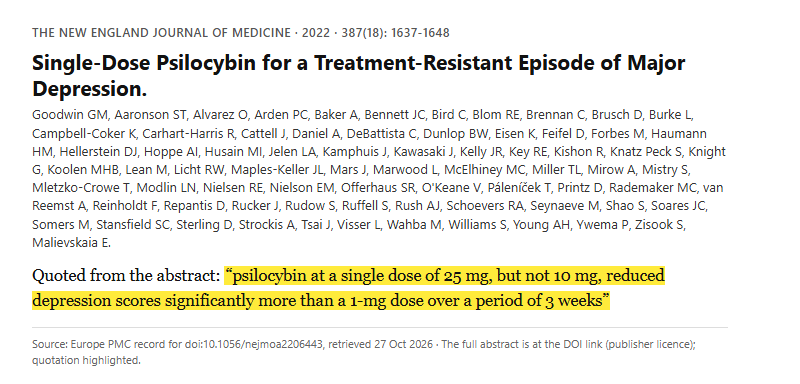
Abstract of the published study (text from Europe PMC), key sentence highlighted in yellow. Source: Goodwin GM, Aaronson ST, Alvarez O, et al. Single-Dose Psilocybin for a Treatment-Resistant Episode of Major Depression. N Engl J Med. 2022;387(18):1637-1648. https://doi.org/10.1056/nejmoa2206443
Study 2. Repeated-dose psilocybin therapy in 30 people with treatment-resistant depression (Rosenblat, 2024)
Psilocybin therapy showed a large effect (Hedges' g 1.07) versus waitlist in treatment-resistant depression, with no serious adverse events!
Researchers reported a randomized clinical trial in a complex population of adults with treatment-resistant depression (as part of major depressive or bipolar II disorder), who were randomized to immediate psilocybin-assisted psychotherapy or a waitlist, with 29 of 30 retained to the week-2 primary endpoint! Depression scores (MADRS) fell more in the immediate-treatment arm, a large effect size (Hedges' g 1.07; p < 0.01), repeated doses were associated with further reductions, and adverse events were transient with no serious adverse events.
“Repeated doses were associated with further reductions in MADRS scores compared to baseline.”
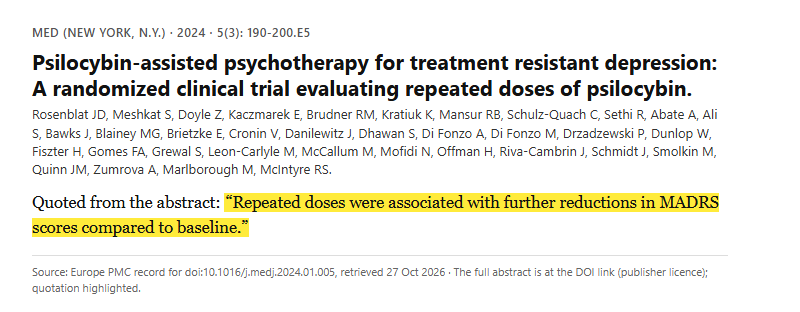
Abstract of the published study (text from Europe PMC), key sentence highlighted in yellow. Source: Rosenblat JD, Meshkat S, Doyle Z, et al. Psilocybin-assisted psychotherapy for treatment resistant depression: A randomized clinical trial evaluating repeated doses of psilocybin. Med. 2024;5(3):190-200.e5. https://doi.org/10.1016/j.medj.2024.01.005
Study 3. Psilocybin in 60 people with treatment-resistant depression in a public health service (Rucker, 2026)
Depression scores were 10.41 points lower with psilocybin than placebo at week 3 in an NHS trial of 60 people!
Researchers reported that in a double-blind randomized feasibility trial at one National Health Service site in England, 60 adults with treatment-resistant major depressive disorder given a single dose of psilocybin or placebo, with preparation, dosing support and integration, had MADRS depression scores 10.41 points lower with psilocybin at week 3 (95% CI -14.86 to -5.95; Cohen's d -1.70), sustained at week 6! Retention was high, with 59 of 60 completing the rating at every follow-up visit, and the authors said the findings support a future confirmatory trial.
“The adjusted between-group difference at week 3 on the MADRS was -10.41 (95% confidence interval: -14.86 to -5.95; Cohen's d = -1.70), favoring psilocybin”
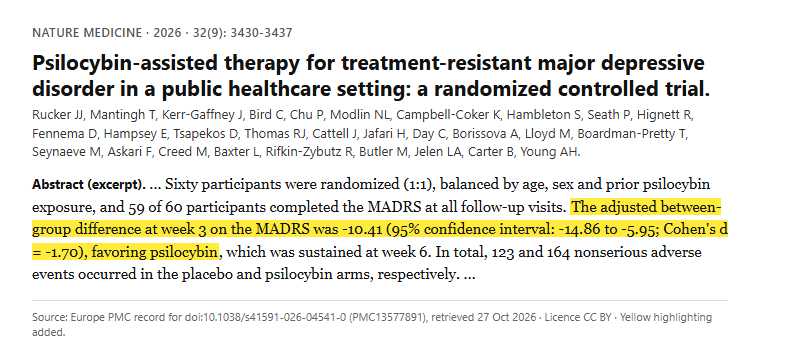
Abstract of the published study (text from Europe PMC), key sentence highlighted in yellow. Source: Rucker JJ, Mantingh T, Kerr-Gaffney J, et al. Psilocybin-assisted therapy for treatment-resistant major depressive disorder in a public healthcare setting: a randomized controlled trial. Nat Med. 2026;32(9):3430-3437. https://doi.org/10.1038/s41591-026-04541-0
Study 4. Ayahuasca in 29 people with treatment-resistant depression (Palhano-Fontes, 2019)
64% responded to ayahuasca at day 7 versus 27% on placebo!
Researchers reported that in a double-blind, randomized placebo-controlled trial of 29 patients with treatment-resistant depression given a single dose of ayahuasca or placebo, MADRS scores were significantly lower with ayahuasca at days 1 and 2 (p = 0.04) and day 7 (p < 0.0001)! Between-group effect sizes rose from d = 0.84 at day 1 to d = 1.49 at day 7, the day-7 response rate was 64% compared with 27%, and no serious adverse events were observed during or after dosing.
“We observed significant antidepressant effects of ayahuasca when compared with placebo at all-time points.”
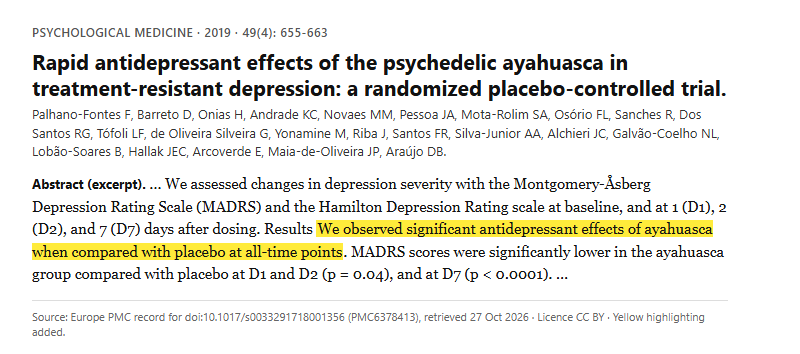
Abstract of the published study (text from Europe PMC), key sentence highlighted in yellow. Source: Palhano-Fontes F, Barreto D, Onias H, et al. Rapid antidepressant effects of the psychedelic ayahuasca in treatment-resistant depression: a randomized placebo-controlled trial. Psychol Med. 2019;49(4):655-663. https://doi.org/10.1017/s0033291718001356
Related reading
- McAllister-Williams RH, Arango C, Blier P, et al. The identification, assessment and management of difficult-to-treat depression: An international consensus statement. J Affect Disord. 2020;267:264-282. https://doi.org/10.1016/j.jad.2020.02.023 — An international consensus statement on difficult-to-treat depression, a broader concept than treatment-resistant depression, with a patient-centered, shared-decision-making approach to reassessing and optimizing care.
- Swainson J, McGirr A, Blier P, et al. The Canadian Network for Mood and Anxiety Treatments (CANMAT) Task Force Recommendations for the Use of Racemic Ketamine in Adults with Major Depressive Disorder. Can J Psychiatry. 2021;66(2):113-125. https://doi.org/10.1177/0706743720970860 — Canadian task force recommendations on racemic ketamine, a different drug, reporting Level 1 evidence for the efficacy of a single intravenous infusion in adults with treatment-resistant depression.
Related pages on this site
Depressive Disorders · Major Depressive Disorder · Bipolar Disorder · Anxiety Disorders · Introduction: A New Era · End of Life Distress
This page summarizes published research for education only. It is not medical advice. Any change to a medication remains the decision of that person’s own prescriber.
Keep reading
All Educational Resources · About This Archive · For Practicum Supervisors