

Psychedelics are transforming depression research! A single dose of psilocybin lowered depression scores 12.3 more MADRS points than placebo by day 43 in 104 adults (P < .001), and a 35-person Stockholm trial met its primary end point, with self-rated symptoms improved from day 2 through day 102. Intravenous DMT beat placebo at two weeks in 34 adults, with effects lasting up to three months in the open-label phase. Head to head with escitalopram, psilocybin matched escitalopram on the main measure and reached 70% response and 57% remission at six weeks, against 48% and 28%! Encouraging to see careful research continuing, with more studies on the way.
Key studies
Study 1. Psilocybin in 104 people with major depressive disorder (Raison, 2023)
A single dose of psilocybin lowered depression scores 12.3 points more than placebo by day 43 in 104 adults!
Researchers reported that in a phase 2 double-blind trial at 11 US sites, 104 adults with major depressive disorder given a single dose of psilocybin or niacin (an active placebo), each with psychological support, had significantly larger drops in MADRS depression scores with psilocybin at day 8 (mean difference -12.0; P < .001) and day 43 (-12.3; 95% CI -17.5 to -7.2; P < .001)! Disability scores on the Sheehan scale improved too (-2.31; P < .001), more people had a sustained response, and no serious treatment-emergent adverse events were reported.
“Psilocybin treatment was associated with significantly reduced MADRS scores compared with niacin from baseline to day 43”
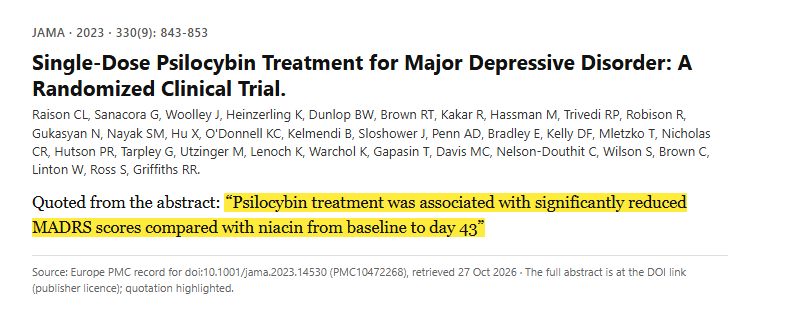
Abstract of the published study (text from Europe PMC), key sentence highlighted in yellow. Source: Raison CL, Sanacora G, Woolley J, et al. Single-Dose Psilocybin Treatment for Major Depressive Disorder: A Randomized Clinical Trial. JAMA. 2023;330(9):843-853. https://doi.org/10.1001/jama.2023.14530
Study 2. Psilocybin compared with escitalopram in 59 people with major depressive disorder (Carhart-Harris, 2021)
70% of people given psilocybin responded versus 48% on escitalopram at six weeks, and 57% reached remission versus 28%, with no significant difference on the main measure!
Researchers reported that in a phase 2 double-blind randomized trial of 59 adults with long-standing, moderate-to-severe major depressive disorder, two sessions of psilocybin three weeks apart matched six weeks of daily escitalopram on the main depression measure (QIDS-SR-16 change -8.0 versus -6.0)! Response reached 70% versus 48% and remission 57% versus 28% at week 6, and other secondary outcomes (uncorrected for multiple comparisons) generally favored psilocybin; everyone received psychological support, and adverse events were similar between the groups.
“A QIDS-SR-16 response occurred in 70% of the patients in the psilocybin group and in 48% of those in the escitalopram group”
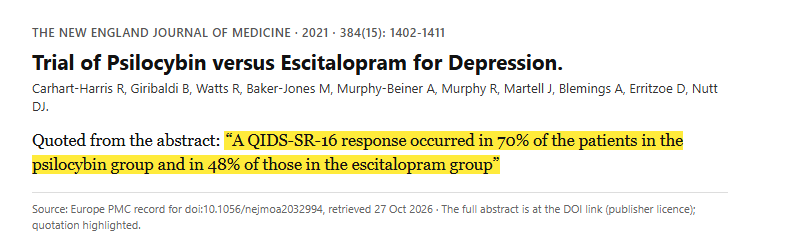
Abstract of the published study (text from Europe PMC), key sentence highlighted in yellow. Source: Carhart-Harris R, Giribaldi B, Watts R, et al. Trial of Psilocybin versus Escitalopram for Depression. N Engl J Med. 2021;384(15):1402-1411. https://doi.org/10.1056/nejmoa2032994
Study 3. Psilocybin in 35 people with recurrent major depressive disorder (Yngwe, 2026)
Psilocybin met its primary end point, with depression scores down 11.03 points more than placebo by day 15 (P < .001)!
Researchers reported that in a double-blind, placebo-controlled trial at a psychiatric clinic in Stockholm, 35 adults with moderate to severe recurrent major depressive disorder given a single psilocybin dose or niacin, with five support sessions, met the primary end point: MADRS scores fell significantly more with psilocybin at day 8 (difference -7.27; P = .01), with larger gaps at day 15 (-11.03; P < .001) and day 42 (-8.33; P = .004)! Self-rated symptoms improved from day 2 through day 102, and the authors concluded that psilocybin was generally well tolerated and may provide a rapid and relatively long-lasting antidepressant effect.
“A single dose of psilocybin was associated with rapid antidepressant effects, observed by day 2 and persisting for more than 3 months on secondary outcomes”
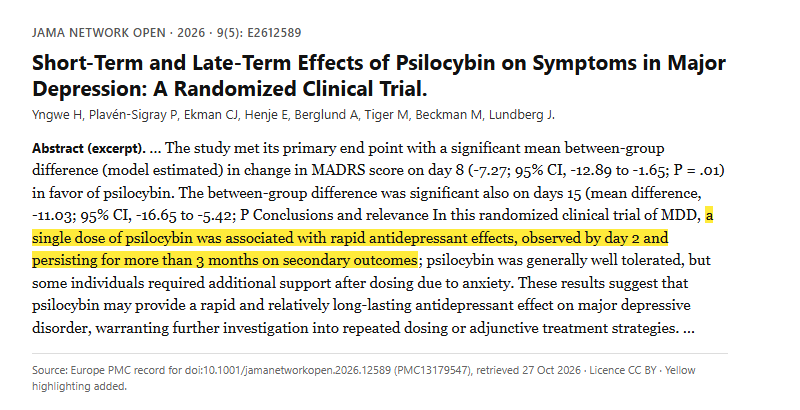
Abstract of the published study (text from Europe PMC), key sentence highlighted in yellow. Source: Yngwe H, Plavén-Sigray P, Ekman CJ, et al. Short-Term and Late-Term Effects of Psilocybin on Symptoms in Major Depression: A Randomized Clinical Trial. JAMA Netw Open. 2026;9(5):e2612589. https://doi.org/10.1001/jamanetworkopen.2026.12589
Study 4. DMT in 34 people with major depressive disorder (Erritzoe, 2026)
A single DMT dose with support lowered depression scores 7.35 points more than placebo at two weeks (P = 0.023)!
Researchers reported that in a phase 2a double-blind trial, 34 adults with moderate-to-severe major depressive disorder given a single intravenous dose of DMT, a short-acting psychedelic, or placebo, with psychotherapeutic support, had a significantly greater fall in MADRS scores with DMT at two weeks (mean difference -7.35; 95% CI -13.62 to -1.08; P = 0.023)! Antidepressant effects persisted up to three months in the open-label phase where all were offered a second DMT dose, and the authors reported adverse events were mostly mild to moderate with none serious.
“At 2 weeks, the DMT group showed a significantly greater reduction in MADRS score than placebo”
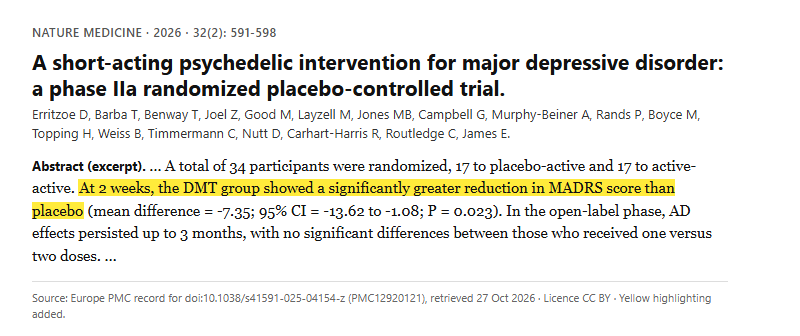
Abstract of the published study (text from Europe PMC), key sentence highlighted in yellow. Source: Erritzoe D, Barba T, Benway T, et al. A short-acting psychedelic intervention for major depressive disorder: a phase IIa randomized placebo-controlled trial. Nat Med. 2026;32(2):591-598. https://doi.org/10.1038/s41591-025-04154-z
Related reading
- Rosenblat JD, Husain MI, Lee Y, et al. The Canadian Network for Mood and Anxiety Treatments (CANMAT) Task Force Report: Serotonergic Psychedelic Treatments for Major Depressive Disorder. Can J Psychiatry. 2023;68(1):5-21. https://doi.org/10.1177/07067437221111371 — A Canadian task force review noting that small psilocybin trials showed superiority to waitlist controls and comparable efficacy to escitalopram in major depression, with preliminary positive ayahuasca results.
- Menon V, Ramamurthy P, Venu S, Andrade C. Randomized Controlled Trials of Psilocybin-Assisted Therapy in the Treatment of Major Depressive Disorder: Systematic Review and Meta-Analysis. Acta Psychiatr Scand. 2025;151(5):557-571. https://doi.org/10.1111/acps.13778 — Pools six randomized psilocybin trials (427 participants) and reports a pooled effect favoring psilocybin-assisted therapy, with response and remission risk ratios of 3.42 and 3.66.
Related pages on this site
Depressive Disorders · Treatment-Resistant Depression · Bipolar Disorder · Anxiety Disorders · Introduction: A New Era · End of Life Distress
This page summarizes published research for education only. It is not medical advice. Any change to a medication remains the decision of that person’s own prescriber.
Keep reading
All Educational Resources · About This Archive · For Practicum Supervisors