


Psychedelics are transforming how researchers think about depression! In a double-blind trial of 30 clinicians, depression scores fell 21.33 points with psilocybin versus 9.33 with an active placebo (P < .001). A second trial of 25 physicians and nurses met its primary endpoint, with psilocybin plus mindfulness beating mindfulness alone (p = 0.008). And a BMJ analysis of 15 trials and 811 participants reported a large effect size (0.88) for high-dose psilocybin against the placebo response in the psychedelic trials, with no more dropouts or severe adverse events than placebo. Encouraging to see careful research continuing, with more studies arriving all the time!
Key studies
Study 1. Psilocybin in 30 clinicians with depressive symptoms after pandemic frontline work (Back, 2024)
Depression scores fell 21.33 points with psilocybin versus 9.33 with niacin in a double-blind trial of 30 clinicians!
Wow: researchers reported that in a double-blind randomized trial of 30 US physicians, advanced practice practitioners and nurses with moderate or severe depressive symptoms after frontline COVID-19 work, a single psilocybin session cut depression scores (MADRS) by 21.33 points at day 28, versus 9.33 with niacin (an active placebo), a 12-point difference (95% CI -17.67 to -6.33; P < .001)! The authors concluded that psilocybin therapy resulted in a significant, sustained reduction in depression symptoms, and no serious adverse events were reported.
“Psilocybin therapy resulted in a significant, sustained reduction in symptoms of depression experienced by clinicians after frontline work during the COVID-19 pandemic.”
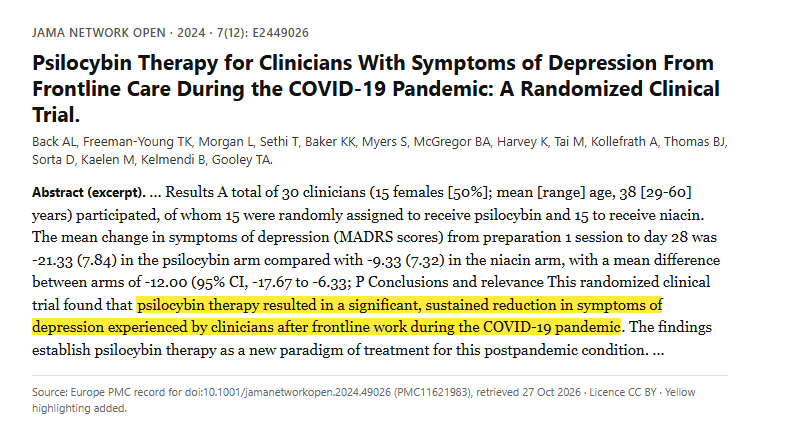
Abstract of the published study (text from Europe PMC), key sentence highlighted in yellow. Source: Back AL, Freeman-Young TK, Morgan L, et al. Psilocybin Therapy for Clinicians With Symptoms of Depression From Frontline Care During the COVID-19 Pandemic: A Randomized Clinical Trial. JAMA Netw Open. 2024;7(12):e2449026. https://doi.org/10.1001/jamanetworkopen.2024.49026
Study 2. Group psilocybin-assisted therapy with mindfulness training in 25 physicians and nurses with depression and burnout (Lewis, 2025)
Psilocybin plus mindfulness beat mindfulness alone for depression, and the trial met its primary endpoint (p = 0.008)!
Researchers reported that the trial met its primary endpoint! Among 25 physicians and nurses with depression and burnout symptoms after frontline COVID-19 work, adding group psilocybin-assisted therapy to an eight-week mindfulness-based stress reduction (MBSR) course produced a significantly larger fall in depressive symptoms (QIDS-SR-16) two weeks after treatment than MBSR alone (between-groups effect 4.6; 95% CI 1.51 to 7.70; p = 0.008). The authors described clinically significant improvement with no serious adverse events, and suggested that combining psilocybin with mindfulness training may be a promising treatment for depression and burnout in physicians and nurses.
“The MBSR + PAP arm evidenced a significantly larger decrease in QIDS-SR-16 score than the MBSR-only arm from baseline to 2-weeks post-intervention”
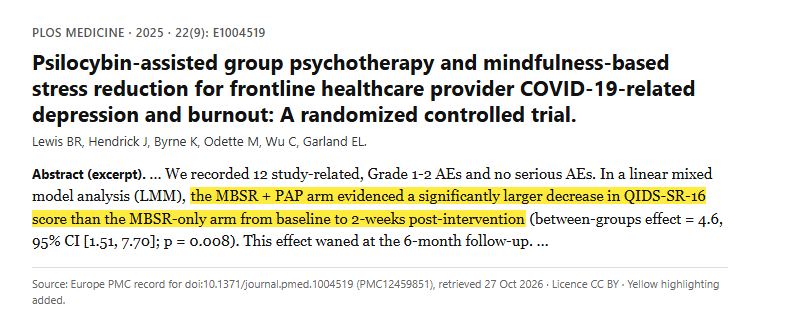
Abstract of the published study (text from Europe PMC), key sentence highlighted in yellow. Source: Lewis BR, Hendrick J, Byrne K, Odette M, Wu C, Garland EL. Psilocybin-assisted group psychotherapy and mindfulness-based stress reduction for frontline healthcare provider COVID-19-related depression and burnout: A randomized controlled trial. PLoS Med. 2025;22(9):e1004519. https://doi.org/10.1371/journal.pmed.1004519
Study 3. Psychedelics compared with escitalopram in 811 participants with depressive symptoms across 15 trials (Hsu, 2024)
Most psychedelics beat placebo across 15 trials and 811 participants, with a large effect size of 0.88 for high-dose psilocybin in the psychedelic trials!
Researchers reported, in a systematic review and network meta-analysis of randomized trials of psilocybin, LSD, MDMA and ayahuasca (15 trials, 811 participants) and of escitalopram (five trials, 1,968 participants) in adults with depressive symptoms, that most psychedelics were better than placebo in the psychedelic trials, with a large effect size (0.88) for high-dose psilocybin against the placebo response in those trials! High-dose psilocybin was also better than placebo in the escitalopram-trial comparison (mean difference 6.45 on the Hamilton scale; credible interval 3.19 to 9.41), and no treatment was linked with more dropouts or severe adverse events than placebo.
“Patients treated with high dose psilocybin showed better responses than those treated with placebo in the antidepressant trials”
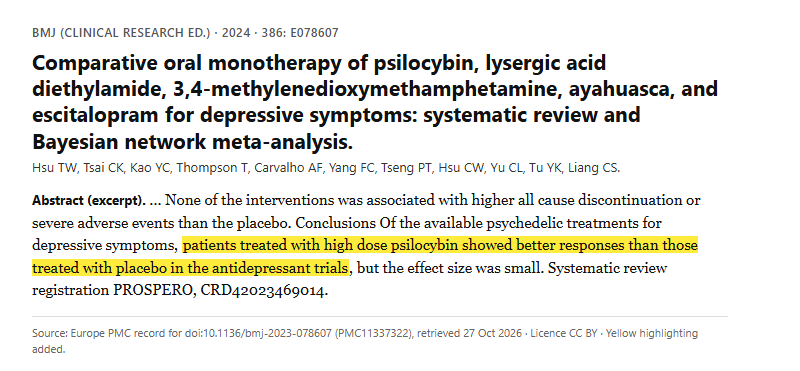
Abstract of the published study (text from Europe PMC), key sentence highlighted in yellow. Source: Hsu TW, Tsai CK, Kao YC, et al. Comparative oral monotherapy of psilocybin, lysergic acid diethylamide, 3,4-methylenedioxymethamphetamine, ayahuasca, and escitalopram for depressive symptoms: systematic review and Bayesian network meta-analysis. BMJ. 2024;386:e078607. https://doi.org/10.1136/bmj-2023-078607
Related reading
- Lam RW, Kennedy SH, Adams C, et al. Canadian Network for Mood and Anxiety Treatments (CANMAT) 2023 Update on Clinical Guidelines for Management of Major Depressive Disorder in Adults. Can J Psychiatry. 2024;69(9):641-687. https://doi.org/10.1177/07067437241245384 — The 2023 CANMAT guideline for depression in adults: evidence-informed, personalized, shared-decision care spanning psychological, lifestyle, digital and neuromodulation treatments.
- Fang S, Yang X, Zhang W. Efficacy and acceptability of psilocybin for primary or secondary depression: A systematic review and meta-analysis of randomized controlled trials. Front Psychiatry. 2024;15:1359088. https://doi.org/10.3389/fpsyt.2024.1359088 — Pools eight randomized psilocybin trials (524 adults) and reports a large effect size in favor of psilocybin (Hedges' g -0.89), with both short-term and long-term antidepressant effects.
Related pages on this site
Major Depressive Disorder · Treatment-Resistant Depression · Bipolar Disorder · Anxiety Disorders · Introduction: A New Era · End of Life Distress
This page summarizes published research for education only. It is not medical advice. Any change to a medication remains the decision of that person’s own prescriber.
Keep reading
All Educational Resources · About This Archive · For Practicum Supervisors