


Psychedelic research is shining a hopeful light on the bonds between partners! In the first systematic review of psychedelics and intimacy, positive intimacy outcomes were reported in all nine laboratory studies (Bradford, 2025). In a survey of 798 participants, including 81 couples, taking a psychedelic together was linked to improved physical intimacy, emotional closeness and satisfaction (Cornelius, 2026). In a pilot of six couples where one partner had PTSD, both partners reported gains in relational support and social intimacy, maintained through 6-month follow-up (Wagner, 2021). Nine couple therapists across four modalities described ketamine helping couples enhance trust and communicate frankly (Avruch, 2026). Encouraging to see couple therapy becoming a growing part of psychedelic research!
Key studies
Study 1. Systematic review of 19 studies on psychedelic use and intimacy (Bradford, 2025)
Positive intimacy outcomes were reported in all nine laboratory studies of psychedelics!
Researchers screened 5,902 studies and identified 19 that met the inclusion criteria, spanning placebo-controlled experiments, quasi-experimental designs and retrospective self-reports. Strikingly, positive intimacy-related outcomes were reported in all nine laboratory studies, including relationship satisfaction, connectedness, emotional disclosure, empathy and affiliation, as well as decreased social anxiety. Six of the 10 self-report studies also identified positive experiences such as relationship quality, interconnection, empathy and closeness. The authors concluded that the review demonstrates overwhelmingly positive effects of psychedelic use in research-controlled settings.
“Positive intimacy-related outcomes were reported in all nine laboratory setting studies, including relationship satisfaction, connectedness, emotional disclosure, empathy, and affiliation, as well as decreased social anxiety. Of the 10 studies that relied solely on retrospective self-report, six identified positive intimacy-related experiences including relationship quality, interconnection, empathy, and closeness.”
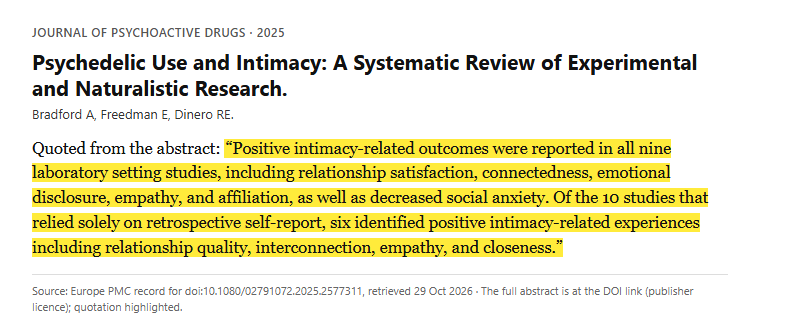
Quotation from the abstract of the published study (text from Europe PMC), highlighted in yellow. Source: Bradford A, Freedman E, Dinero RE. Psychedelic Use and Intimacy: A Systematic Review of Experimental and Naturalistic Research. J Psychoactive Drugs. 2025:1-12. https://doi.org/10.1080/02791072.2025.2577311
Study 2. Couples therapy (CBCT) combined with MDMA-assisted sessions in 6 couples where one partner had PTSD (Wagner, 2021)
Both partners reported gains in post-traumatic growth, relational support and social intimacy, maintained through 6-month follow-up!
In this pilot trial, six romantic dyads in which one partner had PTSD received Cognitive Behavioral Conjoint Therapy combined with two MDMA psychotherapy sessions, with outcomes assessed at mid-treatment, post-treatment, and 3- and 6-month follow-up. Both partners reported improvements in post-traumatic growth, relational support and social intimacy, and partners reported reduced behavioral accommodation and conflict in the relationship. Patients with PTSD also reported improved psychosocial functioning and empathic concern, and these improvements were maintained throughout the follow-up period. The authors conclude the approach had a significant effect on relational and growth outcomes and lends support to treating PTSD dyadically.
“Both partners reported improvements in post-traumatic growth, relational support, and social intimacy. Partners reported reduced behavioral accommodation and conflict in the relationship, and patients with PTSD reported improved psychosocial functioning and empathic concern. These improvements were maintained throughout the follow-up period.”
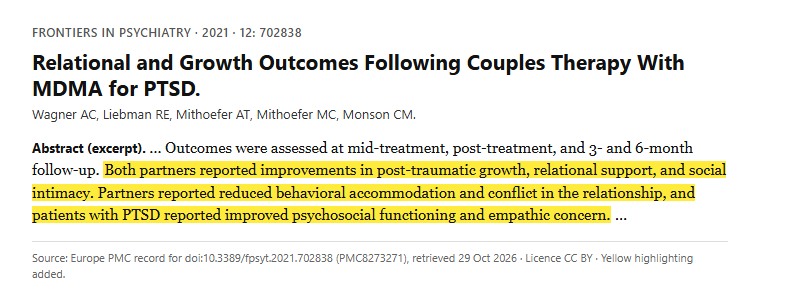
Abstract of the published study (text from Europe PMC), key sentence highlighted in yellow. Source: Wagner AC, Liebman RE, Mithoefer AT, et al. Relational and Growth Outcomes Following Couples Therapy With MDMA for PTSD. Front Psychiatry. 2021;12:702838. https://doi.org/10.3389/fpsyt.2021.702838
Study 3. Survey of 798 participants (81 couples) comparing psychedelic use with versus without a romantic partner (Cornelius, 2026)
In 798 participants, taking a psychedelic together was linked to greater emotional closeness, intimacy and satisfaction!
In a survey of 798 participants, including 81 couples, researchers compared taking a psychedelic with a romantic partner against not taking it together. Multilevel dyadic analyses provided what the authors called overwhelming support for the hypothesis that shared use is associated with greater shared reality and more positive relational changes, including improved physical intimacy, emotional closeness and satisfaction. Shared reality mediated these positive relational changes, and the authors highlight a socially informed approach with potential to increase the effectiveness of psychedelic therapies.
“Multilevel dyadic analyses provided overwhelming support for hypotheses that taking a psychedelic together would be associated with greater shared reality and more positive relational changes (e.g. improved physical intimacy, emotional closeness, satisfaction). Shared reality mediated positive relational changes.”
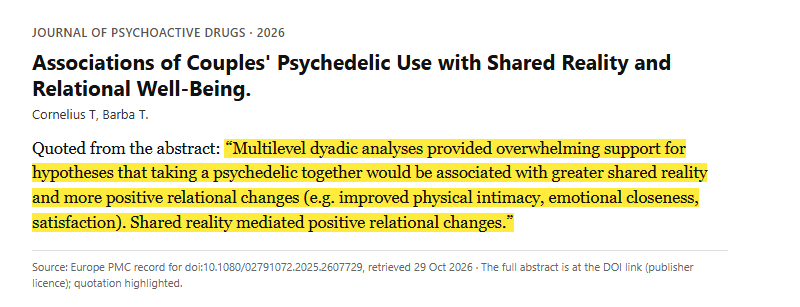
Quotation from the abstract of the published study (text from Europe PMC), highlighted in yellow. Source: Cornelius T, Barba T. Associations of Couples' Psychedelic Use with Shared Reality and Relational Well-Being. J Psychoactive Drugs. 2026:1-11. https://doi.org/10.1080/02791072.2025.2607729
Study 4. In-depth interviews with 8 adult couples who use MDMA together in their committed relationships (Colbert, 2023)
Eight committed couples described MDMA giving their relationship better communication, intimate bonding and a "tune up"!
Researchers conducted confidential in-depth interviews with eight adult couples who use MDMA privately within their committed relationships. Couples described making purposeful decisions about use and collaborating to prepare physically and emotionally together. They reported positive effects on communication and intimate bonding, a relationship "tune up," and other durable changes to the relationship. The authors describe an emerging cognitive-relational model of "evenings with Molly" for relational enhancement.
“Couples described positive effects on communication, intimate bonding, and providing a relationship "tune up," among other durable changes to the relationship.”
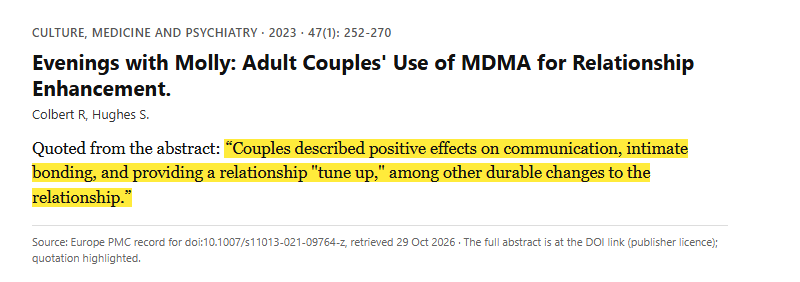
Quotation from the abstract of the published study (text from Europe PMC), highlighted in yellow. Source: Colbert R, Hughes S. Evenings with Molly: Adult Couples' Use of MDMA for Relationship Enhancement. Cult Med Psychiatry. 2023;47(1):252-270. https://doi.org/10.1007/s11013-021-09764-z
Study 5. Interviews with 9 psychotherapists using ketamine-assisted couple therapy (Avruch, 2026)
9 couple therapists across four modalities described ketamine helping couples enhance trust and communicate frankly!
In this phenomenological study, researchers interviewed 9 psychotherapists, representing four different modalities of couple therapy, who are incorporating ketamine into their work with couples. Respondents described ketamine's ability to help couples reduce fearfulness, deepen emotional expression, communicate frankly, enhance trust, gain perspective on relational dysfunction and address issues related to trauma. The study contributes to the emerging subfield of psychedelic-assisted couple therapy.
“This phenomenological analysis sought data from psychotherapists ( n = 9), representing four different modalities of couple therapy, who are incorporating ketamine into their work with dyads. Qualitative interviews revealed substantial diversity with respect to how and why respondents are using ketamine to facilitate attachment processes. Study respondents described ketamine's ability to help couples reduce fearfulness, deepen emotional expression, communicate frankly, enhance trust, gain perspective on relational dysfunction, and address issues related to trauma.”
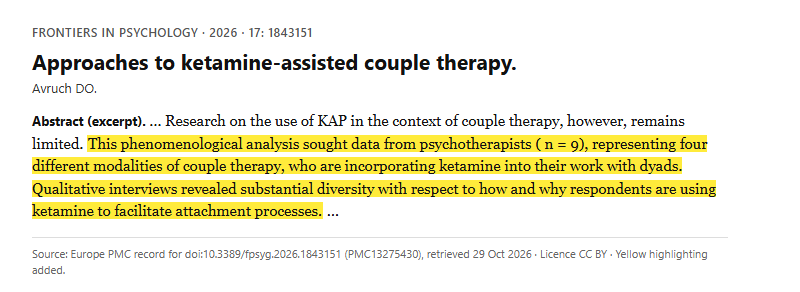
Abstract of the published study (text from Europe PMC), key sentence highlighted in yellow. Source: Avruch DO. Approaches to ketamine-assisted couple therapy. Front Psychol. 2026;17:1843151. https://doi.org/10.3389/fpsyg.2026.1843151
Study 6. Couple interviews and diaries on how heterosexual couples use MDMA together (Anderson, 2019)
Across three couple interviews, two diary interviews and eight written diaries, MDMA emerged as a unique 'date night' that revitalises couples' connection!
Researchers analysed three couple interviews, two diary interviews and eight written diaries describing heterosexual couples' shared MDMA practices. Couples set these experiences apart from daily life through ritual and timing, reenchanting everyday spaces and protecting an emotionally intense space for the two of them. The authors conclude that shared MDMA use forms part of a spectrum of relationship 'work' practices, a unique kind of 'date night' that revitalises couples' connection and transforms couple as well as individual practices.
“This paper claims that MDMA use forms part of a spectrum of relationship 'work' practices; a unique kind of 'date night' that revitalises couples' connection. Hence, MDMA should be recognised as transforming couple as well as individual practices.”
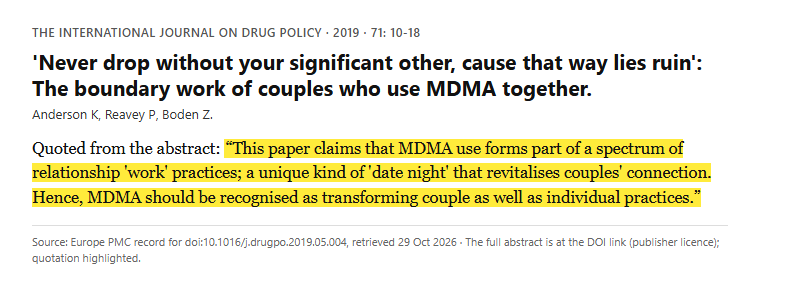
Quotation from the abstract of the published study (text from Europe PMC), highlighted in yellow. Source: Anderson K, Reavey P, Boden Z. 'Never drop without your significant other, cause that way lies ruin': The boundary work of couples who use MDMA together. Int J Drug Policy. 2019;71:10-18. https://doi.org/10.1016/j.drugpo.2019.05.004
Related pages on this site
Social Connection and Relationships · PTSD · Set and Setting · Wellness of the 'Well'
This page summarizes published research for education only. It is not medical advice. Any change to a medication remains the decision of that person’s own prescriber.
Keep reading
All Educational Resources · About This Archive · For Practicum Supervisors