


Psychedelic research is reaching functional neurological disorder (FND), and the early numbers are striking! A systematic review of nine studies with 26 patients found that 69% (n = 18) made at least some recovery with psycholytic therapy, psychotherapy with adjunctive psychedelics (Butler, 2020). A scoping review of 55 unique studies of classic psychedelics in functional disorders found functional neurological symptoms were the most studied category, and 60.7% demonstrated improvement (Bhagavan, 2026). A systematic review of thirteen studies of ketamine and esketamine reported improvement in some patients with functional motor symptoms and functional dissociative seizures (Tamilson, 2026). Encouraging to see registered psilocybin trials now planned or underway!
Key studies
Study 1. Systematic review of nine studies (1954–1967) of psycholytic therapy in 26 patients with functional neurological disorder (Butler, 2020)
69% of patients treated with psychedelic-assisted psychotherapy made at least some recovery!
Researchers systematically reviewed every study of psychedelics in functional neurological disorder (formerly conversion disorder) and identified nine studies published between 1954 and 1967, with a total of 26 patients. Most patients received a course of psychotherapy with adjunctive psychedelics, an approach known as psycholytic therapy. Remarkably, 69% (18 patients) were found to have made at least some recovery on clinician-rated criteria. The authors highlight that modern theories of the disorder focus on aberrant somatic self-representation, the very kind of neural circuitry psychedelics are thought to modify, making this an exciting and unexplored treatment avenue.
“In most cases, patients received a course of psychotherapy with variable adjunctive administration of psychedelics (in a combination known as 'psycholytic therapy'), with protocols varying between studies. Of those treated, 69% ( n = 18) were found to have made at least some recovery on heterogeneous and subjective clinician-rated criteria.”
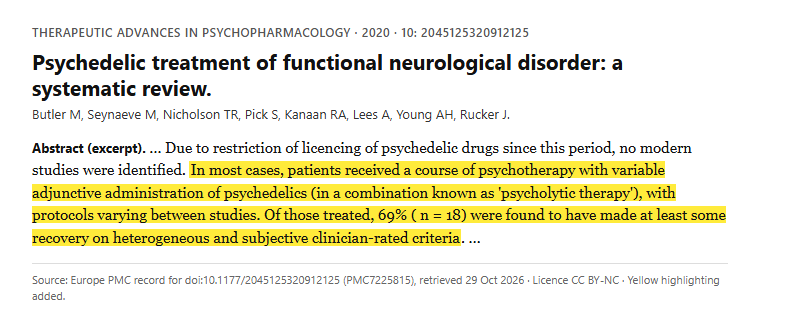
Abstract of the published study (text from Europe PMC), key sentence highlighted in yellow. Source: Butler M, Seynaeve M, Nicholson TR, et al. Psychedelic treatment of functional neurological disorder: a systematic review. Ther Adv Psychopharmacol. 2020;10:2045125320912125. https://doi.org/10.1177/2045125320912125
Study 2. Scoping review of 55 studies of classic psychedelics in functional disorders (Bhagavan, 2026)
60.7% demonstrated improvement in this review of psychedelics for functional disorders!
Researchers searched four databases and the World Health Organisation trials registry and identified 62 reports from 55 unique studies of classic psychedelics in functional disorders, including 33 completed clinical studies and 10 registered trials. Functional neurological symptoms were the most common category of functional disorder studied, and the review reports that 60.7% demonstrated improvement. The registered trials now planned or underway all use psilocybin, and most include comparator or control groups.
“Functional neurological symptoms represented the most common category of functional disorder studied. 60.7% demonstrated improvement.”
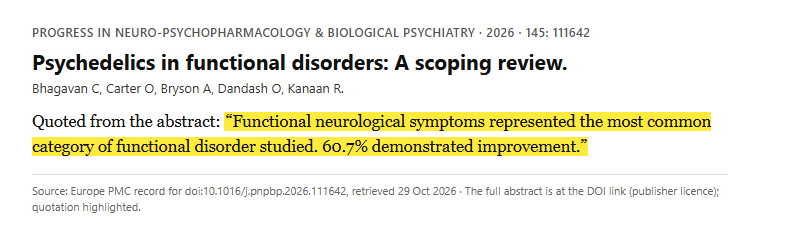
Quotation from the abstract of the published study (text from Europe PMC), highlighted in yellow. Source: Bhagavan C, Carter O, Bryson A, et al. Psychedelics in functional disorders: A scoping review. Prog Neuropsychopharmacol Biol Psychiatry. 2026;145:111642. https://doi.org/10.1016/j.pnpbp.2026.111642
Study 3. Systematic review of 13 studies, mostly case reports and small case series, of ketamine and esketamine in functional neurological disorder (Tamilson, 2026)
Thirteen studies, mostly case reports and small case series, reported improvement in some patients with functional motor symptoms, functional dissociative seizures and other functional presentations after ketamine or esketamine!
Researchers systematically searched PubMed, PsycINFO and Google Scholar up to December 2025 and identified thirteen studies reporting clinical outcomes after ketamine or esketamine in functional neurological symptoms. Across the included studies, some patients were reported to improve in functional motor symptoms, functional dissociative seizures and other functional presentations. The authors noted that improvements in functional symptoms have been reported across several FND presentations.
“Across the included studies, some patients were reported to experience improvement in functional motor symptoms, functional dissociative seizures, and other functional presentations following ketamine or esketamine administration.”
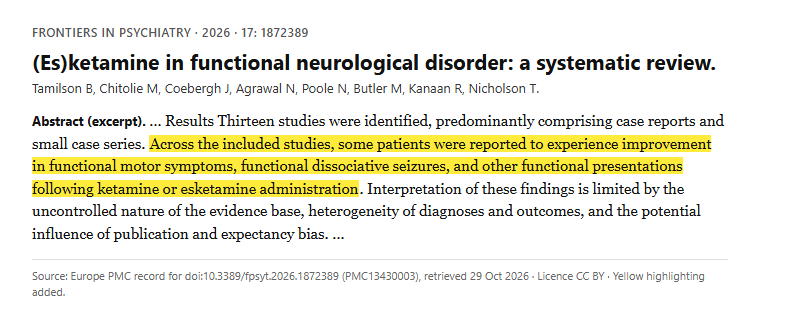
Abstract of the published study (text from Europe PMC), key sentence highlighted in yellow. Source: Tamilson B, Chitolie M, Coebergh J, et al. (Es)ketamine in functional neurological disorder: a systematic review. Front Psychiatry. 2026;17:1872389. https://doi.org/10.3389/fpsyt.2026.1872389
Related pages on this site
Neurological Injury · Fibromyalgia · Chronic Pain · Brain Imaging Research · Anxiety Disorders
This page summarizes published research for education only. It is not medical advice. Any change to a medication remains the decision of that person’s own prescriber.
Keep reading
All Educational Resources · About This Archive · For Practicum Supervisors