

Psychedelic research is getting more inclusive! Across 39 studies and 1,393 participants, researchers found greater inclusion of minoritized groups since 2018, which they called progress toward equity. In 21 randomized trials, gender was reported 100% of the time and race or ethnicity 76%, and MDMA trials enrolled more diverse samples. Participants valued supportive touch for connection and grounding, and Oregon's first year of regulated psilocybin services reached 5,935 clients, including 27.2% LGBTQ+ individuals. Encouraging to see researchers asking these questions openly, so that future care can be safer and fairer for everyone.
Key studies
Study 1. Ethnoracial inclusion in psychedelic treatment studies with 1,393 participants (Hughes, 2024)
Across 39 studies and 1,393 participants, researchers found greater inclusion of minoritized groups since 2018: progress toward equity!
Researchers systematically reviewed studies published from 1994 to May 2024 that tested a psychedelic treatment for a psychiatric or substance use disorder, tallying how 1,393 participants across 39 studies identified by race and ethnicity. Researchers reported greater proportions of ethnic minoritized participants in studies since 2018, particularly in studies conducted in the USA, and a decrease in the proportion of White to non-White participants in US studies over the same period! The authors said this indicates progress toward equity in psychedelic research.
“there were greater proportions of ethnic minoritized populations included in studies since 2018, particularly in studies conducted in the USA”
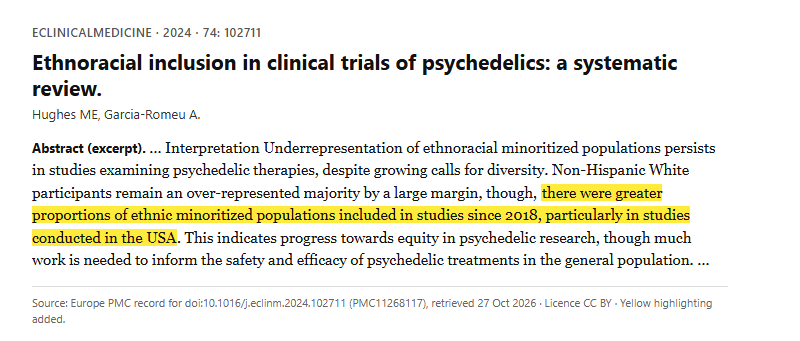
Abstract of the published study (text from Europe PMC), key sentence highlighted in yellow. Source: Hughes ME, Garcia-Romeu A. Ethnoracial inclusion in clinical trials of psychedelics: a systematic review. EClinicalMedicine. 2024;74:102711. https://doi.org/10.1016/j.eclinm.2024.102711
Study 2. Participant diversity in 21 randomized trials with 1,034 participants (Haft, 2025)
100% of 21 randomized psychedelic therapy trials reported participant gender and 76% reported race or ethnicity, and MDMA trials enrolled more diverse samples!
Researchers systematically reviewed 21 randomized controlled trials of psilocybin- and MDMA-assisted therapy, with 1,034 participants in all, to see which participant characteristics were reported. Researchers reported that gender was reported in 100% of the trials, race or ethnicity in 76% and socioeconomic status in 57%, and that MDMA trials enrolled more diverse participant samples than psilocybin trials! The authors called for more inclusive recruitment strategies and rigorous reporting to improve the generalizability of the research.
“MDMA trials enrolled more diverse participant samples than psilocybin trials.”
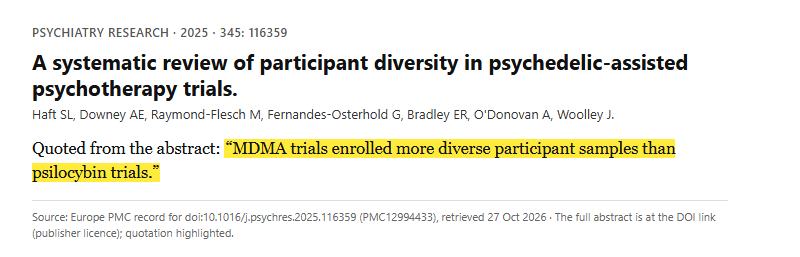
Abstract of the published study (text from Europe PMC), key sentence highlighted in yellow. Source: Haft SL, Downey AE, Raymond-Flesch M, et al. A systematic review of participant diversity in psychedelic-assisted psychotherapy trials. Psychiatry Res. 2025;345:116359. https://doi.org/10.1016/j.psychres.2025.116359
Study 3. Supportive touch in psilocybin-assisted therapy, in 18 trial participants (Ham, 2026)
Most of 18 psilocybin-trial participants valued supportive touch for connection and grounding, and several reported therapeutic benefit directly attributable to it!
Researchers held 39 interviews with 18 people taking part in a large randomized trial of psilocybin-assisted therapy that allowed protocol-defined supportive touch, before and after dosing sessions. Researchers reported that most valued having touch available, particularly after firsthand experience, describing its capacity to foster emotional connection and provide grounding, and that several perceived therapeutic benefit directly attributable to it! They concluded that therapeutic touch may support emotional safety and affect regulation, with acceptability linked to the quality of the therapeutic relationship and robust consent processes.
“Therapeutic touch may support emotional safety and affect regulation during acute psychedelic states.”
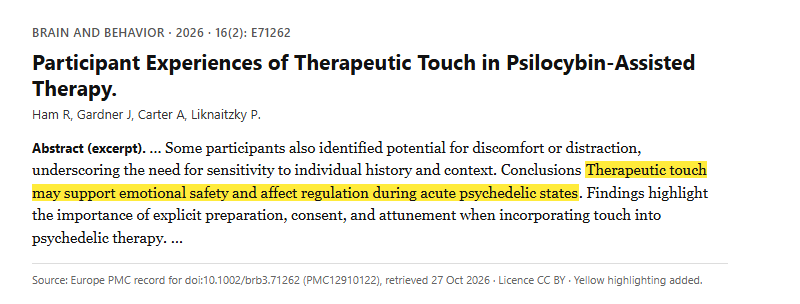
Abstract of the published study (text from Europe PMC), key sentence highlighted in yellow. Source: Ham R, Gardner J, Carter A, Liknaitzky P. Participant Experiences of Therapeutic Touch in Psilocybin-Assisted Therapy. Brain Behav. 2026;16(2):e71262. https://doi.org/10.1002/brb3.71262
Study 4. Oregon's first year of regulated psilocybin services, with 5,935 clients (Yu, 2026)
Oregon's first year of regulated psilocybin services reached 5,935 clients in 5,375 sessions, including 27.2% LGBTQ+ individuals and 57.4% women!
Researchers analyzed statewide aggregate data from the Oregon Psilocybin Services public dashboard for 1 January to 31 December 2025, covering service volume, client demographics and motivations. Researchers reported that 5,935 clients took part in 5,375 sessions, that the largest age segment was 35 to 49 (about 40%), and that women (57.4%) and LGBTQ+ individuals (27.2%) represented substantial portions of the annual cohort! The authors noted that the program successfully reaches sexual and gender minorities and that full-year data indicate stabilized utilization.
“women (57.4%) and LGBTQ+ individuals (27.2%) represented substantial portions of the annual cohort.”
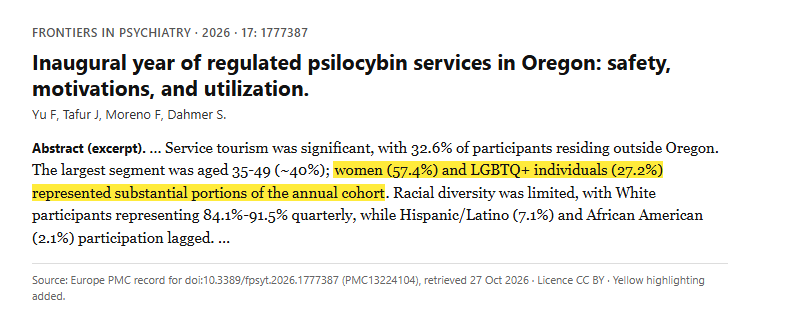
Abstract of the published study (text from Europe PMC), key sentence highlighted in yellow. Source: Yu F, Tafur J, Moreno F, Dahmer S. Inaugural year of regulated psilocybin services in Oregon: safety, motivations, and utilization. Front Psychiatry. 2026;17:1777387. https://doi.org/10.3389/fpsyt.2026.1777387
Related reading
- Rea K, Wallace B. Enhancing equity-oriented care in psychedelic medicine: Utilizing the EQUIP framework. Int J Drug Policy. 2021;98:103429. https://doi.org/10.1016/j.drugpo.2021.103429 — Shows how the EQUIP Health Care approach (cultural safety, harm reduction, trauma- and violence-informed care) can make psychedelic medicine more equitable.
- Lee A, Rosenbaum D, Buchman DZ. Informed Consent to Psychedelic-Assisted Psychotherapy: Ethical Considerations. Can J Psychiatry. 2024;69(5):309-313. https://doi.org/10.1177/07067437231225937 — An ethics paper on informed consent to psychedelic-assisted psychotherapy, in the Canadian Journal of Psychiatry.
Related pages on this site
Safety and Risk Management · Public Health and Prevention · Health Economics and Coverage · Implementation and Service Delivery · Medication Safety Screening · Harm Reduction in Practice · Introduction: A New Era
This page summarizes published research for education only. It is not medical advice. Any change to a medication remains the decision of that person’s own prescriber.
Keep reading
All Educational Resources · About This Archive · For Practicum Supervisors