

Psilocybin therapy is moving from trials into real services! In Oregon's regulated program, 92.2% of 321 clients felt they benefited at one month and 58.6% ranked the experience among the 10 most meaningful of their lives. In an NHS trial, depression scores were 10.41 points lower with psilocybin at week 3, sustained at week 6, and a group therapy trial in physicians and nurses met its primary endpoint. Canadian hospital professionals viewed psilocybin-assisted therapy favorably. Encouraging to see careful research continuing on how these services might reach people responsibly.
Key studies
Study 1. Oregon's state-regulated psilocybin services in 346 clients (Korthuis, 2026)
92.2% of 321 Oregon psilocybin-service clients felt they benefited, and 58.6% ranked it among the 10 most meaningful experiences of their lives!
In a cohort study at 24 of Oregon's 26 licensed psilocybin service centers, researchers followed 346 clients supported by 83 licensed facilitators, using confidential reports at baseline and one week, one month and three months after sessions. Researchers reported that at one month 92.2% (296 of 321) felt they benefited and 58.6% (188 of 321) ranked the experience among the 10 most meaningful of their lives, with 90.2% retained at three months, when moderate-to-severe depression, anxiety and PTSD symptoms were reported at relative risks of 0.40, 0.29 and 0.35 compared with baseline! The journal has since corrected the article; the figures summarized here are the same in the corrected version.
“At 1 month, 92.2% (296 of 321 participants) felt they benefited”
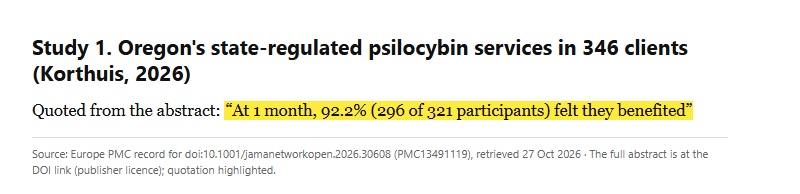
Abstract of the published study (text from Europe PMC), key sentence highlighted in yellow. Source: Korthuis PT, Cook RR, Gregoire D, et al. Safety and Mental Health Outcomes of Oregon State-Regulated Psilocybin Services. JAMA Netw Open. 2026;9(8):e2630608. https://doi.org/10.1001/jamanetworkopen.2026.30608
Study 2. Psilocybin therapy at a National Health Service site in 60 adults with treatment-resistant depression (Rucker, 2026)
In an NHS feasibility trial, depression scores were 10.41 points lower with psilocybin than placebo at week 3 (MADRS), sustained at week 6, and 59 of 60 completed every follow-up!
In a double-blind, randomized, placebo-controlled feasibility trial at one National Health Service site in England, researchers gave 60 adults with treatment-resistant depression psilocybin or placebo, with preparation, dosing support and integration. Researchers reported that 59 of 60 participants completed the depression rating at every follow-up visit, and that the adjusted between-group difference at week 3 was -10.41 points on the MADRS (95% CI -14.86 to -5.95; Cohen's d = -1.70), favoring psilocybin and sustained at week 6! The authors said the findings support a future confirmatory trial.
“The adjusted between-group difference at week 3 on the MADRS was -10.41 (95% confidence interval: -14.86 to -5.95; Cohen's d = -1.70), favoring psilocybin”
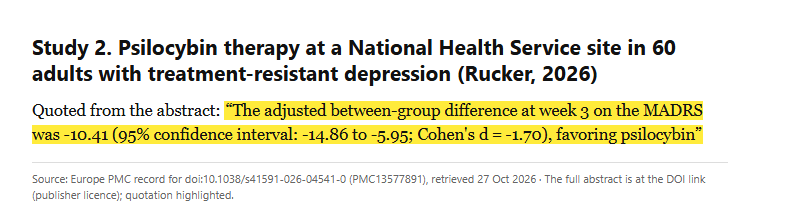
Abstract of the published study (text from Europe PMC), key sentence highlighted in yellow. Source: Rucker JJ, Mantingh T, Kerr-Gaffney J, et al. Psilocybin-assisted therapy for treatment-resistant major depressive disorder in a public healthcare setting: a randomized controlled trial. Nat Med. 2026;32(9):3430-3437. https://doi.org/10.1038/s41591-026-04541-0
Study 3. Group psilocybin therapy plus mindfulness training in 25 physicians and nurses with depression and burnout (Lewis, 2025)
Group psilocybin therapy plus mindfulness met its primary endpoint in physicians and nurses: a 4.6-point larger drop in depressive symptoms at 2 weeks than with mindfulness training alone!
In a randomized controlled trial, researchers assigned 25 frontline physicians and nurses with symptoms of depression and burnout to an eight-week mindfulness-based stress reduction (MBSR) course alone or the same course plus group psilocybin-assisted psychotherapy. Researchers reported that the trial met its primary endpoint, with a significantly larger decrease in depressive symptoms (QIDS-SR-16) two weeks after the program in the combination group (between-groups effect = 4.6, 95% CI 1.51 to 7.70; p = 0.008)! The authors described the combination as associated with clinically significant improvement in depressive symptoms and suggested it may represent a promising treatment for depression and burnout among physicians and nurses.
“This trial met its primary endpoint: group psilocybin-assisted therapy plus MBSR was associated with clinically significant improvement in depressive symptoms”
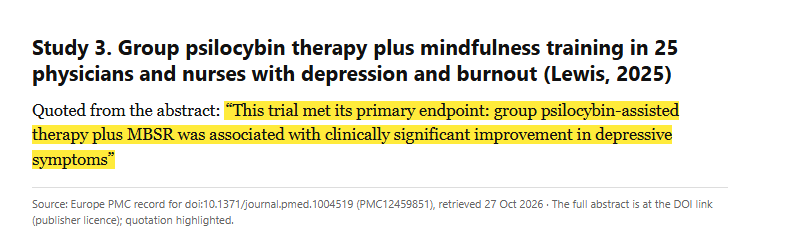
Abstract of the published study (text from Europe PMC), key sentence highlighted in yellow. Source: Lewis BR, Hendrick J, Byrne K, et al. Psilocybin-assisted group psychotherapy and mindfulness-based stress reduction for frontline healthcare provider COVID-19-related depression and burnout: A randomized controlled trial. PLoS Med. 2025;22(9):e1004519. https://doi.org/10.1371/journal.pmed.1004519
Study 4. Psilocybin-assisted therapy implementation studied in 10 professionals at a Canadian hospital (Dorval, 2026)
Hospital professionals viewed psilocybin-assisted therapy favorably, with delivery estimated at a relatively modest 2,648 to 5,827 Canadian dollars per patient, excluding the drug itself!
In a single-case implementation study at a large university-affiliated hospital in Canada, researchers interviewed 10 professionals in clinical and managerial roles during the first year after psilocybin-assisted therapy was introduced for people with advanced cancer, and estimated the cost of delivering it. Researchers reported that participants viewed the therapy favorably, that perceived clinical relevance and institutional leadership were seen as important facilitators, and that delivering a complete intervention was estimated at 2,648 to 5,827 Canadian dollars per patient, excluding the psilocybin itself! The authors described the estimated costs as relatively modest.
“From the health care system perspective, the estimated cost of delivering a complete PAT intervention ranged from 2648 to 5827 Canadian dollars (CAD) per patient”
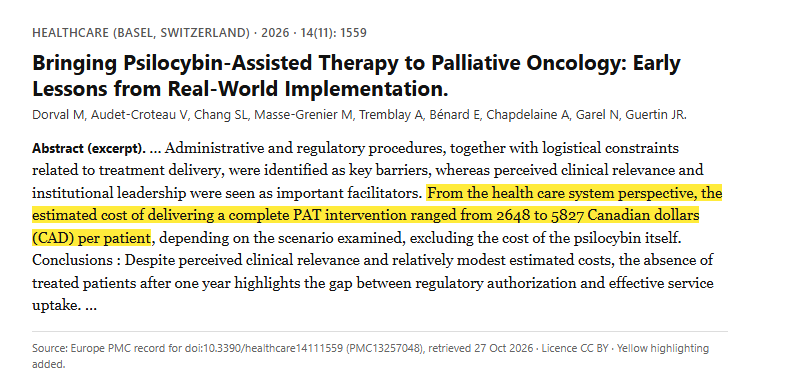
Abstract of the published study (text from Europe PMC), key sentence highlighted in yellow. Source: Dorval M, Audet-Croteau V, Chang SL, et al. Bringing Psilocybin-Assisted Therapy to Palliative Oncology: Early Lessons from Real-World Implementation. Healthcare (Basel). 2026;14(11):1559. https://doi.org/10.3390/healthcare14111559
Related reading
- Smith KA, Harcourt E, Cipriani A. Psychedelics in NHS services: exploring a model for real-world implementation of psilocybin. Br J Psychiatry. Published online 2026. https://doi.org/10.1192/bjp.2026.10612 — Outlines a model for delivering psychological support with psilocybin in publicly funded health services such as the NHS, aiming for equitable access for all.
- Gründer G, Mertens LJ, Spangemacher M, et al. Psychedelics: The pathway to implementation in the European healthcare systems. Eur Neuropsychopharmacol. 2026;102:41-48. https://doi.org/10.1016/j.euroneuro.2025.11.007 — Explains how health technology assessment can open the way to reimbursement and access, and how a unified European approach could promote equitable access across countries.
Related pages on this site
Safety and Risk Management · Public Health and Prevention · Equity and Ethics · Health Economics and Coverage · Medication Safety Screening · Harm Reduction in Practice · Introduction: A New Era
This page summarizes published research for education only. It is not medical advice. Any change to a medication remains the decision of that person’s own prescriber.
Keep reading
All Educational Resources · About This Archive · For Practicum Supervisors