

The economics are looking good! A model of MDMA-assisted therapy for 1,000 people with severe PTSD estimated $132.9 million in net health-care savings over 30 years, with treatment costs breaking even at 3.8 years. In a Canadian model, ketamine saved CA$1,663 to $3,413 compared with ECT while adding quality-adjusted life years, and ketamine was dominant (less costly, more effective) from a health-sector view alongside a randomized, double-blind trial. Psilocybin therapy delivered the highest quality-adjusted life years of every option modelled. Encouraging to see careful research weighing value and fairness as these treatments are studied.
Key studies
Study 1. MDMA-assisted therapy costs modelled for a hypothetical 1,000 people with severe PTSD (Marseille, 2022)
MDMA-assisted therapy for 1,000 people with severe PTSD: $132.9 million in modelled net health-care savings over 30 years, 4,856 QALYs gained and 61.4 premature deaths averted!
Researchers used results from a phase 3 trial of 90 people with severe PTSD, sponsored by the Multidisciplinary Association for Psychedelic Studies (MAPS), to model costs and health benefits for a hypothetical 1,000 patients over 30 years from a US payer's point of view. Researchers reported discounted net health-care savings of $132.9 million, 4,856 quality-adjusted life years (QALYs) gained and 61.4 premature deaths averted, with treatment costs breaking even at 3.8 years while delivering 887 QALYs! The authors concluded that MDMA-assisted therapy was cost-saving from a payer's perspective while delivering substantial clinical benefit.
“Compared to standard of care for 1,000 patients, MDMA-AT generates discounted net health care savings of $132.9 million over 30 years”
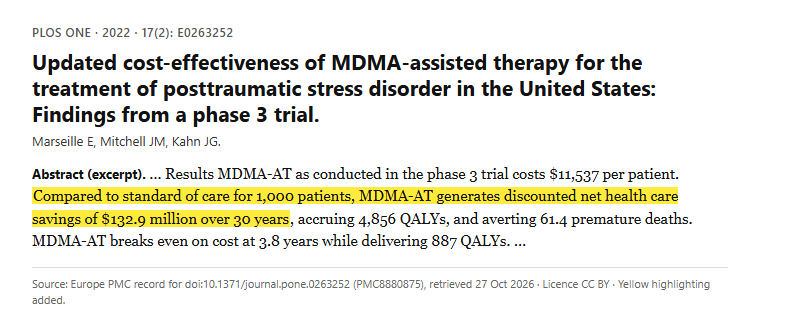
Abstract of the published study (text from Europe PMC), key sentence highlighted in yellow. Source: Marseille E, Mitchell JM, Kahn JG. Updated cost-effectiveness of MDMA-assisted therapy for the treatment of posttraumatic stress disorder in the United States: Findings from a phase 3 trial. PLoS One. 2022;17(2):e0263252. https://doi.org/10.1371/journal.pone.0263252
Study 2. Ketamine compared with ECT for treatment-resistant depression in a Canadian cost model (Lebenbaum, 2026)
Ketamine saved CA$1,663 (health-care view) and $3,413 (societal view) versus ECT, while adding quality-adjusted life years!
Researchers used a decision model to compare racemic ketamine with electroconvulsive therapy (ECT) for treatment-resistant depression over 29 weeks, from Canadian health-care and societal perspectives. Researchers reported higher health-related quality of life with ketamine (incremental QALY 0.024) and lower costs, CA$1,663 less from a health-care view and $3,413 less from a societal view, and that in nearly all one-way sensitivity analyses ketamine was cost-effective relative to ECT! The authors concluded that ketamine provided additional QALYs while saving costs, and that health plans that cover all costs of ECT should also cover all costs of ketamine treatment for treatment-resistant depression.
“Ketamine provided additional QALYs while saving costs relative to ECT for treatment-resistant depression.”
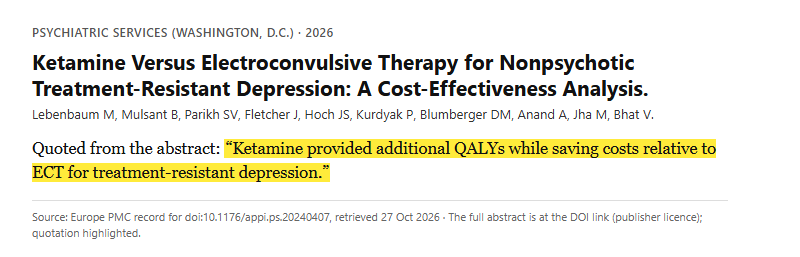
Abstract of the published study (text from Europe PMC), key sentence highlighted in yellow. Source: Lebenbaum M, Mulsant B, Parikh SV, et al. Ketamine Versus Electroconvulsive Therapy for Nonpsychotic Treatment-Resistant Depression: A Cost-Effectiveness Analysis. Psychiatr Serv. 2026. https://doi.org/10.1176/appi.ps.20240407
Study 3. Subcutaneous ketamine costs in 174 participants with treatment-resistant depression (Chatterton, 2025)
In a trial of 174 adults with treatment-resistant depression, ketamine scored higher on quality of life than the active control (0.435 vs 0.352) in the response-guided dosing group, and was dominant (less costly and more effective) from a health-sector view, with a 91% probability of falling below $50,000 per QALY!
Researchers ran a cost analysis alongside the KADS randomized, double-blind trial, in which 174 participants with treatment-resistant depression received subcutaneous ketamine or an active control (midazolam) twice weekly for four weeks. Researchers reported that in the health-sector base case that counted control-arm costs, ketamine was dominant (less costly, more effective), with probabilities of falling below $50,000 per QALY of 89% at the end of the trial and 91% across eight weeks, and that utility values in the second cohort were significantly higher for ketamine than for the control treatment (0.435 vs. 0.352)! The authors concluded that the initial four-week ketamine phase appeared cost-effective from a health sector perspective.
“At end of RCT, cohort 2 utility values were significantly higher for ketamine than the control treatment (0.435 vs. 0.352; p < 0.05).”
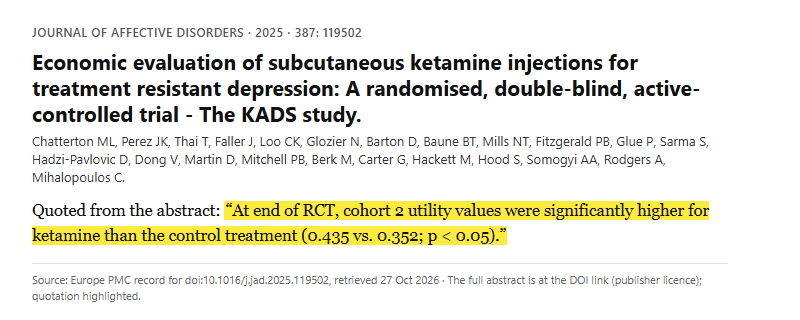
Abstract of the published study (text from Europe PMC), key sentence highlighted in yellow. Source: Chatterton ML, Perez JK, Thai T, et al. Economic evaluation of subcutaneous ketamine injections for treatment resistant depression: A randomised, double-blind, active-controlled trial - The KADS study. J Affect Disord. 2025;387:119502. https://doi.org/10.1016/j.jad.2025.119502
Study 4. Psilocybin-assisted therapy costs in a decision model for severe depression (McCrone, 2023)
Psilocybin therapy had the highest QALYs (0.310) of every option modelled, and improved cost-effectiveness from a societal perspective!
Researchers built a six-month decision model comparing psilocybin-assisted psychotherapy with conventional medication, cognitive behavioural therapy (CBT), or both; the work was funded by Drug Science, Clerkenwell Health (a company that runs psychedelic trials) and Policy at Manchester. Researchers reported that psilocybin delivered the highest quality-adjusted life years (0.310, compared with 0.278 to 0.287 for the other options), that it was shown to be cost-effective when therapist support costs were reduced by 50% and the drug price fell to £400 to £800 per person, and that its cost-effectiveness improved from a societal perspective! The authors concluded that psilocybin has the potential to be a cost-effective therapy for severe depression.
“QALYs were highest for psilocybin (0.310), followed by CBT alone (0.283), conventional medication alone (0.278), and their combination (0.287).”
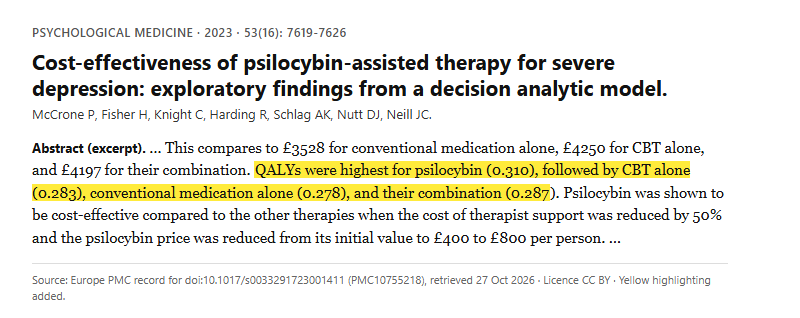
Abstract of the published study (text from Europe PMC), key sentence highlighted in yellow. Source: McCrone P, Fisher H, Knight C, et al. Cost-effectiveness of psilocybin-assisted therapy for severe depression: exploratory findings from a decision analytic model. Psychol Med. 2023;53(16):7619-7626. https://doi.org/10.1017/s0033291723001411
Related reading
- Ochigbo EB, Beinfeld MT, Chambers JD. Balancing Evidence and Need: Variation in US Commercial Payer Coverage of Esketamine. Clin Ther. 2024;46(10):808-811. https://doi.org/10.1016/j.clinthera.2024.06.017 — Maps how 18 large US health plans cover esketamine, a useful guide for making access clearer and fairer.
Related pages on this site
Safety and Risk Management · Public Health and Prevention · Equity and Ethics · Implementation and Service Delivery · Medication Safety Screening · Harm Reduction in Practice · Introduction: A New Era
This page summarizes published research for education only. It is not medical advice. Any change to a medication remains the decision of that person’s own prescriber.
Keep reading
All Educational Resources · About This Archive · For Practicum Supervisors