

Safety research keeps delivering good news! A review of 114 studies and 3,504 participants reported serious adverse events for no healthy participants and for about 4% of participants with preexisting neuropsychiatric disorders, with no reports of deaths by suicide in contemporary research settings, and concluded that classic psychedelics were generally well tolerated. Among 9,233 past-year magic mushroom users, just 0.2% sought emergency medical treatment, and all but one of those returned to normal within 24 hours. Research guidelines report that persisting adverse reactions are rare when screening, preparation and supportive settings are in place. Encouraging to see researchers paying closer attention to safety as the field grows!
Key studies
Study 1. Psilocybin after escitalopram or placebo in 23 healthy volunteers (Becker, 2022)
Psilocybin's positive mood effects were unchanged after two weeks of escitalopram in 23 healthy volunteers, with less anxiety too!
In a randomized, double-blind, placebo-controlled crossover study, 23 healthy volunteers each received psilocybin twice: once after two weeks of the antidepressant escitalopram and once after two weeks of placebo! Researchers reported that escitalopram had no relevant effect on the positive mood effects of psilocybin and significantly reduced bad drug effects, anxiety and cardiovascular effects. The one severe adverse event reported in the study was judged unrelated to the study treatments.
“Escitalopram pretreatment had no relevant effect on positive mood effects of psilocybin”
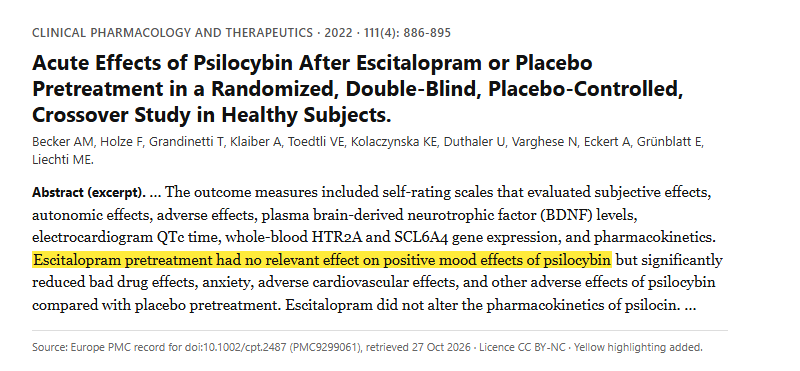
Abstract of the published study (text from Europe PMC), key sentence highlighted in yellow. Source: Becker AM, Holze F, Grandinetti T, et al. Acute Effects of Psilocybin After Escitalopram or Placebo Pretreatment in a Randomized, Double-Blind, Placebo-Controlled, Crossover Study in Healthy Subjects. Clin Pharmacol Ther. 2022;111(4):886-895. https://doi.org/10.1002/cpt.2487
Study 2. Classic psychedelics in 3,504 participants across 114 studies (Hinkle, 2024)
Classic psychedelics were generally well tolerated, with serious adverse events reported for no healthy participants in a review of 114 studies and 3,504 people!
Researchers systematically reviewed 214 studies in which LSD, psilocybin, DMT or 5-MeO-DMT was given in clinical or research settings, and analyzed adverse-event data from 114 studies covering 3,504 participants! They reported serious adverse events for no healthy participants and for approximately 4% of participants with preexisting neuropsychiatric disorders (including worsening depression, suicidal behavior, psychosis and convulsive episodes), nonserious events needing medical intervention being similarly rare, and no reports of deaths by suicide, persistent psychotic disorders or hallucinogen persisting perception disorders in contemporary research settings. The authors concluded that classic psychedelics were generally well tolerated in clinical or research settings.
“In this systematic review and meta-analysis, classic psychedelics were generally well tolerated in clinical or research settings”
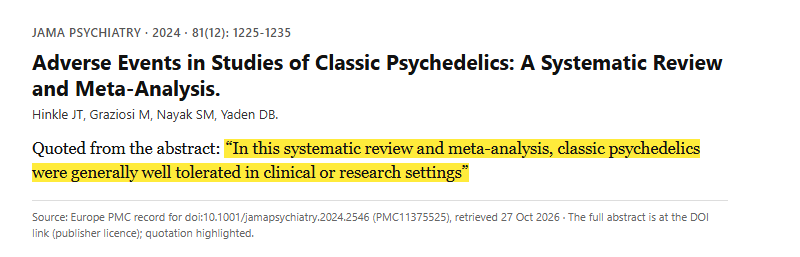
Abstract of the published study (text from Europe PMC), key sentence highlighted in yellow. Source: Hinkle JT, Graziosi M, Nayak SM, Yaden DB. Adverse Events in Studies of Classic Psychedelics: A Systematic Review and Meta-Analysis. JAMA Psychiatry. 2024;81(12):1225-1235. https://doi.org/10.1001/jamapsychiatry.2024.2546
Study 3. Magic mushrooms in 9,233 people reporting past-year use in a global online survey (Kopra, 2022)
Only 0.2% of 9,233 past-year magic mushroom users sought emergency medical treatment, and all but one of those were back to normal within 24 hours!
Researchers analyzed answers from 9,233 people who reported using magic mushrooms in the past year in the 2017 Global Drug Survey, a large anonymous online survey! They reported that just 19 people (0.2%) had sought emergency medical treatment, with a per-event risk estimate of 0.06%, and that all but one returned to normal within 24 hours. The most common symptoms were anxiety or panic and paranoia, younger age was linked with higher risk, and the most-reported reasons were mindset, setting and mixing substances, with the authors noting that harm-reduction information likely plays a key role in preventing such incidents.
“The results confirm psilocybin mushrooms are a relatively safe drug, with serious incidents rare and short lasting.”
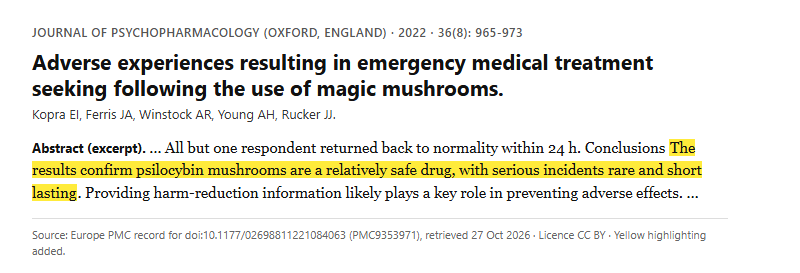
Abstract of the published study (text from Europe PMC), key sentence highlighted in yellow. Source: Kopra EI, Ferris JA, Winstock AR, Young AH, Rucker JJ. Adverse experiences resulting in emergency medical treatment seeking following the use of magic mushrooms. J Psychopharmacol. 2022;36(8):965-973. https://doi.org/10.1177/02698811221084063
Study 4. Psychedelic use in 608 people who reported extended difficulties afterward (Evans, 2023)
In 608 people who reported difficulties, a guided setting predicted a narrower range of difficulties and knowing the dose and drug type predicted shorter ones!
Researchers gathered survey answers and written accounts from 608 people who reported difficulties continuing after a psychedelic experience, and found clear protective patterns! They reported that shorter difficulties were linked with knowing the dose and drug type and with lower difficulty during the experience, and that taking the drug in a guided setting was linked with a narrower range of difficulties. The most common difficulties were anxiety and fear, existential struggle and social disconnection, and for about a third of this group they lasted over a year, which makes these protective factors worth knowing.
“A narrower range of difficulties was predicted by taking the drug in a guided setting”
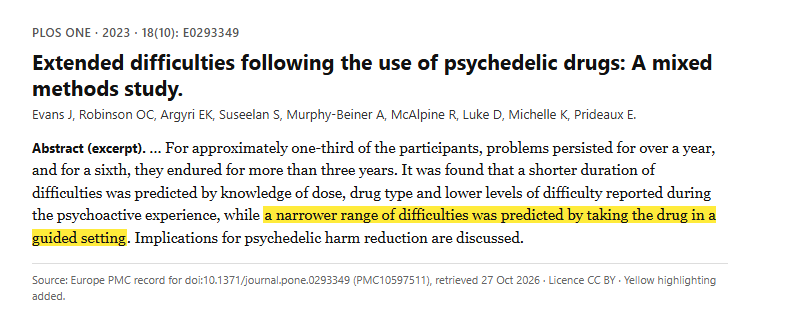
Abstract of the published study (text from Europe PMC), key sentence highlighted in yellow. Source: Evans J, Robinson OC, Argyri EK, et al. Extended difficulties following the use of psychedelic drugs: A mixed methods study. PLoS One. 2023;18(10):e0293349. https://doi.org/10.1371/journal.pone.0293349
Related reading
- Johnson M, Richards W, Griffiths R. Human hallucinogen research: guidelines for safety. J Psychopharmacol. 2008;22(6):603-620. https://doi.org/10.1177/0269881108093587 — Widely cited safeguards for research sessions (careful screening, preparation, a suitable physical setting, in-session support and follow-up); the authors report persisting adverse reactions are rare when research follows them.
- Breeksema JJ, Kuin BW, Kamphuis J, van den Brink W, Vermetten E, Schoevers RA. Adverse events in clinical treatments with serotonergic psychedelics and MDMA: A mixed-methods systematic review. J Psychopharmacol. 2022;36(10):1100-1117. https://doi.org/10.1177/02698811221116926 — A systematic review of 44 articles and 598 patients finding treatments overall well tolerated, and noting that challenging experiences may also be therapeutically beneficial.
Related pages on this site
Public Health and Prevention · Equity and Ethics · Health Economics and Coverage · Implementation and Service Delivery · Medication Safety Screening · Harm Reduction in Practice · Introduction: A New Era
This page summarizes published research for education only. It is not medical advice. Any change to a medication remains the decision of that person’s own prescriber.
Keep reading
All Educational Resources · About This Archive · For Practicum Supervisors