


Psychedelics are showing up well in the population data! In a survey of 130,152 US adults, researchers found no significant link between lifetime psychedelic use and higher rates of any mental health problem, and in several cases lower rates. Across more than 190,000 adults, classic psychedelic use was linked to significantly reduced odds of suicidal thinking, planning and attempts. Among 9,233 past-year magic mushroom users, just 0.2% sought emergency care, and poison-center encounters stay far below those for other mushrooms and toxic plants. Encouraging to see careful research guiding prevention and harm reduction.
Key studies
Study 1. Lifetime psychedelic use in 130,152 US survey respondents (Krebs, 2013)
130,152 US adults surveyed: no significant link between lifetime psychedelic use and increased rates of any mental health outcome, and lower rates in several cases!
Researchers analyzed four years (2001 to 2004) of a US national drug-use survey covering 130,152 adults, comparing those who reported ever using LSD, psilocybin, mescaline or peyote with those who had not, and adjusting for other drug use, risk taking and trauma exposure. Researchers reported no significant associations between lifetime psychedelic use and increased rates of psychological distress, mental health treatment or symptoms of eight psychiatric disorders, and in several cases psychedelic use was associated with lower rates! The authors concluded they found psychedelic use was not an independent risk factor for mental health problems.
“We did not find use of psychedelics to be an independent risk factor for mental health problems.”
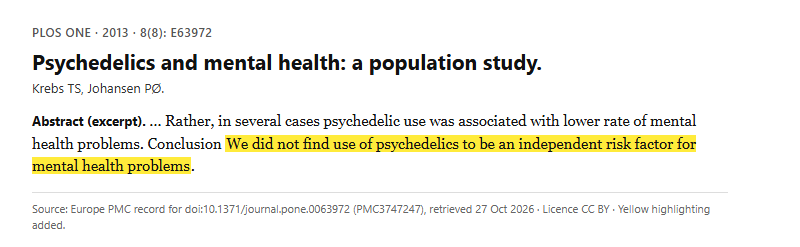
Abstract of the published study (text from Europe PMC), key sentence highlighted in yellow. Source: Krebs TS, Johansen PØ. Psychedelics and mental health: a population study. PLoS One. 2013;8(8):e63972. https://doi.org/10.1371/journal.pone.0063972
Study 2. Classic psychedelic use and suicidality in over 190,000 US adults (Hendricks, 2015)
Among 190,000+ US adults, lifetime classic psychedelic use was linked to significantly reduced odds of psychological distress, suicidal thinking, planning and attempts!
Researchers pooled five years (2008 to 2012) of the US National Survey on Drug Use and Health, covering over 190,000 adults, and examined classic psychedelic use alongside psychological distress and suicidality while controlling for a range of covariates. Researchers reported that lifetime classic psychedelic use was associated with significantly reduced odds of past-month psychological distress (weighted OR 0.81), past-year suicidal thinking (0.86), suicidal planning (0.71) and suicide attempt (0.64)!
“Lifetime classic psychedelic use was associated with a significantly reduced odds of past month psychological distress”
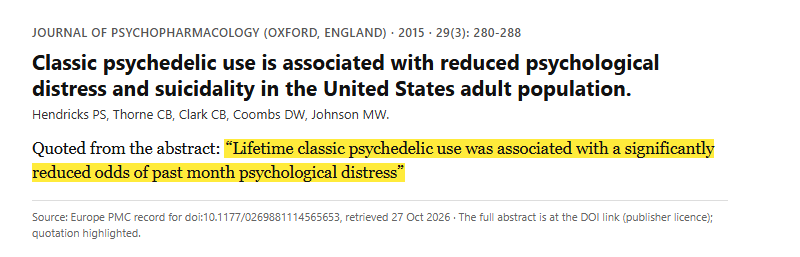
Abstract of the published study (text from Europe PMC), key sentence highlighted in yellow. Source: Hendricks PS, Thorne CB, Clark CB, Coombs DW, Johnson MW. Classic psychedelic use is associated with reduced psychological distress and suicidality in the United States adult population. J Psychopharmacol. 2015;29(3):280-288. https://doi.org/10.1177/0269881114565653
Study 3. Magic mushroom use in 9,233 people in a global drug survey (Kopra, 2022)
Only 0.2% (19 of 9,233) past-year magic mushroom users sought emergency care, and all but one returned to normal within 24 hours!
Researchers used the 2017 Global Drug Survey, a large anonymous online survey, to ask 9,233 people who had used psilocybin ('magic') mushrooms in the past year whether they had sought emergency medical treatment. Researchers reported that just 19 people (0.2%) had, with a per-event risk estimate of 0.06%, and that all but one respondent returned to normality within 24 hours! The authors concluded that serious incidents are rare and short lasting, and that providing harm-reduction information likely plays a key role in prevention.
“The results confirm psilocybin mushrooms are a relatively safe drug, with serious incidents rare and short lasting.”
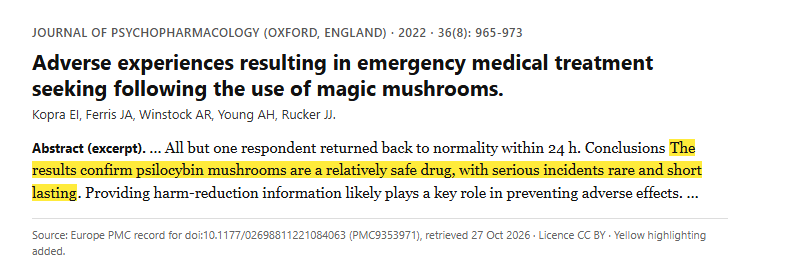
Abstract of the published study (text from Europe PMC), key sentence highlighted in yellow. Source: Kopra EI, Ferris JA, Winstock AR, Young AH, Rucker JJ. Adverse experiences resulting in emergency medical treatment seeking following the use of magic mushrooms. J Psychopharmacol. 2022;36(8):965-973. https://doi.org/10.1177/02698811221084063
Study 4. Psilocybin exposures in 6,933 US poison-control encounters (Montoy, 2025)
Across 2013 to 2022, psilocybin poison-center encounters (6,933) stayed similar to LSD and mescaline and far lower than for other mushrooms and toxic plants!
Researchers reviewed US poison-control records from 2013 to 2022, comparing 6,933 psilocybin-related encounters with those involving LSD, mescaline or peyote, and toxic plants and mushrooms. Researchers reported that across all years, psilocybin-related encounters were similar to those for LSD and mescaline/peyote and far lower than those for other mushrooms and toxic plants! The authors noted that the number of encounters remains low.
“Across all years, the number of psilocybin-related encounters was similar to those for lysergic acid diethylamide and mescaline/peyote”
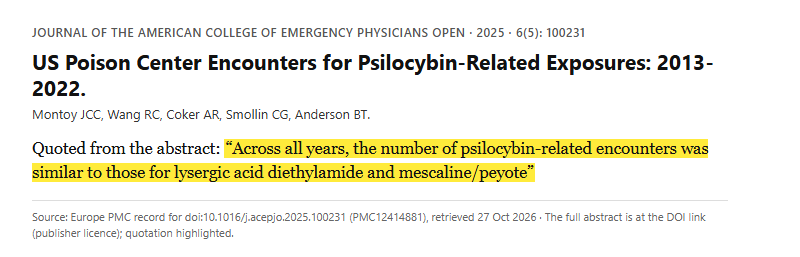
Abstract of the published study (text from Europe PMC), key sentence highlighted in yellow. Source: Montoy JCC, Wang RC, Coker AR, Smollin CG, Anderson BT. US Poison Center Encounters for Psilocybin-Related Exposures: 2013-2022. J Am Coll Emerg Physicians Open. 2025;6(5):100231. https://doi.org/10.1016/j.acepjo.2025.100231
Related reading
- Dutton C, North E, Chun Tie Y, Oliva J, Skeffington P. Harm reduction practises for users of psychedelic drugs: a scoping review. Harm Reduct J. 2025;22(1):158. https://doi.org/10.1186/s12954-025-01264-2 — Maps the many harm-reduction steps people already use before, during and after psychedelic use, pointing to where new tools can help.
Related pages on this site
Safety and Risk Management · Equity and Ethics · Health Economics and Coverage · Implementation and Service Delivery · Medication Safety Screening · Harm Reduction in Practice · Introduction: A New Era
This page summarizes published research for education only. It is not medical advice. Any change to a medication remains the decision of that person’s own prescriber.
Keep reading
All Educational Resources · About This Archive · For Practicum Supervisors