


Psychedelic research is bringing real hope to people carrying the weight of loss! In a three-arm controlled study of 84 adults with severe grief, ayahuasca-assisted meaning reconstruction therapy cut grief severity with a huge effect size of d = 2.44, and the reduction was greater than with therapy alone (between-group d = 0.86) (Soto-Angona, 2025). Among bereaved people attending Shipibo ayahuasca ceremonies, grief severity fell with Cohen's d = 1.39 at 12 months (González, 2020). In a survey of 363 bereaved psychedelic users, grief symptoms improved with a large effect size (Cohen's d = 0.83) (Low, 2024). Encouraging to see researchers now building careful psychedelic-assisted grief therapy protocols!
Key studies
Study 1. Ayahuasca-assisted meaning reconstruction therapy compared with therapy alone and no treatment in 84 adults with severe grief (Soto-Angona, 2025)
Ayahuasca-assisted grief therapy cut grief severity with a huge effect size of d = 2.44!
In this three-arm controlled study, 84 adults experiencing severe grief within 12 months of losing a first-degree relative were allocated to ayahuasca-assisted meaning reconstruction therapy (n = 28), meaning reconstruction therapy alone (n = 28), or no treatment (n = 28). Grief severity fell with a striking effect size of d = 2.44 in the ayahuasca arm, and the reductions were significantly greater than with therapy alone (between-group d = 0.86) and no treatment (between-group d = 1.07). Researchers also reported significant improvements in prolonged grief symptoms, post-traumatic growth, and quality of life, with medium-to-large effect sizes.
“All groups showed significant grief severity reduction (A-MR: p < .0001, d = 2.44; MR: p < .0001, d = 1.84; NT: p < .002, d = 0.74). Greater reductions were observed in the A-MR compared to MR (p = .012, d = 0.86) and NT (p = .0008, d = 1.07). A-MR was also associated with significant improvements in prolonged grief symptomatology, post-traumatic growth, and quality of life, with medium-to-large effect sizes.”
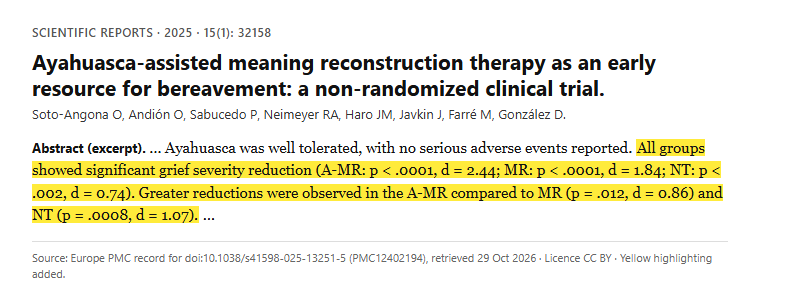
Abstract of the published study (text from Europe PMC), key sentence highlighted in yellow. Source: Soto-Angona O, Andión O, Sabucedo P, et al. Ayahuasca-assisted meaning reconstruction therapy as an early resource for bereavement: a non-randomized clinical trial. Sci Rep. 2025;15(1):32158. https://doi.org/10.1038/s41598-025-13251-5
Study 2. Online-survey follow-up over 1 year of bereaved people attending indigenous Shipibo ayahuasca ceremonies (50 at baseline, 27 at 12 months) (González, 2020)
Grief severity dropped with a large effect of Cohen's d = 1.39 at 12 months after ayahuasca ceremonies!
Researchers followed bereaved people (50 at baseline, 27 by 12 months) who took part in indigenous Shipibo ayahuasca ceremonies at a center in Peru, measuring grief with the Texas Revised Inventory of Grief from baseline through 15 days, 3 months, 6 months and 12 months after the retreat. Grief severity fell significantly at every time point, with effect sizes of Cohen's d = 0.84 at 15 days, 1.38 at 3 months, 1.16 at 6 months and a striking 1.39 at 12 months. The authors concluded that ceremonial ayahuasca use has therapeutic value by reducing the severity of grief, with acceptance and decentering identified as the psychological processes that mediate the improvement.
“A significant decrease in Texas Revised Inventory was observed at all time points (T1: Cohen's d = 0.84; T2: Cohen's d = 1.38; T3: Cohen's d = 1.16; T4: Cohen's d = 1.39).”
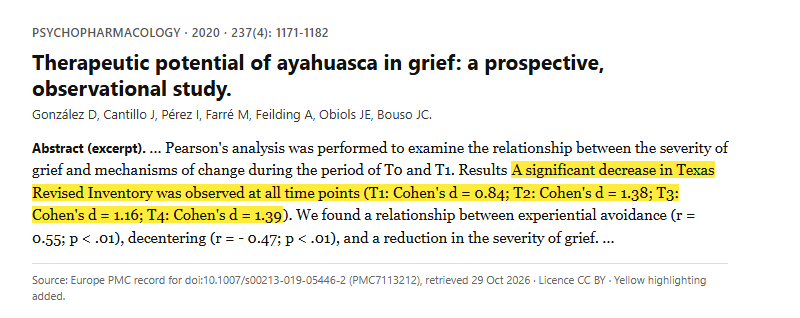
Abstract of the published study (text from Europe PMC), key sentence highlighted in yellow. Source: González D, Cantillo J, Pérez I, et al. Therapeutic potential of ayahuasca in grief: a prospective, observational study. Psychopharmacology (Berl). 2020;237(4):1171-1182. https://doi.org/10.1007/s00213-019-05446-2
Study 3. Retrospective survey of 363 recreational psychedelic users who had a psychedelic experience after a bereavement (Low, 2024)
Grief symptoms improved after a psychedelic experience with a large effect size (Cohen's d = 0.83)!
Researchers surveyed 363 recreational psychedelic users who had suffered a bereavement, asking them to rate their grief symptoms before and after a later psychedelic experience. Grief symptoms improved with a large effect size (Cohen's d = 0.83). Emotional breakthroughs during the experience were positively associated with greater improvements in grief, and the authors concluded that the findings support developing a psychedelic-assisted therapy protocol for grief.
“Results indicate improvements in grief symptoms after a psychedelic experience, with a large effect size (Cohen's d = 0.83).”
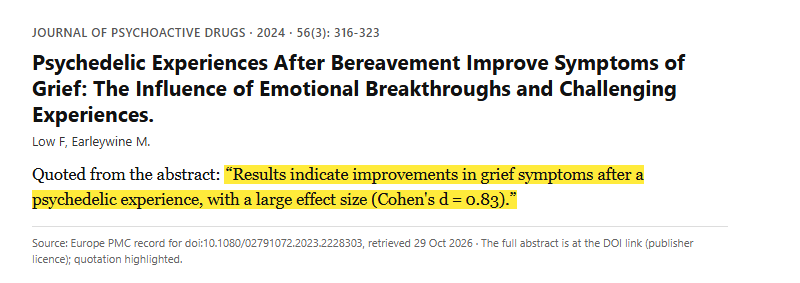
Quotation from the abstract of the published study (text from Europe PMC), highlighted in yellow. Source: Low F, Earleywine M. Psychedelic Experiences After Bereavement Improve Symptoms of Grief: The Influence of Emotional Breakthroughs and Challenging Experiences. J Psychoactive Drugs. 2024;56(3):316-323. https://doi.org/10.1080/02791072.2023.2228303
Study 4. Ayahuasca users compared with peer-support group attendees, 30 bereaved people in each group (González, 2019)
30 bereaved people who took ayahuasca showed lower grief than 30 who attended peer-support groups!
Researchers compared 30 bereaved people who had taken ayahuasca with 30 who had attended peer-support groups, measuring grief and experiential avoidance. The ayahuasca group showed a lower level of grief on the Present Feelings Scale of the Texas Revised Inventory of Grief, with benefits in some psychological and interpersonal dimensions. Participants described experiences of emotional release, biographical memories, and contact with the deceased.
“We compared 30 people who had taken ayahuasca with 30 people who had attended peer-support groups, measuring level of grief and experiential avoidance. We also examined themes in participant responses to an open-ended question regarding their experiences with ayahuasca. The ayahuasca group presented a lower level of grief in the Present Feelings Scale of Texas Revised Inventory of Grief, showing benefits in some psychological and interpersonal dimensions.”
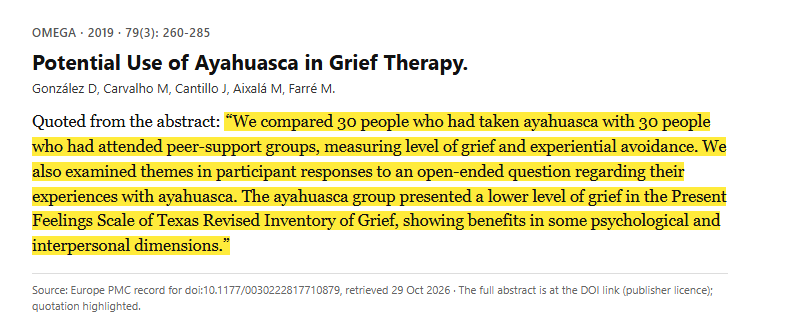
Quotation from the abstract of the published study (text from Europe PMC), highlighted in yellow. Source: González D, Carvalho M, Cantillo J, et al. Potential Use of Ayahuasca in Grief Therapy. Omega (Westport). 2019;79(3):260-285. https://doi.org/10.1177/0030222817710879
Related pages on this site
End of Life Distress · Depressive Disorders · Social Connection and Relationships · Spiritual Wellness
This page summarizes published research for education only. It is not medical advice. Any change to a medication remains the decision of that person’s own prescriber.
Keep reading
All Educational Resources · About This Archive · For Practicum Supervisors