

Healing together is showing remarkable promise! In an Oregon study of group psilocybin therapy for low-income adults, 19 of 20 people completed treatment, participants rated their satisfaction at 4.8 out of 5, and depression scores fell with a strong effect size (Cohen's d = 1.89) (Hicks, 2026). A mixed-methods systematic review of 30 papers covering 22 group therapy protocols reported overall improvement in depression, anxiety and trauma symptoms (Tsang, 2026). Among 886 ceremony participants, a shared sense of togetherness was linked to gains in psychological wellbeing (r = 0.22) and social connectedness (r = 0.25) (Kettner, 2021). A group ketamine-assisted psychotherapy pilot reported 100% retention (Sevelius, 2025). Encouraging to see the group itself becoming part of the healing!
Key studies
Study 1. Open-label group psilocybin therapy in 20 low-income adults with depression in Oregon (Hicks, 2026)
Depression scores fell with a strong effect size (Cohen's d = 1.89) after group psilocybin therapy!
Researchers tested group psilocybin therapy for low-income adults with depression inside Oregon's regulated psilocybin program, enrolling participants in cohorts of six with two online 90-min preparation sessions, two group psilocybin sessions one week apart and online integration after each. Of 20 people who began treatment, 19 completed, and participants rated their satisfaction at a remarkable 4.8 out of 5, reporting moderate to high benefit. Hamilton Depression scores dropped with a strong effect size (Cohen's d = 1.89), and all eight domains of the PROMIS-29 improved, with effect sizes ranging from 0.667 to 1.774.
“Exploratory outcomes include Hamilton Depression scores which demonstrated a significant decrease (t = 8.24, p < 0.001) in a paired t-test and a strong effect size (Cohen's d = 1.89). For the same time periods all eight domains of the PROMIS-29 were significantly improved on paired t-tests at p < .01 with effect sizes ranging from 0.667 to 1.774.”
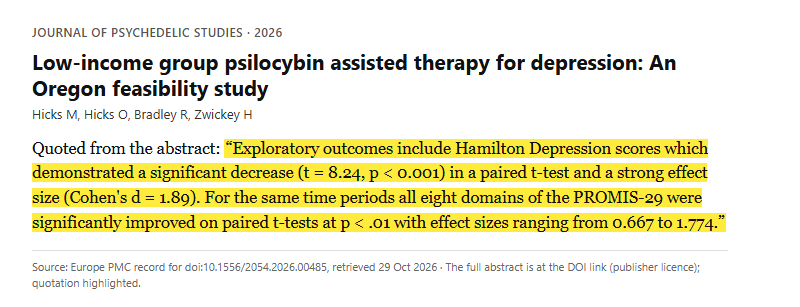
Quotation from the abstract of the published study (text from Europe PMC), highlighted in yellow. Source: Hicks M, Hicks O, Bradley R, Zwickey H. Low-income group psilocybin assisted therapy for depression: An Oregon feasibility study. Journal of Psychedelic Studies. 2026. https://doi.org/10.1556/2054.2026.00485
Study 2. Mixed-methods systematic review of group psychedelic-assisted therapy across 30 papers (Tsang, 2026)
Group psychedelic-assisted therapy showed overall improvement in depression, anxiety and trauma symptoms in a systematic review of 30 papers covering 22 unique group therapy protocols!
Researchers systematically reviewed 30 papers representing 22 unique group psychedelic therapy protocols for adults with a psychiatric diagnosis, fifteen of which reported pre-post outcomes on validated scales. The quantitative results showed overall improvement in depression, anxiety, trauma symptoms, functioning and other psychiatric outcomes. The qualitative results were remarkably complementary, describing gains in mindfulness, emotional processing, psychological flexibility, meaning-making and social connectedness supported by the group format itself.
“Quantitative results showed overall decreases in validated scale outcomes reflecting improvement in depression, anxiety, trauma symptoms, functioning, and other psychiatric outcomes. Qualitative results described improvements in mindfulness, emotional processing, psychological flexibility, meaning-making, and social connectedness supported by the group format.”
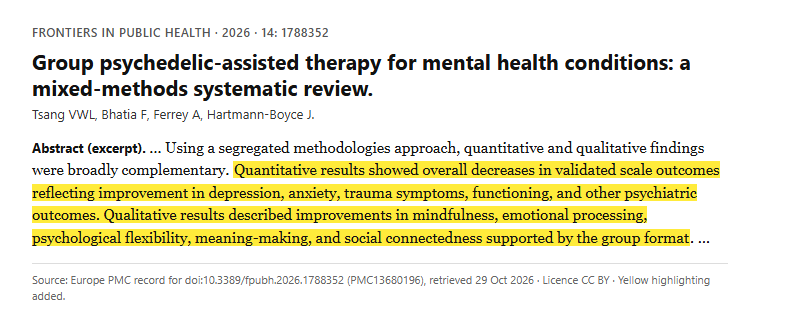
Abstract of the published study (text from Europe PMC), key sentence highlighted in yellow. Source: Tsang VWL, Bhatia F, Ferrey A, Hartmann-Boyce J. Group psychedelic-assisted therapy for mental health conditions: a mixed-methods systematic review. Front Public Health. 2026;14:1788352. https://doi.org/10.3389/fpubh.2026.1788352
Study 3. Survey of shared experience during group psychedelic ceremonies in 886 participants (Kettner, 2021)
In 886 ceremony participants, a sense of togetherness predicted lasting gains in wellbeing and social connectedness!
In this observational study, researchers followed 886 people across five time-points around guided psychedelic group ceremonies and retreats, from 2 weeks before to 4 weeks after. They validated a new Communitas Scale measuring shared togetherness and common humanity (Cronbach's alpha = 0.92). Communitas during ceremony was significantly correlated with increases in psychological wellbeing (r = 0.22) and social connectedness (r = 0.25), and a positive relationship with facilitators and emotional support helped this sense of community emerge.
“Furthermore, communitas during ceremony was significantly correlated with increases in psychological wellbeing (r = 0.22), social connectedness (r = 0.25), and other salient mental health outcomes. Path analyses revealed that the effect of ceremony-communitas on long-term outcomes was fully mediated by communitas experienced in reference to the retreat overall, and that the extent of personal sharing or 'self-disclosure' contributed to this process. A positive relationship between participants and facilitators, and the perceived impact of emotional support, facilitated the emergence of communitas.”
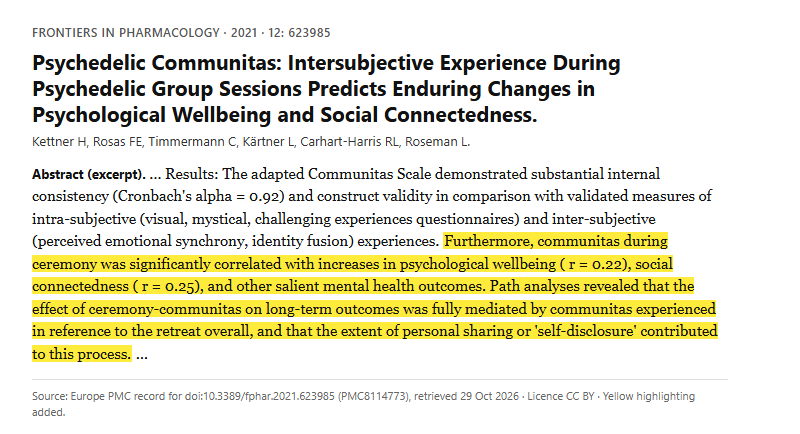
Abstract of the published study (text from Europe PMC), key sentence highlighted in yellow. Source: Kettner H, Rosas FE, Timmermann C, et al. Psychedelic Communitas: Intersubjective Experience During Psychedelic Group Sessions Predicts Enduring Changes in Psychological Wellbeing and Social Connectedness. Front Pharmacol. 2021;12:623985. https://doi.org/10.3389/fphar.2021.623985
Study 4. Brief group therapy course with a single individually dosed psilocybin session in 18 male long-term AIDS survivors (Stauffer, 2021)
Attachment anxiety fell significantly 3 months after a brief group therapy course that included psilocybin!
Researchers offered a brief group therapy course, including a single open-label psilocybin session conducted individually, to 18 male long-term AIDS survivors with moderate-severe demoralization. Self-reported attachment anxiety decreased significantly from baseline to 3 months after the intervention (d = 0.45), a move toward more secure attachment. Baseline attachment anxiety was also strongly correlated with psilocybin-occasioned mystical-type experiences (r = 0.53), pointing to ways of optimizing psilocybin-assisted psychotherapy.
“Self-reported ratings of attachment anxiety decreased significantly from baseline to 3-months post-intervention, t (16) = -2.2; p = 0.045; d rm = 0.45; 95% CI 0.01, 0.87.”
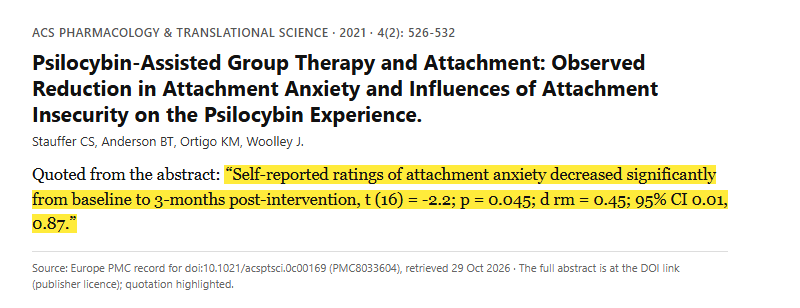
Quotation from the abstract of the published study (text from Europe PMC), highlighted in yellow. Source: Stauffer CS, Anderson BT, Ortigo KM, Woolley J. Psilocybin-Assisted Group Therapy and Attachment: Observed Reduction in Attachment Anxiety and Influences of Attachment Insecurity on the Psilocybin Experience. ACS Pharmacol Transl Sci. 2021;4(2):526-532. https://doi.org/10.1021/acsptsci.0c00169
Study 5. Group ketamine-assisted psychotherapy with cognitive processing therapy in eight transgender and gender-expansive adults (Sevelius, 2025)
100% retention and high satisfaction in the Kindred group ketamine-assisted psychotherapy program!
Researchers ran a nine-week mixed-methods pilot of Kindred, a group-based ketamine-assisted psychotherapy program that alternated ketamine sessions with cognitive processing therapy skills-building and integration sessions, in eight transgender and gender-expansive adults. Retention was a remarkable 100%, with high satisfaction ratings, and participants reported significant reductions in depression, anxiety and cognitive fusion. Participants described group belonging, peer validation and shared identity as therapeutic factors that enhanced the impact of the treatment.
“The intervention was feasible and highly acceptable, with 100% retention and high satisfaction ratings. Participants reported significant reductions in depression, anxiety, and cognitive fusion scores, alongside qualitative reports of decreased shame, suicidality, and internalized transphobia. Participants reported that group belonging, peer validation, and shared identity were important therapeutic factors that enhanced the impact of ketamine and CPT.”
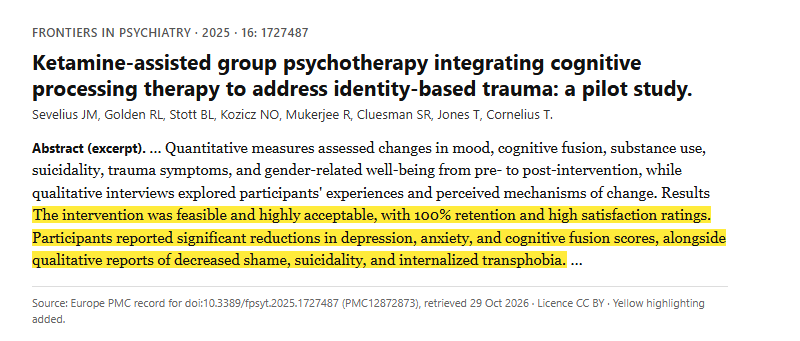
Abstract of the published study (text from Europe PMC), key sentence highlighted in yellow. Source: Sevelius JM, Golden RL, Stott BL, et al. Ketamine-assisted group psychotherapy integrating cognitive processing therapy to address identity-based trauma: a pilot study. Front Psychiatry. 2025;16:1727487. https://doi.org/10.3389/fpsyt.2025.1727487
Study 6. Community-based group therapy with three psychedelic-dose ketamine sessions: interviews with eight Indigenous participants and two Elders (Manson, 2023)
Indigenous participants attributed significant benefits to a community group therapy program with psychedelic-dose ketamine!
In a partnership between Roots to Thrive and the Snuneymuxw First Nation, researchers piloted group-based therapy augmented by three sessions of ketamine at a psychedelic dose for Indigenous participants. Qualitative interviews and anonymous feedback from eight participants and two Elders showed that participants attributed significant benefits to the program. They highlighted the involvement of Indigenous team members, the incorporation of traditional approaches to healing, and open, authentic relationships between group participants and facilitators as key to its success.
“In addition to challenges, participants attributed significant benefits to the program while highlighting the importance of the involvement of Indigenous team members, the incorporation of traditional approaches to healing, and the cultivation of open and authentic relationships between group participants and facilitators.”
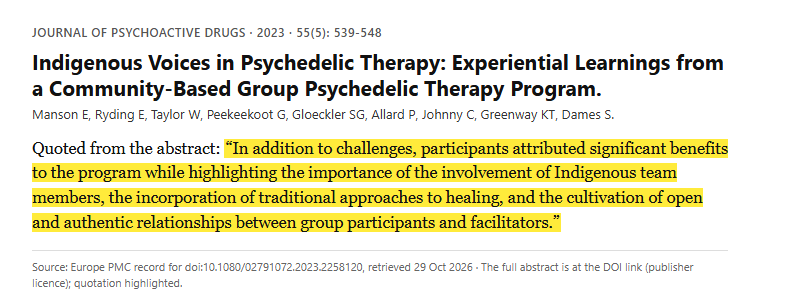
Quotation from the abstract of the published study (text from Europe PMC), highlighted in yellow. Source: Manson E, Ryding E, Taylor W, et al. Indigenous Voices in Psychedelic Therapy: Experiential Learnings from a Community-Based Group Psychedelic Therapy Program. J Psychoactive Drugs. 2023;55(5):539-548. https://doi.org/10.1080/02791072.2023.2258120
Study 7. Qualitative study of 15 facilitators of naturalistic psychedelic groups (Dorsen, 2025)
Fifteen psychedelic group facilitators described community as essential to every aspect of psychedelic work!
Researchers interviewed fifteen facilitators of naturalistic psychedelic groups in the United States and analysed how they described the role of community. Facilitators saw community as essential from the motivation to use psychedelics, through the group journey, to integration into everyday life, and they described naturally occurring psychedelic communities as group therapy built on belonging, authenticity, corrective experience and trust. The authors concluded that psychedelic groups may provide benefits that individual work does not support.
“Participants viewed the concept of community as essential to every aspect of psychedelic work, from the motivation to use psychedelics, to the psychedelic dosing experience and the integration of lessons learned during psychedelic experiences into everyday life.”
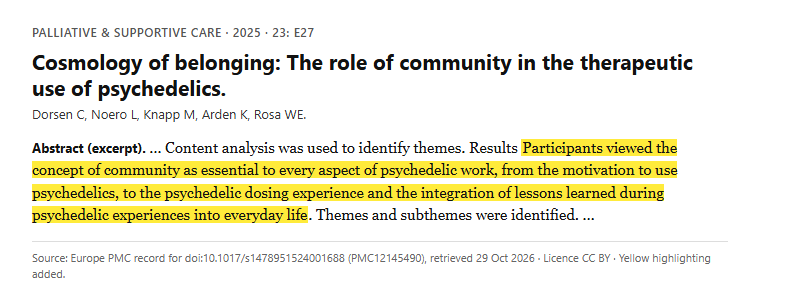
Abstract of the published study (text from Europe PMC), key sentence highlighted in yellow. Source: Dorsen C, Noero L, Knapp M, et al. Cosmology of belonging: The role of community in the therapeutic use of psychedelics. Palliat Support Care. 2025;23:e27. https://doi.org/10.1017/s1478951524001688
Related pages on this site
Social Connection and Relationships · Set and Setting · Implementation and Service Delivery · Depressive Disorders · Equity and Ethics
This page summarizes published research for education only. It is not medical advice. Any change to a medication remains the decision of that person’s own prescriber.
Keep reading
All Educational Resources · About This Archive · For Practicum Supervisors