


Psychedelic research is reaching Parkinson’s disease, and the first results are encouraging! In the first open-label pilot of psilocybin therapy, 12 people with Parkinson’s had clinically meaningful drops in depression and anxiety that lasted three months, with no serious adverse events and no worsening of Parkinson’s symptoms. Case reports in five people given low-dose ketamine infusions describe long-lasting relief from levodopa-induced dyskinesia, more ‘on’ time and less depression. And a woman with Parkinson’s reported better well-being and less worry a year after psilocybin-assisted psychotherapy. Encouraging to see this research beginning, with so much promise for people living with Parkinson’s!
Key studies
Study 1. Psilocybin therapy in 12 people with Parkinson’s disease and depression or anxiety (Bradley, 2025)
Clinically meaningful drops in depression and anxiety that lasted three months, with MADRS down 9.3 points, in 12 people with Parkinson’s!
In an open-label pilot trial, researchers gave 12 people with mild to moderate Parkinson’s disease and depression and/or anxiety two doses of psilocybin with psychotherapy. They reported no serious adverse events and no worsening of Parkinson’s symptoms, along with improvements in non-motor symptoms, motor symptoms and some cognitive measures after treatment. Depression and anxiety scores improved to a clinically meaningful degree and the improvements persisted to the three-month assessment, in the first data on psilocybin’s effects in any neurodegenerative disease!
“We observed significant and sustained improvements in depression and anxiety”
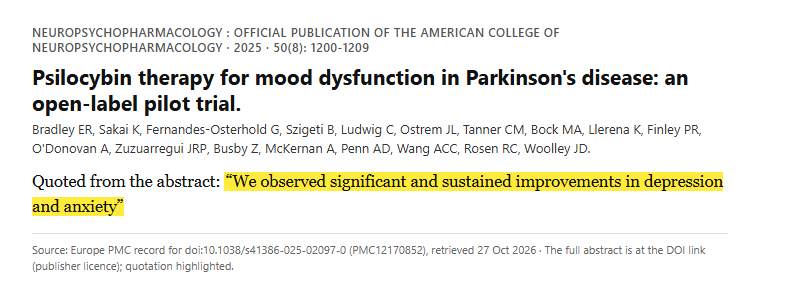
Abstract of the published study (text from Europe PMC), key sentence highlighted in yellow. Source: Bradley ER, Sakai K, Fernandes-Osterhold G, et al. Psilocybin therapy for mood dysfunction in Parkinson's disease: an open-label pilot trial. Neuropsychopharmacology. 2025;50(8):1200-1209. https://doi.org/10.1038/s41386-025-02097-0
Study 2. Ketamine infusions in 5 people with Parkinson’s disease (Sherman, 2016)
Case reports in 5 people with Parkinson’s describe long-lasting relief from levodopa-induced dyskinesia, more ‘on’ time and less depression after low-dose ketamine infusions!
Researchers described five people with Parkinson’s disease who received low-dose ketamine infusions into a vein, and reported a long-lasting therapeutic benefit: reduced levodopa-induced dyskinesia (involuntary movements linked to long-term levodopa treatment), more ‘on’ time when symptoms were well controlled, and less depression. They said the case reports indicate tolerability and long-term beneficial effects. The authors hypothesized that low-dose ketamine may act as a ‘chemical deep brain stimulation’ and called for a properly controlled trial!
“We report on low-dose subanesthetic intravenous ketamine infusion treatment in Parkinson's disease (PD) patients by 5 case studies and show a long-lasting therapeutic benefit”
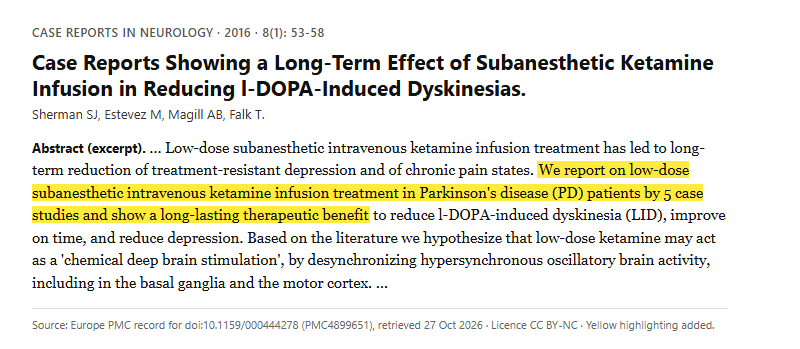
Abstract of the published study (text from Europe PMC), key sentence highlighted in yellow. Source: Sherman SJ, Estevez M, Magill AB, et al. Case Reports Showing a Long-Term Effect of Subanesthetic Ketamine Infusion in Reducing l-DOPA-Induced Dyskinesias. Case Rep Neurol. 2016;8(1):53-58. https://doi.org/10.1159/000444278
Study 3. Psilocybin-assisted psychotherapy in 1 woman with Parkinson’s disease without depression (Fleury, 2025)
A 43-year-old woman with Parkinson’s had a brighter outlook and better well-being at one-year follow-up after four psilocybin-assisted sessions!
Researchers described a 43-year-old woman, diagnosed with Parkinson’s disease two years earlier, who was not depressed but was finding it hard to adjust to the diagnosis; she received four sessions of psilocybin-assisted psychotherapy within one year. They reported that the treatment was well tolerated, that it significantly improved her overall outlook on her future and decreased her anxious ruminations and worries, and that her general well-being improved at one-year follow-up. The authors suggested it could be a useful treatment for people with Parkinson’s who have difficulty accepting their disease!
“One year later, the patient demonstrated significant improvement in her well-being.”
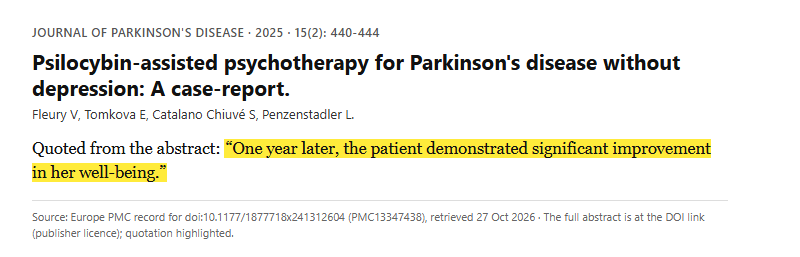
Abstract of the published study (text from Europe PMC), key sentence highlighted in yellow. Source: Fleury V, Tomkova E, Catalano Chiuvé S, et al. Psilocybin-assisted psychotherapy for Parkinson's disease without depression: A case-report. J Parkinsons Dis. 2025;15(2):440-444. https://doi.org/10.1177/1877718x241312604
Related reading
- Costello H, Reeves S, Glue P, et al. Depression in neurodegenerative disease: neurobiological mechanisms and emerging treatments. Mol Psychiatry. 2026;31(11):6603-6621. https://doi.org/10.1038/s41380-026-03728-8 — A 2026 review of depression in Parkinson’s and Alzheimer’s disease that highlights emerging treatments, including glutamate modulators, dopaminergic agents and brain stimulation, as offering therapeutic promise; it does not cover the 2025 psilocybin pilot above.
Related pages on this site
Dementia and Neurocognitive Disorders · Neurological Injury · Traumatic Brain Injury · Older Adults · Major Depressive Disorder · Medication Safety Screening
This page summarizes published research for education only. It is not medical advice. Any change to a medication remains the decision of that person’s own prescriber.
Keep reading
All Educational Resources · About This Archive · For Practicum Supervisors