


Psychedelics are showing striking early results for veterans living with traumatic brain injury! In 30 Special Operations veterans, magnesium-ibogaine therapy was followed by significant improvements in functioning, PTSD, depression and anxiety (effect sizes up to d = 2.80). In veterans with a history of TBI, PTSD scores fell 50%, depression 65% and anxiety 28% four weeks after a psilocybin retreat, with EEG changes the authors say suggest better emotional regulation! And 21 service members and veterans with TBI averaged 4.52 out of 5 in support of psychedelic-assisted therapy in medical settings if shown beneficial. Encouraging to see careful research continuing, with more studies on the way.
Key studies
Study 1. Ibogaine given with magnesium in 30 veterans with mostly mild traumatic brain injury (Cherian, 2024)
Significant improvements in functioning in 30 veterans after magnesium-ibogaine therapy, with gains in processing speed and executive function and no unexpected or serious adverse events!
In a prospective observational study, 30 male Special Operations Forces veterans with predominantly mild TBI received ibogaine together with magnesium, alongside complementary treatments, and were assessed before, right after and one month after treatment! Researchers reported significant improvements in day-to-day functioning on the World Health Organization disability scale, both immediately after treatment and one month later, with no unexpected or serious adverse events. Neuropsychological testing showed improvement after treatment, particularly in processing speed and executive function, with no detrimental changes observed.
“Neuropsychological testing (NPT) revealed areas of improvement after treatment, particularly in processing speed and executive function, without any detrimental changes observed.”
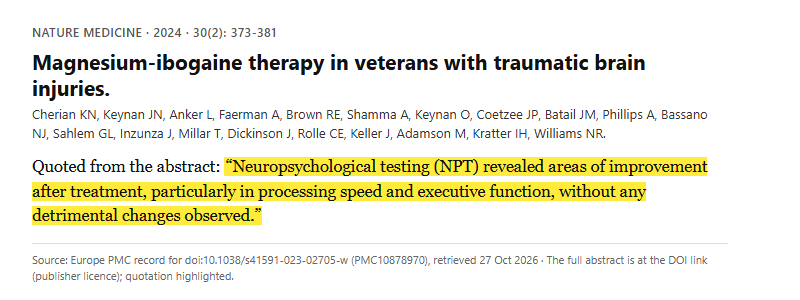
Abstract of the published study (text from Europe PMC), key sentence highlighted in yellow. Source: Study 1. Ibogaine given with magnesium in 30 veterans with mostly mild traumatic brain injury (Cherian, 2024) https://doi.org/10.1038/s41591-023-02705-w
Study 2. Psilocybin retreats in 21 veterans with a history of traumatic brain injury (Blest-Hopley, 2025)
PTSD scores down 50%, depression down 65% and anxiety down 28% four weeks after a psilocybin retreat in veterans with TBI!
Researchers followed 21 veterans with a history of TBI who attended one of two six-day psilocybin retreats in Jamaica after coaching sessions, comparing questionnaires from four weeks before and four weeks after, and EEG brain-wave recordings from before and after! Researchers reported PTSD (PCL-5) scores down 50% (p = 0.010), depression (PHQ-9) down 65% (p < 0.001) and anxiety (STAI) down 28% (p < 0.001), plus EEG changes they said indicate potential improvements in cognitive control and emotional processing. The authors suggested the retreats might provide improvements in psychological well-being and brain connectivity.
“Improvements were observed across several mental health measures: PTSD (PCL-5 scores decreased by 50%, p=0.010), depression (PHQ-9 scores decreased by 65%, p<0.001)”
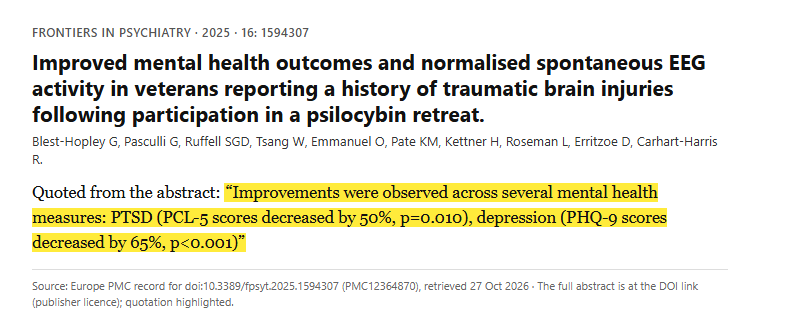
Abstract of the published study (text from Europe PMC), key sentence highlighted in yellow. Source: Study 2. Psilocybin retreats in 21 veterans with a history of traumatic brain injury (Blest-Hopley, 2025) https://doi.org/10.3389/fpsyt.2025.1594307
Study 3. Views on psychedelic-assisted therapy in 21 service members and veterans with a history of traumatic brain injury (Gray, 2023)
After a short education summary, service members and veterans with TBI reported a significantly more positive view of psychedelic drugs (P = .014) and averaged 4.52 out of 5 in support of availability if shown beneficial!
In a pilot study, 21 service members and veterans with a history of TBI and ongoing cognitive and psychological symptoms answered questions about psychedelic-assisted therapy before and after reading a brief educational summary; no psychedelic was given. Researchers reported that after the education, participants held a significantly more positive view of psychedelic drugs (P = .014) and more interest in psychedelic-assisted therapy (P = .016), averaged 4.52 out of 5 in support of its availability in medical settings if shown beneficial and 4.29 in support of a loved one engaging in it, and 48% reported no barriers at all. The authors concluded that military populations may be interested in these therapies, particularly with education and outreach.
“After psychoeducation, participants reported a significantly more positive view of psychedelic drugs (M = 3.24, P = .014)”
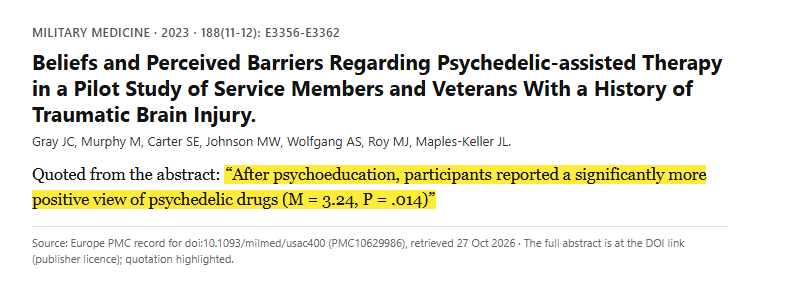
Abstract of the published study (text from Europe PMC), key sentence highlighted in yellow. Source: Study 3. Views on psychedelic-assisted therapy in 21 service members and veterans with a history of traumatic brain injury (Gray, 2023) https://doi.org/10.1093/milmed/usac400
Related reading
- Brunt TM. Rare but relevant: Ibogaine and cardiovascular complications-prolonged QT interval and ventricular arrhythmias. Addiction. 2026. https://doi.org/10.1111/add.70319 — A review reporting that observational, open-label and randomized evidence indicates ibogaine reduces craving and withdrawal symptoms, and describing new efforts such as heart monitoring and safer analogues under controlled medical supervision.
- Allen J, Dames SS, Foldi CJ, Shultz SR. Psychedelics for acquired brain injury: a review of molecular mechanisms and therapeutic potential. Mol Psychiatry. 2024. https://doi.org/10.1038/s41380-023-02360-0 — A narrative review concluding that psychedelics’ promotion of neuronal growth, cell survival and anti-inflammatory properties strongly supports their potential benefit in managing acquired brain injury.
Related pages on this site
Neurological Injury · Veterans · Dementia and Neurocognitive Disorders · Parkinson's Disease · Brain Imaging Research · Medication Safety Screening
This page summarizes published research for education only. It is not medical advice. Any change to a medication remains the decision of that person’s own prescriber.
Keep reading
All Educational Resources · About This Archive · For Practicum Supervisors