

Psychedelics and related medicines are showing striking early signals after brain injury! In 30 Special Operations veterans, magnesium-ibogaine therapy was followed by significant improvements in PTSD, depression and anxiety (effect sizes of d = 2.54, 2.80 and 2.13). In veterans with a history of TBI, PTSD scores fell 50%, depression 65% and anxiety 28% four weeks after a psilocybin retreat. And in a randomized trial of 60 adults with severe TBI in intensive care, only 16.6% of those given ketamine, a dissociative anesthetic, needed vasopressors, versus 43.3% of controls! Encouraging to see careful research continuing, with more studies on the way.
Key studies
Study 1. Ketamine infusion in 60 adults with severe traumatic brain injury (Burman, 2026)
Only 16.6% of ketamine-treated patients with severe brain injury needed vasopressors, versus 43.3% of controls (p = 0.02)!
In a randomized controlled pilot trial, 60 adults with severe traumatic brain injury in intensive care received either an infusion of ketamine, a dissociative anesthetic rather than a classic psychedelic, or saline while the pressure inside the skull was monitored! Researchers reported that for the first 4–6 hours the ketamine group had significantly higher blood pressure and cerebral perfusion pressure, a significant reduction in intracranial pressure between the fourth and sixth hours, and less use of vasopressors (16.6% versus 43.3% of controls; p = 0.02).
“Vasopressors were more often used in the control group (13 [43.3%] vs. 5 [16.6%]; p = 0.02).”
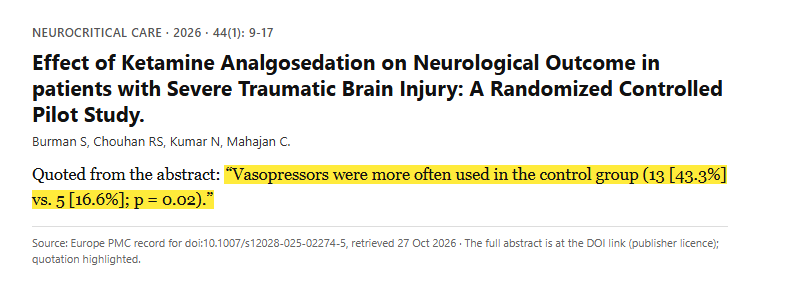
Abstract of the published study (text from Europe PMC), key sentence highlighted in yellow. Source: Burman S, Chouhan RS, Kumar N, Mahajan C. Effect of Ketamine Analgosedation on Neurological Outcome in patients with Severe Traumatic Brain Injury: A Randomized Controlled Pilot Study. Neurocritical care. 2026;44(1):9-17. https://doi.org/10.1007/s12028-025-02274-5
Study 2. Magnesium-ibogaine in 30 male veterans with mostly mild traumatic brain injury (Cherian, 2024)
PTSD (d = 2.54), depression (d = 2.80) and anxiety (d = 2.13) all improved significantly one month after magnesium-ibogaine therapy in 30 veterans with TBI, with gains in processing speed and executive function too!
Researchers followed 30 male Special Operations veterans, most with mild traumatic brain injury, who had independently arranged magnesium-ibogaine treatment at a clinic, assessing them before, right after and one month after treatment! They reported significant improvements in disability scores both immediately and at one month, and in PTSD, depression and anxiety scores at one month (all P < 0.001), with effect sizes up to d = 2.80. Neuropsychological testing showed improvement after treatment, particularly in processing speed and executive function, with no detrimental changes observed.
“Neuropsychological testing (NPT) revealed areas of improvement after treatment, particularly in processing speed and executive function, without any detrimental changes observed.”
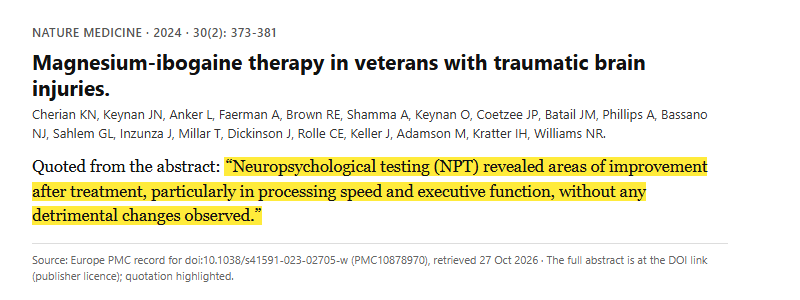
Abstract of the published study (text from Europe PMC), key sentence highlighted in yellow. Source: Cherian KN, Keynan JN, Anker L, Faerman A, Brown RE, Shamma A, et al. Magnesium-ibogaine therapy in veterans with traumatic brain injuries. Nature medicine. 2024;30(2):373-381. https://doi.org/10.1038/s41591-023-02705-w
Study 3. Psilocybin retreats in 21 male veterans with a history of traumatic brain injury (Blest-Hopley, 2025)
PTSD scores down 50%, depression down 65% and anxiety down 28% four weeks after a psilocybin retreat in veterans with TBI!
Researchers recorded brain activity with EEG in 21 male veterans with a history of traumatic brain injury before and after organized psilocybin retreats, with mental health questionnaire data for 13 of them! They reported lower PTSD, depression and anxiety scores (down 50%, 65% and 28%), and EEG changes they suggested may reflect better emotional regulation. The authors said the study suggests psilocybin retreats might provide improvements in psychological well-being and brain connectivity.
“Improvements were observed across several mental health measures: PTSD (PCL-5 scores decreased by 50%, p=0.010), depression (PHQ-9 scores decreased by 65%, p<0.001)”
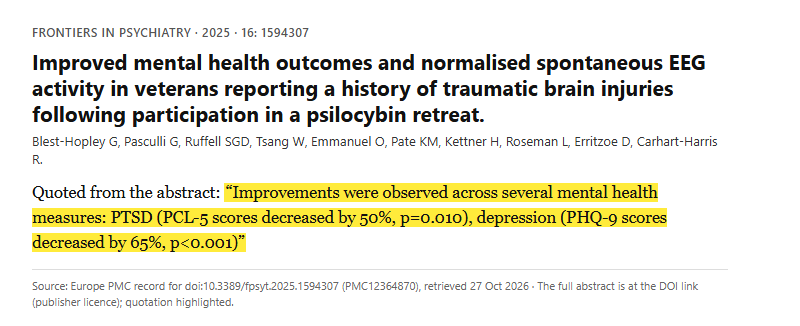
Abstract of the published study (text from Europe PMC), key sentence highlighted in yellow. Source: Blest-Hopley G, Pasculli G, Ruffell SGD, Tsang W, Emmanuel O, Pate KM, et al. Improved mental health outcomes and normalised spontaneous EEG activity in veterans reporting a history of traumatic brain injuries following participation in a psilocybin retreat. Frontiers in psychiatry. 2025;16:1594307. https://doi.org/10.3389/fpsyt.2025.1594307
Related reading
- Andreasen TH, Madsen FA, Barbateskovic M, Lindschou J, Gluud C, Møller K. Ketamine for Critically Ill Patients with Severe Acute Brain Injury: A Systematic Review with Meta-analysis and Trial Sequential Analysis of Randomized Clinical Trials. Neurocritical care. 2025;42(2):610-621. https://doi.org/10.1007/s12028-024-02075-2 — Pools five randomized trials (149 participants) of ketamine in severe acute brain injury, noting that ketamine reportedly inhibits cortical spreading depolarization, which makes it potentially attractive for these patients.
- Abrams SK, Rabinovitch BS, Zafar R, Aziz AS, Cherup NP, McMillan DW, et al. Persons With Spinal Cord Injury Report Peripherally Dominant Serotonin-Like Syndrome After Use of Serotonergic Psychedelics. Neurotrauma reports. 2023;4(1):543-550. https://doi.org/10.1089/neur.2023.0022 — A review of reports from people with spinal cord injury who used classic psychedelics, who described beneficial effects and no worsening of baseline neurological deficits, and proposing ways to help them tolerate the experience.
Related pages on this site
Chronic Pain · Acute Pain · Pain · Cluster Headache and Migraine · Physical Well Being · Medication Safety Screening
This page summarizes published research for education only. It is not medical advice. Any change to a medication remains the decision of that person’s own prescriber.
Keep reading
All Educational Resources · About This Archive · For Practicum Supervisors