

Ketamine-type medicines are showing amazing results for new mothers! In a randomized, double-blind trial of 364 mothers, a single esketamine infusion after childbirth cut major depressive episodes at 42 days from 25.4% to 6.7%, about three quarters lower. A trial of 298 women reported depression symptoms one week after cesarean falling from 35.3% to 23.0%, and a randomized study of 654 women reported that ketamine protected against postpartum depression. Encouraging to see researchers bringing such promising results to new parents!
Key studies
Study 1. Esketamine after childbirth in 364 mothers with symptoms of prenatal depression (Wang, 2024)
Major depressive episodes at 42 days after birth fell from 25.4% to 6.7% with esketamine, about three quarters lower!
In a randomized, double-blind, placebo-controlled trial at five hospitals in China, researchers randomly assigned 364 mothers who had at least mild depression symptoms during pregnancy to a single infusion of esketamine (a form of the anesthetic ketamine) or placebo after childbirth. They reported a major depressive episode at 42 days after birth in just 6.7% of the esketamine group versus 25.4% of the placebo group, with lower depression scores at 7 and 42 days. The authors concluded that this decreased major depressive episodes at 42 days by about three quarters!
“For mothers with prenatal depression, a single low dose of esketamine after childbirth decreases major depressive episodes at 42 days post partum by about three quarters.”
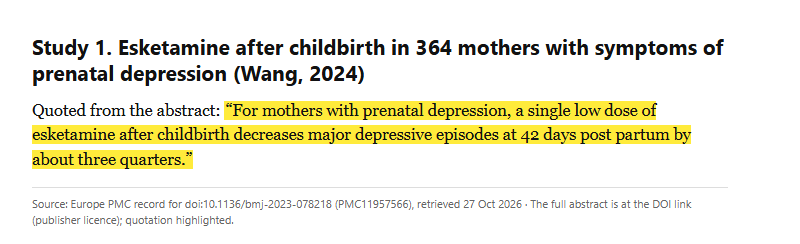
Abstract of the published study (text from Europe PMC), key sentence highlighted in yellow. Source: Wang S, Deng CM, Zeng Y, et al. Efficacy of a single low dose of esketamine after childbirth for mothers with symptoms of prenatal depression: randomised clinical trial. BMJ. 2024;385:e078218. https://doi.org/10.1136/bmj-2023-078218
Study 2. Esketamine around cesarean delivery in 298 women (Chen, 2024)
Depression symptoms one week after cesarean fell from 35.3% to 23.0% with esketamine in a 298-woman trial!
In a single-center, double-blind, placebo-controlled randomized trial in China, researchers assigned 298 women having elective cesarean delivery to esketamine (148 women) or saline (150 women) around the time of surgery and screened them with the Edinburgh Postnatal Depression Scale. They reported depression symptoms on postpartum day 7 in 23.0% of the esketamine group versus 35.3% of controls, along with a significantly larger fall in depression scores. The authors concluded that esketamine can improve depression symptoms during the early postpartum period!
“The prevalence of depression symptoms was significantly lower among patients given esketamine compared with controls”
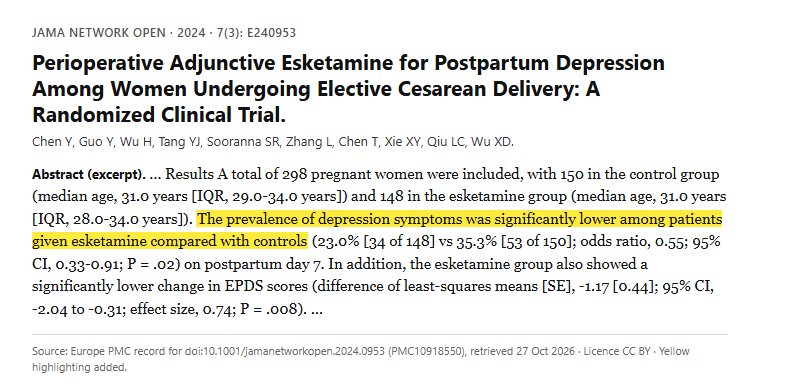
Abstract of the published study (text from Europe PMC), key sentence highlighted in yellow. Source: Chen Y, Guo Y, Wu H, et al. Perioperative Adjunctive Esketamine for Postpartum Depression Among Women Undergoing Elective Cesarean Delivery: A Randomized Clinical Trial. JAMA Netw Open. 2024;7(3):e240953. https://doi.org/10.1001/jamanetworkopen.2024.0953
Study 3. Ketamine after cesarean delivery in 654 women (Ma, 2019)
In a 654-woman randomized study, ketamine protected against postpartum depression, with significantly lower rates of postpartum blues and depression!
In a randomized controlled study of 654 Chinese women undergoing cesarean section, women in the ketamine group received ketamine shortly after childbirth while the control group received standard postpartum care, and depression was assessed with the Edinburgh Postnatal Depression Scale. Researchers reported that the prevalence of postpartum blues and of postpartum depression was significantly lower in the ketamine group, and that ketamine administration protected against postpartum depression. The authors added that the effect was stronger in mothers with moderate stress or depressive symptoms during pregnancy, and suggested that ketamine functions as a prophylactic agent against postpartum depression!
“The prevalence of postpartum blues and postpartum depression were significantly lower in the ketamine group than in the control group.”
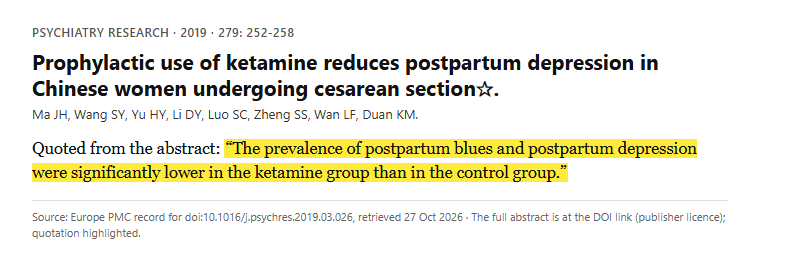
Abstract of the published study (text from Europe PMC), key sentence highlighted in yellow. Source: Ma JH, Wang SY, Yu HY, et al. Prophylactic use of ketamine reduces postpartum depression in Chinese women undergoing cesarean section. Psychiatry Res. 2019;279:252-258. https://doi.org/10.1016/j.psychres.2019.03.026
Related reading
- Thuery G, Crossen F, Mc Loone D, et al. Psychedelic therapy and postpartum depression: priorities and prospects. Ther Adv Psychopharmacol. 2026;16:20451253251408280. https://doi.org/10.1177/20451253251408280 — A 2026 review reporting early findings that serotonergic psychedelics may represent a viable therapeutic approach for postpartum depression, with safeguards for future studies.
Related pages on this site
Women’s Health · Premenstrual Dysphoric Disorder · Major Depressive Disorder · Treatment-Resistant Depression · Depressive Disorders · Medication Safety Screening
This page summarizes published research for education only. It is not medical advice. Any change to a medication remains the decision of that person’s own prescriber.
Keep reading
All Educational Resources · About This Archive · For Practicum Supervisors