

Psychedelics are opening exciting doors for women’s health! In a Metro Vancouver community study, 43% of 486 marginalized women said they were interested in psychedelic-assisted therapy, and in a cohort of 290 women, lifetime psychedelic use was associated with a 60% reduced hazard of suicidality. Researchers reported that psilocybin therapy was acceptable to most of 10 women with anorexia nervosa, and a randomized trial reported postpartum depression at day 14 falling from 24.2% to 9.8% with S-ketamine. Encouraging to see researchers asking these questions, with women’s experiences shaping the answers.
Key studies
Study 1. Psychedelic use and suicidality in 290 marginalized women in Metro Vancouver (Argento, 2017)
Lifetime psychedelic use was linked to a 60% reduced hazard of suicidality in marginalized women in Metro Vancouver!
Researchers followed a community-based cohort of marginalized women in Metro Vancouver over 54 months, including 290 women eligible at baseline. They reported that lifetime psychedelic drug use was associated with a 60% reduced hazard of new suicidality, and concluded that naturalistic psychedelic drug use is independently associated with reduced suicidality. What a result for women’s mental health, supporting calls to investigate the therapeutic use of psychedelic drugs!
“In multivariable analysis, reported lifetime psychedelic drug use was associated with a 60% reduced hazard for suicidality”
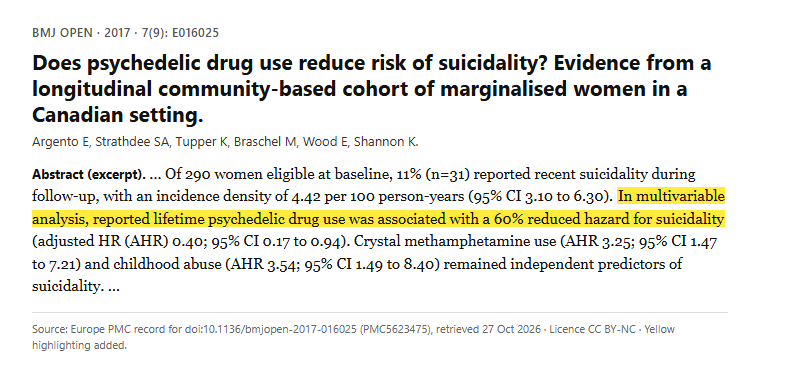
Abstract of the published study (text from Europe PMC), key sentence highlighted in yellow. Source: Argento E, Strathdee SA, Tupper K, et al. Does psychedelic drug use reduce risk of suicidality? Evidence from a longitudinal community-based cohort of marginalised women in a Canadian setting. BMJ Open. 2017;7(9):e016025. https://doi.org/10.1136/bmjopen-2017-016025
Study 2. Interest in psychedelic-assisted therapy in 486 marginalized women in Metro Vancouver (Argento, 2022)
43% of 486 marginalized women in Metro Vancouver were interested in psychedelic-assisted therapy!
Using 2016–2017 data from two community-based cohorts in Metro Vancouver, researchers asked 486 women aged 20 to 67, more than half of whom identified as Indigenous, about their interest in psychedelic-assisted therapy. They reported that 43% (211 women) were interested, with interest higher among women with past depression, anxiety or PTSD, childhood abuse or past psychedelic use. The authors noted that several of these factors have been shown to be amenable to psychedelic-assisted therapy, and pointed to trauma-informed care and broader supports as access expands!
“Of 486 eligible participants (aged 20-67 years), 43% (n = 211) were interested in receiving psychedelic-assisted therapy.”
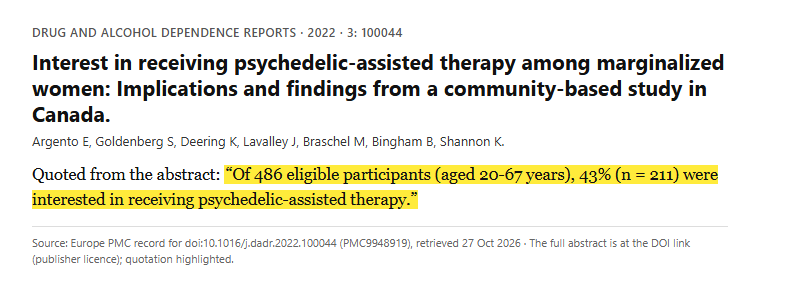
Abstract of the published study (text from Europe PMC), key sentence highlighted in yellow. Source: Argento E, Goldenberg S, Deering K, et al. Interest in receiving psychedelic-assisted therapy among marginalized women: Implications and findings from a community-based study in Canada. Drug Alcohol Depend Rep. 2022;3:100044. https://doi.org/10.1016/j.dadr.2022.100044
Study 3. Psilocybin therapy in 10 women with anorexia nervosa (Peck, 2023)
10 women with anorexia nervosa tried psilocybin therapy, and most found it acceptable!
In an open-label phase 1 feasibility study, 10 adult women who met criteria for anorexia nervosa or partial remission received a single psilocybin session with psychological support at an academic clinical research institute. Researchers reported no clinically significant changes in heart tracings, vital signs or suicidality, and that participants’ perceptions suggested the treatment was acceptable for most. The authors called it a promising finding for people with this illness!
“Results suggest that psilocybin therapy is safe, tolerable and acceptable for female AN”
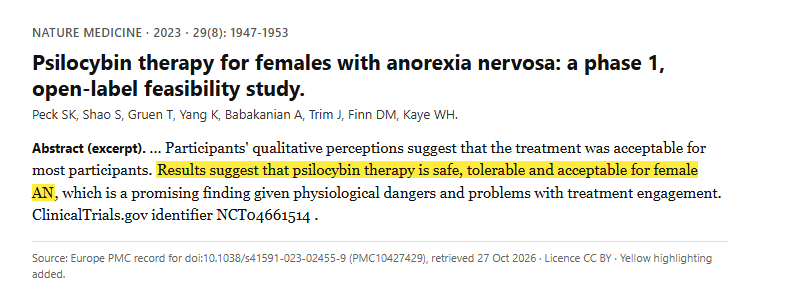
Abstract of the published study (text from Europe PMC), key sentence highlighted in yellow. Source: Peck SK, Shao S, Gruen T, et al. Psilocybin therapy for females with anorexia nervosa: a phase 1, open-label feasibility study. Nat Med. 2023;29(8):1947-1953. https://doi.org/10.1038/s41591-023-02455-9
Study 4. S-ketamine after cesarean delivery in 275 women (Han, 2022)
Postpartum depression at day 14 fell from 24.2% to 9.8% with S-ketamine in a randomized trial of 275 women!
In a randomized controlled trial of women undergoing cesarean delivery, researchers added S-ketamine to the post-surgery pain-relief pump or used the standard mixture, and followed 275 women with the Edinburgh postnatal depression scale. They reported depression rates of 8.2% versus 17.6% on postoperative day 3 and 9.8% versus 24.2% on day 14 in the S-ketamine and control groups, with lower depression scores at both time points. The authors concluded that S-ketamine significantly reduces the incidence of postpartum depression within 14 days and relieves pain within 48 hours, without increasing the rate of adverse reactions!
“S-ketamine (0.01 mg/kg/h) as an adjuvant in PCIA significantly reduces the incidence of PPD within 14 days and relieves pain within 48 h after cesarean delivery”
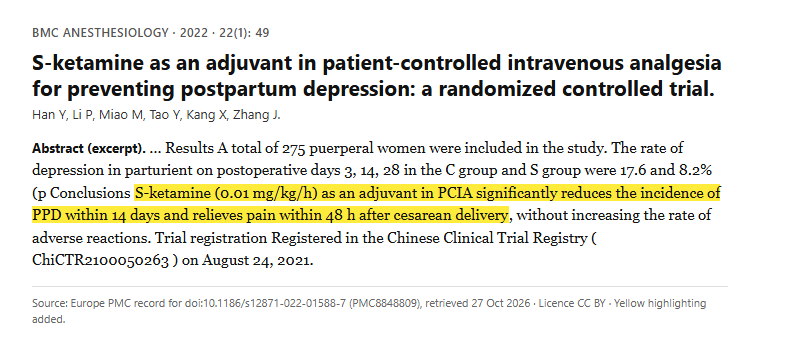
Abstract of the published study (text from Europe PMC), key sentence highlighted in yellow. Source: Han Y, Li P, Miao M, et al. S-ketamine as an adjuvant in patient-controlled intravenous analgesia for preventing postpartum depression: a randomized controlled trial. BMC Anesthesiol. 2022;22(1):49. https://doi.org/10.1186/s12871-022-01588-7
Related reading
- Shoar S, Bazinet A, Jairaj C. Exploring Psychedelics for Unmet Needs in Women's Reproductive Health. Psychedelic Med (New Rochelle). 2025;3(2):113-120. https://doi.org/10.1089/psymed.2024.0033 — A review pointing to opportunities for psychedelics to address symptoms of menstruation, sexual dysfunction, chronic pelvic pain, menopause and postpartum depression.
- Shadani S, Conn K, Andrews ZB, et al. Potential Differences in Psychedelic Actions Based on Biological Sex. Endocrinology. 2024;165(8):bqae083. https://doi.org/10.1210/endocr/bqae083 — A review of how estrogen and the serotonin system interact, which could aid the advancement of therapeutic outcomes.
Related pages on this site
Veterans · Older Adults · Adolescents · Autism · PTSD · End of Life Distress
This page summarizes published research for education only. It is not medical advice. Any change to a medication remains the decision of that person’s own prescriber.
Keep reading
All Educational Resources · About This Archive · For Practicum Supervisors