


Psychedelics and meditation make a remarkable pair! In a randomized, placebo-controlled trial of 38 people on a 5-day mindfulness retreat, the extent of ego dissolution under psilocybin predicted positive changes in psycho-social functioning 4 months later (Smigielski, 2019). Just 24 h after one ayahuasca session, mindfulness scores in 25 people reached the range seen after extensive mindfulness practice (Soler, 2016), and four ayahuasca sessions matched an 8-week mindfulness course in boosting acceptance (Soler, 2018). In a survey of 863 regular meditators, 73.5% said psychedelic use had a positive influence on the quality of their meditation (Jiwani, 2025). Encouraging to see these two paths to awareness studied side by side!
Key studies
Study 1. Psilocybin versus placebo during a 5-day mindfulness retreat in 38 participants (Smigielski, 2019)
The extent of ego dissolution during a psilocybin-assisted 5-day mindfulness retreat predicted positive changes in psycho-social functioning 4 months later in a 38-person placebo-controlled trial!
In a randomized, double-blind, placebo-controlled trial, 38 participants received psilocybin or placebo once during a 5-day mindfulness retreat, with brain scans taken directly before and after. Psilocybin combined with meditation produced changes in the self-referential default mode network, and the extent of ego dissolution and brain connectivity predicted positive changes in participants' psycho-social functioning 4 months later. Psilocybin combined with meditation facilitated changes in the brain's self-referential networks that support the process of meditation, linking altered self-experience to later behavioural change.
“The extent of ego dissolution and brain connectivity predicted positive changes in psycho-social functioning of participants 4 months later. Psilocybin, combined with meditation, facilitated neurodynamic modulations in self-referential networks, subserving the process of meditation by acting along the anterior-posterior DMN connection.”
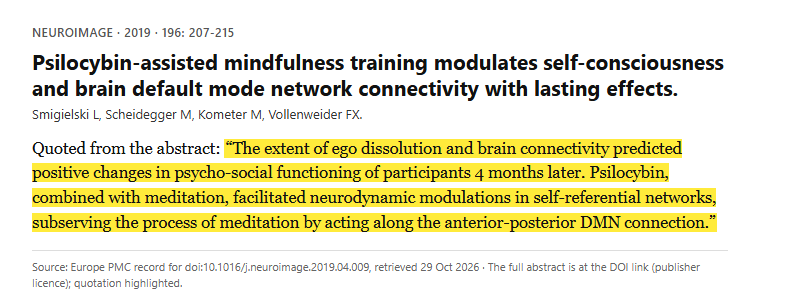
Quotation from the abstract of the published study (text from Europe PMC), highlighted in yellow. Source: Smigielski L, Scheidegger M, Kometer M, Vollenweider FX. Psilocybin-assisted mindfulness training modulates self-consciousness and brain default mode network connectivity with lasting effects. Neuroimage. 2019;196:207-215. https://doi.org/10.1016/j.neuroimage.2019.04.009
Study 2. A single inhalation of 5-MeO-DMT from dried toad secretion in 42 volunteers in naturalistic settings (Uthaug, 2019)
Mindfulness rose to statistical significance 4 weeks after a single 5-MeO-DMT inhalation in 42 people!
Researchers assessed 42 individuals at baseline, within 24 h and 4 weeks after they inhaled vapor from dried toad secretion containing 5-MeO-DMT at several European locations. Satisfaction with life and convergent thinking increased right after intake and were maintained at the 4-week follow-up, while mindfulness ratings climbed over time and reached statistical significance at 4 weeks. Ratings of depression, anxiety and stress fell after the session, and participants who experienced high levels of ego dissolution or oceanic boundlessness showed higher satisfaction with life and lower depression and stress.
“Relative to baseline, ratings of satisfaction with life and convergent thinking significantly increased right after intake and were maintained at follow-up 4 weeks later. Ratings of mindfulness also increased over time and reached statistical significance at 4 weeks.”
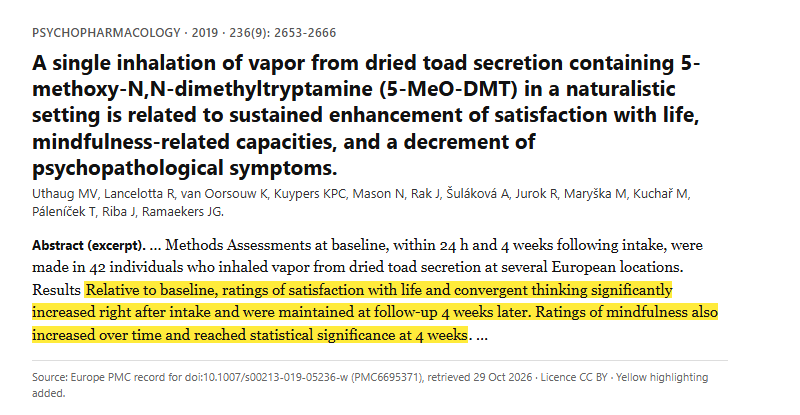
Abstract of the published study (text from Europe PMC), key sentence highlighted in yellow. Source: Uthaug MV, Lancelotta R, van Oorsouw K, et al. A single inhalation of vapor from dried toad secretion containing 5-methoxy-N,N-dimethyltryptamine (5-MeO-DMT) in a naturalistic setting is related to sustained enhancement of satisfaction with life, mindfulness-related capacities, and a decrement of psychopathological symptoms. Psychopharmacology (Berl). 2019;236(9):2653-2666. https://doi.org/10.1007/s00213-019-05236-w
Study 3. Longitudinal survey of psychedelic use and meditation practice following 7484 US adults (Simonsson, 2025)
In a study following 7484 US adults, the 336 who used psychedelics showed greater increases in the number of days they practised mindfulness and loving-kindness meditation!
Researchers followed a sample of 13,012 US residents aged 18 to 50 in a longitudinal design; 7484 completed the follow-up survey, of whom 336 reported psychedelic use during the two-month study. In covariate-adjusted regression models, psychedelic use was associated with greater increases in the number of days of mindfulness and loving-kindness or compassion meditation practice in the past week. Strikingly, the increase was especially marked among people with no prior experience of psychedelics or meditation.
“In covariate-adjusted regression models, psychedelic use was associated with greater increases in the number of days of mindfulness and loving-kindness or compassion meditation practice in the past week, especially among those with no prior experience of psychedelics or meditation.”
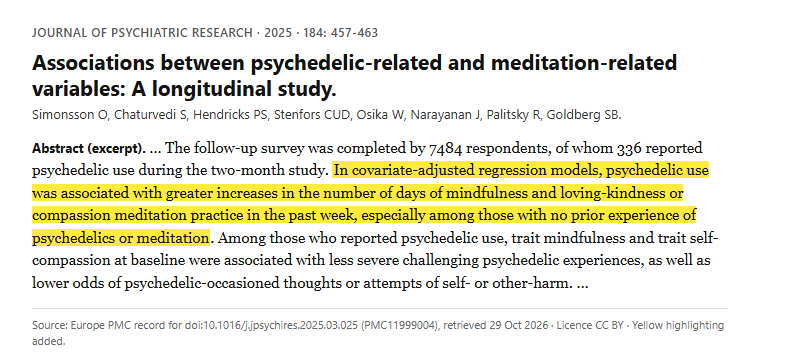
Abstract of the published study (text from Europe PMC), key sentence highlighted in yellow. Source: Simonsson O, Chaturvedi S, Hendricks PS, et al. Associations between psychedelic-related and meditation-related variables: A longitudinal study. J Psychiatr Res. 2025;184:457-463. https://doi.org/10.1016/j.jpsychires.2025.03.025
Study 4. A single psilocybin dose with PET brain imaging in ten healthy psychedelic-naïve volunteers (Madsen, 2020)
Mindfulness was significantly higher three months after a single psilocybin session in ten healthy volunteers!
In the first study to pair psilocybin with [11C]Cimbi-36 PET imaging of serotonin 2A receptors, ten healthy, psychedelic-naïve volunteers were scanned at baseline and one week after a single oral dose of psilocybin, and completed personality and mindfulness questionnaires at baseline and at a three-month follow-up. Researchers reported statistically significant increases in personality Openness and in mindfulness (MAAS mean change 0.5, p FWER = 0.02). The change in mindfulness tracked the individual change in neocortical 5-HT2A receptor binding, pointing to a possible brain mechanism behind psilocybin's lasting effects on mindfulness.
“In conclusion, we confirm that psilocybin intake is associated with long-term increases in Openness and - as a novel finding - mindfulness, which may be a key element of psilocybin therapy.”
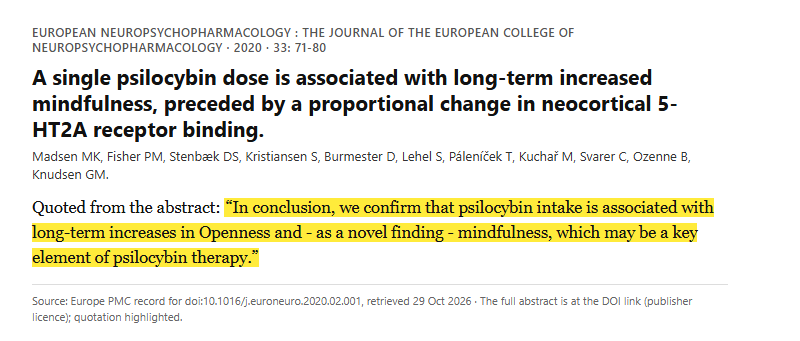
Quotation from the abstract of the published study (text from Europe PMC), highlighted in yellow. Source: Madsen MK, Fisher PM, Stenbæk DS, et al. A single psilocybin dose is associated with long-term increased mindfulness, preceded by a proportional change in neocortical 5-HT2A receptor binding. Eur Neuropsychopharmacol. 2020;33:71-80. https://doi.org/10.1016/j.euroneuro.2020.02.001
Study 5. Mixed-methods study of insights from 147 psychedelic and 66 meditation experiences (Jylkkä, 2025)
Insights from 147 psychedelic and 66 meditation experiences were largely similar, and metacognitive, value and mystical-type insights went with perceived gains in positive affect and meaning in life!
Researchers collected narrative reports of insights from personally meaningful psychedelic (n = 147) or meditation (n = 66) experiences and analysed them qualitatively and quantitatively. Three main insight themes emerged, Mystical-type, Psychological and Philosophical-existential; mystical-type insights were more frequent in meditation reports and value insights more common in psychedelic reports, and otherwise the reported insights were highly similar across the two types of reports. Remarkably, regression analyses showed that metacognitive and value insights were positively associated with perceived improvements in positive affect, while mystical-type insights predicted increased meaning in life.
“Regression analyses indicated that metacognitive and value insights were positively associated with perceived improvements in positive affect, while mystical-type insights predicted increased meaning in life.”
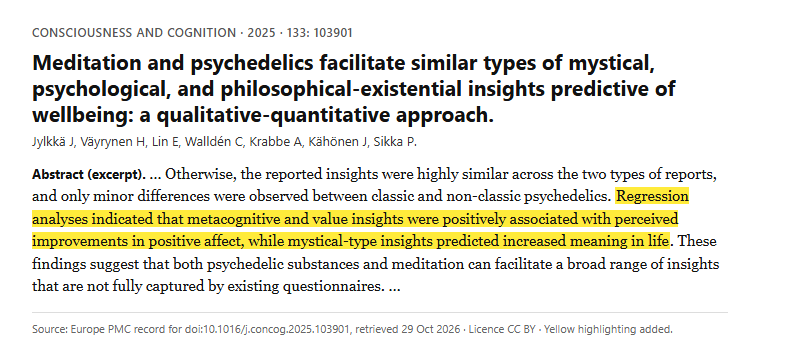
Abstract of the published study (text from Europe PMC), key sentence highlighted in yellow. Source: Jylkkä J, Väyrynen H, Lin E, et al. Meditation and psychedelics facilitate similar types of mystical, psychological, and philosophical-existential insights predictive of wellbeing: a qualitative-quantitative approach. Conscious Cogn. 2025;133:103901. https://doi.org/10.1016/j.concog.2025.103901
Study 6. Mindfulness measured before and 24 hours after an ayahuasca session in 25 people (Soler, 2016)
Just 24 h after one ayahuasca session, mindfulness scores in 25 people reached the range seen after extensive mindfulness practice!
Researchers assessed 25 individuals before and 24 h after an ayahuasca session using the Five Facets Mindfulness Questionnaire and the Experiences Questionnaire. Ayahuasca led to significant increases in two mindfulness facets, reflecting less judgmental processing of experiences and less inner reactivity, plus a significant rise in decentering ability. Strikingly, these are classic goals of conventional mindfulness training, and the scores were in the range observed after extensive mindfulness practice.
“Ayahuasca intake led to significant increases in two facets of the FFMQ indicating a reduction in judgmental processing of experiences and in inner reactivity. It also led to a significant increase in decentering ability as measured by the EQ. These changes are classic goals of conventional mindfulness training, and the scores obtained are in the range of those observed after extensive mindfulness practice.”
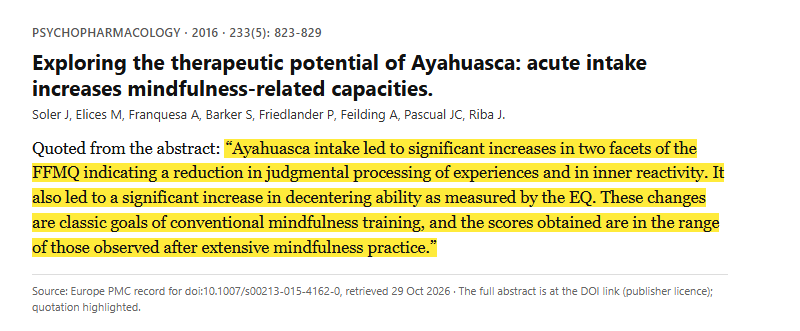
Quotation from the abstract of the published study (text from Europe PMC), highlighted in yellow. Source: Soler J, Elices M, Franquesa A, et al. Exploring the therapeutic potential of Ayahuasca: acute intake increases mindfulness-related capacities. Psychopharmacology (Berl). 2016;233(5):823-829. https://doi.org/10.1007/s00213-015-4162-0
Study 7. Psilocybin sessions and trait mindfulness three months later in 39 healthy volunteers (Søndergaard, 2022)
Trait mindfulness was significantly increased at 3-month follow-up after psilocybin in 39 healthy volunteers, rising with the intensity of the mystical-type experience!
Researchers conducted forty-six medium-high dose psilocybin sessions in 39 healthy individuals and measured trait mindfulness (Mindful Attention and Awareness Scale) at baseline and 3 months later. The mindfulness score was significantly increased at the 3-month follow-up, and the size of that lasting change was positively associated with the strength of the mystical-type experience during the session. The authors concluded that the acute experience of psilocybin facilitates a shift in awareness conducive for mindful living.
“We here show that lasting changes in trait mindfulness following psilocybin administration are positively associated with intensity of the mystical-type experience, suggesting that the acute phenomenology of psilocybin facilitates a shift in awareness conducive for mindful living.”
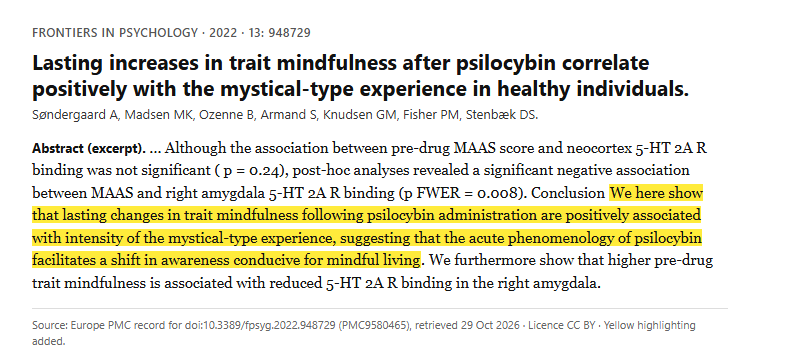
Abstract of the published study (text from Europe PMC), key sentence highlighted in yellow. Source: Søndergaard A, Madsen MK, Ozenne B, et al. Lasting increases in trait mindfulness after psilocybin correlate positively with the mystical-type experience in healthy individuals. Front Psychol. 2022;13:948729. https://doi.org/10.3389/fpsyg.2022.948729
Study 8. Four ayahuasca sessions compared with an 8-week mindfulness-based stress reduction course in two groups of 10 people (Soler, 2018)
Just four ayahuasca sessions matched an 8-week mindfulness course in boosting acceptance!
Researchers compared two independent groups: 10 people assessed before and after the last of four closely spaced ayahuasca sessions, and 10 people assessed before and after a standard 8-week mindfulness-based stress reduction (MBSR) course. The ayahuasca sessions produced increases in the Non-Judging ("acceptance") subscale of the Five Facet Mindfulness Questionnaire comparable to those of the MBSR course. The authors concluded that a small number of ayahuasca sessions can be as effective at improving acceptance as more lengthy and costly interventions.
“However, the ayahuasca sessions induced comparable increases in the Non-Judging subscale of the FFMQ, specifically measuring "acceptance." Improving this capacity allows for a more detached and less judgmental stance toward potentially distressing thoughts and emotions.”
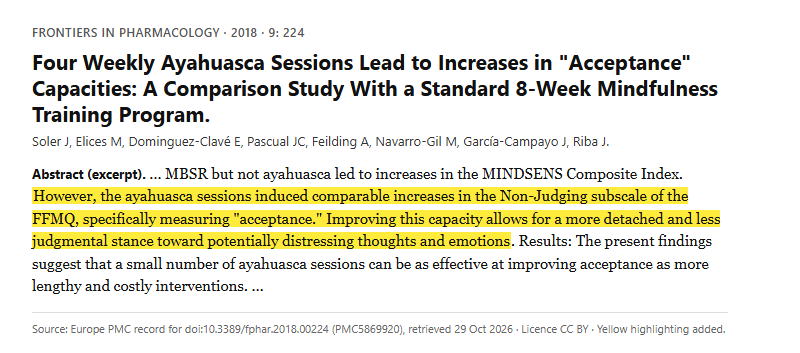
Abstract of the published study (text from Europe PMC), key sentence highlighted in yellow. Source: Soler J, Elices M, Dominguez-Clavé E, et al. Four Weekly Ayahuasca Sessions Lead to Increases in "Acceptance" Capacities: A Comparison Study With a Standard 8-Week Mindfulness Training Program. Front Pharmacol. 2018;9:224. https://doi.org/10.3389/fphar.2018.00224
Study 9. Longitudinal study of psychedelic use and meditation practice in 9732 adults, 100 of whom used psychedelics, in the United States and United Kingdom (Simonsson, 2024)
Psychedelic use was linked to more days of mindfulness meditation practice over a 2-month study period among 100 psychedelic users within a representative sample of 9732 US and UK adults!
This longitudinal observational study followed a sample of 9732 adults representative of the US and UK population, with 7667 completing follow-up (a 79% retention rate). Of these, 100 respondents used psychedelics during the 2-month period. In covariate-adjusted models, psychedelic use during the study period was associated with greater increases in the number of days of mindfulness meditation practice in the past week. Among those who used psychedelics, the experience of insight during their most intense session was also associated with greater increases in both mindfulness and loving-kindness or compassion meditation practice.
“In covariate-adjusted regression models, psychedelic use during the study period was associated with greater increases in the number of days of mindfulness meditation practice in the past week ( B = 0.40, p = 0.004).”
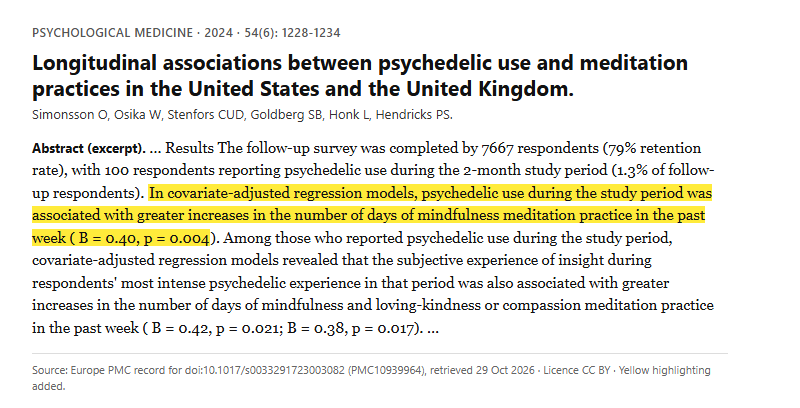
Abstract of the published study (text from Europe PMC), key sentence highlighted in yellow. Source: Simonsson O, Osika W, Stenfors CUD, et al. Longitudinal associations between psychedelic use and meditation practices in the United States and the United Kingdom. Psychol Med. 2024;54(6):1228-1234. https://doi.org/10.1017/s0033291723003082
Study 10. Decentering and sense of self in 81 experienced ayahuasca users compared with 41 non-users (Franquesa, 2018)
Ayahuasca users (n = 81) scored higher in Decentering and Positive self than 41 non-users!
Researchers compared 81 people with experience of ayahuasca against 41 people without it on psychotherapy process measures of Decentering, Values and Self. Ayahuasca users scored higher in Decentering, a core mindfulness capacity, and in Positive self. Decentering scores were higher still in the most experienced users (more than 15 occasions), suggesting these psychological processes may help explain the outcomes of ayahuasca psychotherapy.
“Results confirm that ayahuasca users scored higher than non-users in Decentering and Positive self, but not in Valued living, Life fulfillment, Self in social relations, Self in close relations and General self. Scores in Decentering were higher in the more experienced subjects (more than 15 occasions) than in those with less experience (less than 15 occasions).”
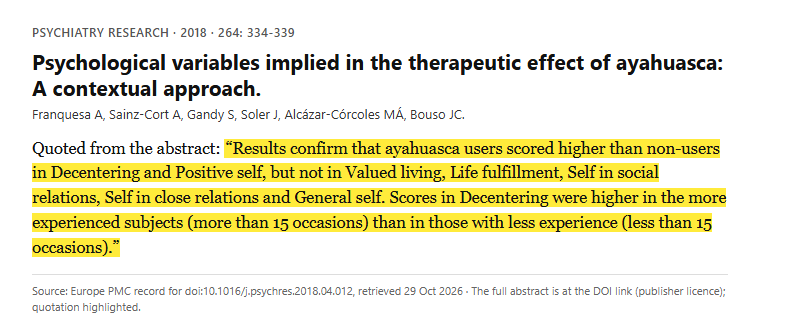
Quotation from the abstract of the published study (text from Europe PMC), highlighted in yellow. Source: Franquesa A, Sainz-Cort A, Gandy S, et al. Psychological variables implied in the therapeutic effect of ayahuasca: A contextual approach. Psychiatry Res. 2018;264:334-339. https://doi.org/10.1016/j.psychres.2018.04.012
Study 11. Survey of 863 regular meditators who use psychedelics (Jiwani, 2025)
73.5% of 863 regular meditators said psychedelic use had a positive influence on the quality of their meditation!
Researchers surveyed 863 people who used psychedelics and meditated at least 3 times per week over the previous 12 months, using machine learning to analyse 53 variables. A remarkable 634 participants (73.5%) found psychedelic use to have a positive influence on their quality of meditation. The strongest predictors of that benefit were more regular psychedelic use, setting intentions for psychedelic use, an agreeable personality and exposure to N,N-DMT.
“Most participants (n = 634, 73.5%) found psychedelic use to have a positive influence on their quality of meditation.”
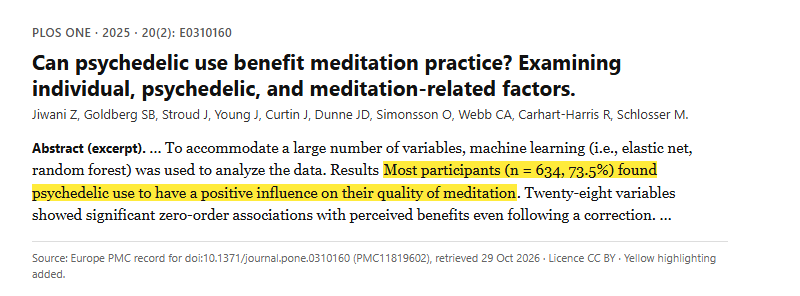
Abstract of the published study (text from Europe PMC), key sentence highlighted in yellow. Source: Jiwani Z, Goldberg SB, Stroud J, et al. Can psychedelic use benefit meditation practice? Examining individual, psychedelic, and meditation-related factors. PLoS One. 2025;20(2):e0310160. https://doi.org/10.1371/journal.pone.0310160
Study 12. Mindfulness and cognitive flexibility before and within 24 hours after ayahuasca in 48 participants (Murphy-Beiner, 2020)
Mindfulness and decentering significantly increased within 24 h of drinking ayahuasca in forty-eight participants!
Researchers assessed forty-eight participants on mindfulness (Five Facets Mindfulness Questionnaire), decentering and cognitive flexibility before drinking ayahuasca and again within 24 hours. Total mindfulness scores and four of the five mindfulness facets (observe, describe, act with awareness and non-reactivity) rose significantly, as did decentering, and cognitive flexibility also improved. These gains occurred regardless of prior ayahuasca use, pointing to benefits for both first-time and experienced drinkers.
“Mindfulness (FFMQ total scores and four of the five mindfulness facets: observe, describe, act with awareness, and non-reactivity) and decentering (EQ) significantly increased in the 24 h after ayahuasca use.”
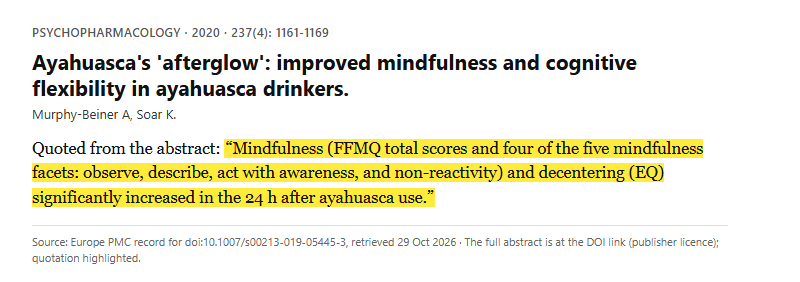
Quotation from the abstract of the published study (text from Europe PMC), highlighted in yellow. Source: Murphy-Beiner A, Soar K. Ayahuasca's 'afterglow': improved mindfulness and cognitive flexibility in ayahuasca drinkers. Psychopharmacology (Berl). 2020;237(4):1161-1169. https://doi.org/10.1007/s00213-019-05445-3
Study 13. Survey of mindfulness, psychedelic experience and wellbeing in 1,219 people who meditate and use psychedelics (Qiu, 2023)
Mindfulness and mystical experiences were both linked to substantial increases in wellbeing in 1,219 people who meditate and use psychedelics!
Researchers used hierarchical regression in a sample of 1,219 people who engage in both meditation practice and psychedelic use. Both mindfulness and mystical experiences were associated with substantial increases in multi-faceted wellbeing, and psychedelics moderated the link between mystical experience and wellbeing. The authors described these data as among the first to establish a strong relationship between personal mindfulness practice, psychedelic use and overall psychological wellbeing in a naturalistic setting.
“Results show that both mindfulness and mystical experiences are associated with substantial increases in wellbeing.”
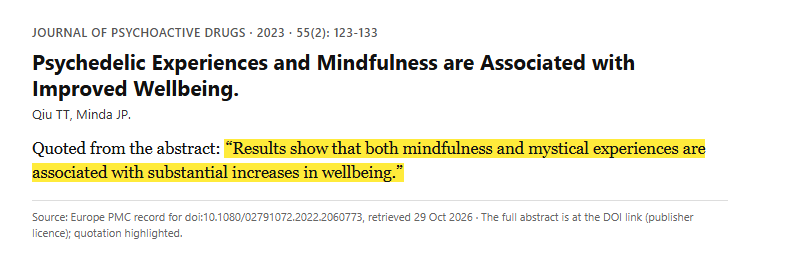
Quotation from the abstract of the published study (text from Europe PMC), highlighted in yellow. Source: Qiu TT, Minda JP. Psychedelic Experiences and Mindfulness are Associated with Improved Wellbeing. J Psychoactive Drugs. 2023;55(2):123-133. https://doi.org/10.1080/02791072.2022.2060773
Study 14. Population survey of classic psychedelic experiences and meditation practice in 2,822 US adults (Simonsson, 2023)
Psychological insight and ego dissolution from psychedelics were linked to more frequent mindfulness and loving-kindness meditation in 2,822 US adults!
This population-based observational study of 2,822 US adults examined classic psychedelic experiences alongside current meditation practice using covariate-adjusted models. Lifetime classic psychedelic use was associated with a higher frequency of current mindfulness meditation practice, and both psychological insight and ego dissolution were associated with more frequent mindfulness and loving-kindness or compassion meditation. The authors suggested that classic psychedelic experiences may exert a positive effect on cultivating and maintaining healthy habits such as regular meditation, with psychological insight the stronger predictor.
“Both psychological insight and "ego dissolution" were associated with a higher frequency of current mindfulness meditation practice and current loving-kindness or compassion meditation practice.”
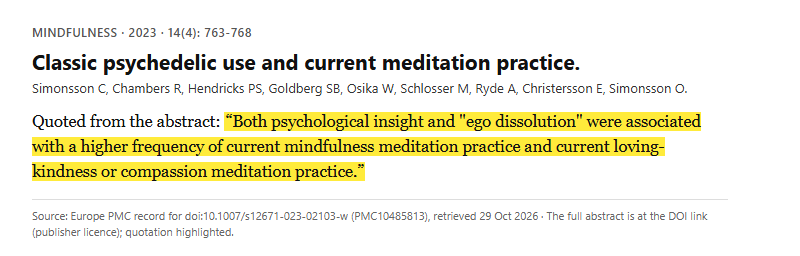
Quotation from the abstract of the published study (text from Europe PMC), highlighted in yellow. Source: Simonsson C, Chambers R, Hendricks PS, et al. Classic psychedelic use and current meditation practice. Mindfulness (N Y). 2023;14(4):763-768. https://doi.org/10.1007/s12671-023-02103-w
Study 15. Population-based survey of psychedelic use and meditation in 953 American adults (Simonsson, 2023)
Among meditators, greater ego dissolution was linked to more frequent practice and to finding meditation more effective, in a representative sample of 953 American adults!
Researchers surveyed a representative sample of 953 American adults, and 536 meditators completed a follow-up survey (a 92.1% response rate). Among meditators, greater ego dissolution during their most intense psychedelic experience was associated with more frequent meditation practice and with finding meditation more effective. Both lifetime classic psychedelic use and ego dissolution were associated with enlightenment as a motivation to meditate and with a lower likelihood of perceived barriers to practice, results the authors said support potential synergy between psychedelics and meditation.
“Both lifetime classic psychedelic use and ego dissolution were associated with enlightenment as motivation to practice meditation as well as lower likelihood of overall perceived barriers to meditation practice. Ego dissolution was positively associated with finding meditation more effective.”
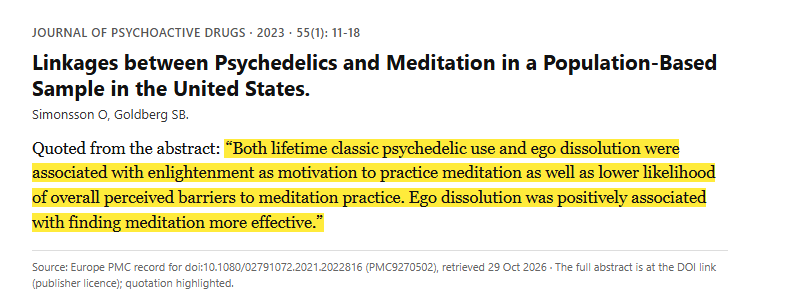
Quotation from the abstract of the published study (text from Europe PMC), highlighted in yellow. Source: Simonsson O, Goldberg SB. Linkages between Psychedelics and Meditation in a Population-Based Sample in the United States. J Psychoactive Drugs. 2023;55(1):11-18. https://doi.org/10.1080/02791072.2021.2022816
Study 16. Thematic analysis of 256 accounts of combining psychedelics with meditation (Azmoodeh, 2023)
256 people who combined psychedelics with meditation described acceptance, connection, peacefulness, and transformation in their written accounts!
In an online survey of people with at least one psychedelic experience, 875 (66.5%) said they meditated and 345 (39.4%) of them had combined psychedelic use with meditation practice. Researchers analysed 256 written accounts and identified themes including compatibility between psychedelic and meditative states, enhancement of both experiences, beneficial changes in relating to the internal and external world, and meditation as a preparatory and navigational tool. The authors concluded that these experiences support the parallels and complementarity between psychedelic effects and meditation, with implications for their combined therapeutic use.
“Participants' experiences appear to support recent empirical and theoretical work on the parallels and complementarity between psychedelic drug effects and meditation. The findings identify facilitating conditions for combining psychedelics with meditation, which may have implications for their combined therapeutic use.”
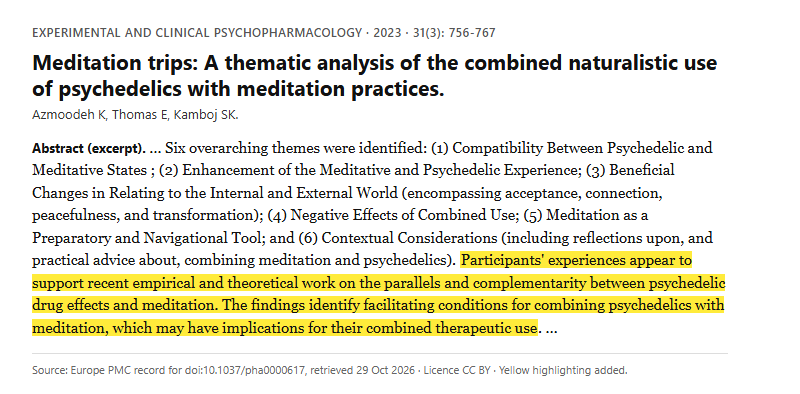
Abstract of the published study (text from Europe PMC), key sentence highlighted in yellow. Source: Azmoodeh K, Thomas E, Kamboj SK. Meditation trips: A thematic analysis of the combined naturalistic use of psychedelics with meditation practices. Exp Clin Psychopharmacol. 2023;31(3):756-767. https://doi.org/10.1037/pha0000617
Related pages on this site
Spiritual Wellness · Personality and Traits · Set and Setting · Brain Imaging Research · Wellness of the 'Well'
This page summarizes published research for education only. It is not medical advice. Any change to a medication remains the decision of that person’s own prescriber.
Keep reading
All Educational Resources · About This Archive · For Practicum Supervisors