

Researchers have called music the hidden therapist of psychedelic therapy! In interviews with 19 patients with treatment-resistant depression, the music experience predicted reductions in depression 1 week after psilocybin, while general drug intensity did not (Kaelen, 2018). A scoping review of 19 studies with 330 participants found that music amplifies and intensifies emotions (Rowe, 2026). In a placebo-controlled study, LSD enhanced the emotional response to music, especially wonder, transcendence, power and tenderness (Kaelen, 2015), and a substantial majority of more than 2,000 Canadian Psychedelic Survey participants experienced both therapeutic benefits and enjoyment from music with psychedelics (Gloeckler, 2024). Encouraging to see researchers studying the playlist as carefully as the medicine!
Key studies
Study 1. Interview study of how music shaped psilocybin therapy in 19 patients with treatment-resistant depression (Kaelen, 2018)
The music experience predicted reductions in depression 1 week after psilocybin in 19 patients, while general drug intensity did not!
Researchers interviewed 19 patients receiving psilocybin therapy for treatment-resistant depression about the role music played in their sessions. Patients described music evoking personally meaningful and therapeutically useful emotion and imagery, a sense of guidance, openness, calm and safety, and their experience of the music was associated with mystical experiences and insightfulness. Strikingly, the nature of the music experience significantly predicted reductions in depression 1 week after psilocybin, whereas general drug intensity did not, leading the authors to conclude that music plays a central therapeutic function in psychedelic therapy.
“Crucially, the nature of the music experience was significantly predictive of reductions in depression 1 week after psilocybin, whereas general drug intensity was not.”
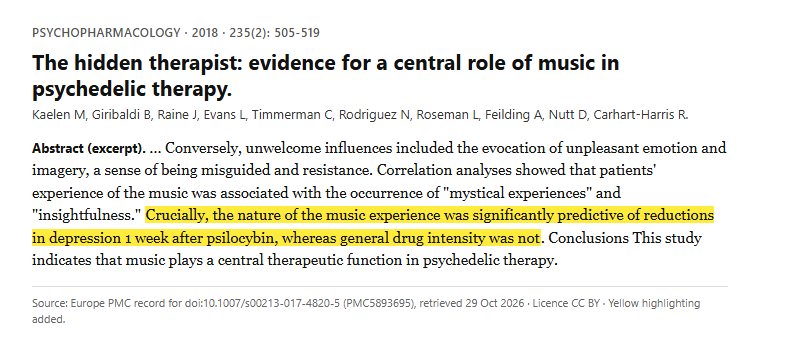
Abstract of the published study (text from Europe PMC), key sentence highlighted in yellow. Source: Kaelen M, Giribaldi B, Raine J, et al. The hidden therapist: evidence for a central role of music in psychedelic therapy. Psychopharmacology (Berl). 2018;235(2):505-519. https://doi.org/10.1007/s00213-017-4820-5
Study 2. Scoping review of music across 19 quantitative psychedelic studies with 330 participants (Rowe, 2026)
19 studies with 330 participants map how music shapes the psychedelic experience!
Researchers followed PRISMA guidelines to search MEDLINE, Embase, PsychINFO and Scopus for quantitative human studies of music and psychedelics in therapeutic and controlled experimental settings, and 19 papers with a total of 330 participants met inclusion criteria. Psilocybin and LSD were the most studied compounds. The review found that music modulates the psychedelic experience by amplifying and intensifying emotions, recruiting brain networks involved in meaning-attribution and visual imagery, and increasing overall neural entropy. The authors concluded that the review underscores the critical role of music in shaping psychedelic experiences and therapeutic outcomes.
“The findings suggest that music modulates the psychedelic experience through: (1) amplifying and intensifying emotions, (2) recruiting brain networks involved in meaning-attribution and visual imagery, and (3) increasing overall neural entropy.”
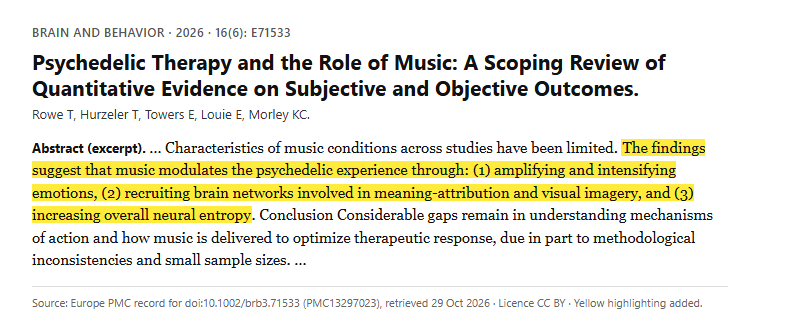
Abstract of the published study (text from Europe PMC), key sentence highlighted in yellow. Source: Rowe T, Hurzeler T, Towers E, et al. Psychedelic Therapy and the Role of Music: A Scoping Review of Quantitative Evidence on Subjective and Objective Outcomes. Brain Behav. 2026;16(6):e71533. https://doi.org/10.1002/brb3.71533
Study 3. Qualitative analysis of music experiences from interviews with thirty-one participants in a randomized trial of psilocybin-assisted psychotherapy for life-threatening illness (O'Callaghan, 2026)
Participants with life-threatening illness felt more intensely connected to music in psilocybin sessions than in control sessions, in interviews with thirty-one trial participants!
Inside an 11-session, manualized randomized controlled trial of psilocybin-assisted psychotherapy for depression and anxiety linked to life-threatening illness, a music therapist-led analysis examined interviews from thirty-one participants. Participants felt more intensely connected to music in psilocybin sessions compared with control sessions. Researchers reported that music during psilocybin could connect and integrate with deep multisensorial, somatic and mental realms, catalyze awareness of one's essence, and access lasting sensations that spawned ongoing processing.
“Participants felt more intensely connected to music in psilocybin compared to control sessions.”
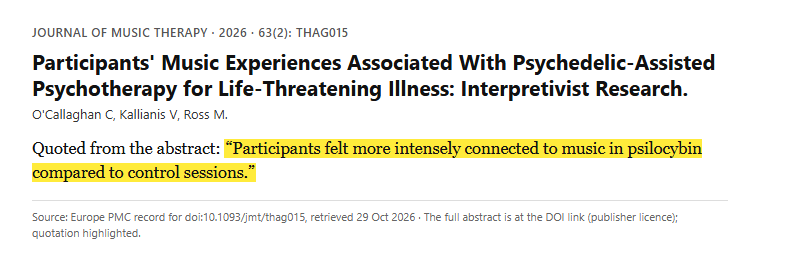
Quotation from the abstract of the published study (text from Europe PMC), highlighted in yellow. Source: O'Callaghan C, Kallianis V, Ross M. Participants' Music Experiences Associated With Psychedelic-Assisted Psychotherapy for Life-Threatening Illness: Interpretivist Research. J Music Ther. 2026;63(2):thag015. https://doi.org/10.1093/jmt/thag015
Study 4. Brain imaging of music listening before and after psilocybin therapy in nineteen patients with treatment-resistant depression (Wall, 2023)
In nineteen patients with treatment-resistant depression, the brain's responsiveness to music was elevated after psilocybin therapy!
Nineteen patients with treatment-resistant depression underwent two psilocybin treatment sessions, with fMRI brain scans of music listening one week before and the day after dosing. Comparing music-listening with resting-state scans, researchers found significantly greater low-frequency brain activity in the bilateral superior temporal cortex during the post-treatment music scan, with a significant effect of treatment in the superior temporal lobe for the music scan only. This music-related activity was significantly correlated with the intensity of the subjective effects felt during the dosing sessions, pointing to an elevated responsiveness to music after psilocybin therapy.
“These data suggest an effect of PT on the brain's response to music, implying an elevated responsiveness to music after psilocybin therapy that was related to subjective drug effects felt during dosing.”
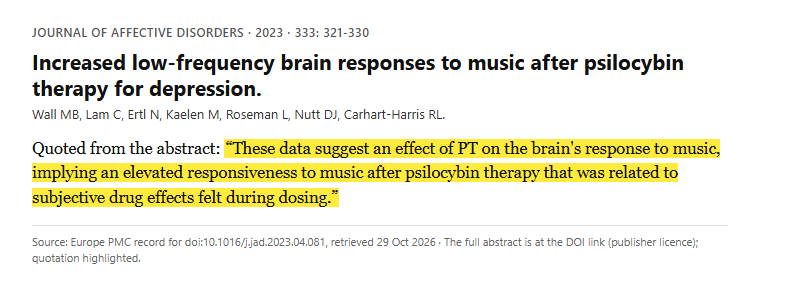
Quotation from the abstract of the published study (text from Europe PMC), highlighted in yellow. Source: Wall MB, Lam C, Ertl N, et al. Increased low-frequency brain responses to music after psilocybin therapy for depression. J Affect Disord. 2023;333:321-330. https://doi.org/10.1016/j.jad.2023.04.081
Study 5. Placebo-controlled study of LSD and music-evoked emotion in ten healthy volunteers (Kaelen, 2015)
In ten healthy volunteers, LSD enhanced the emotional response to music, especially wonder, transcendence, power and tenderness!
Ten healthy volunteers listened to five instrumental music tracks on a placebo day and on an LSD day, rating their emotions with a visual analogue scale and the Geneva Emotional Music Scale (GEMS-9). Researchers found that the emotional response to music was enhanced by LSD, especially the emotions of wonder, transcendence, power and tenderness. The authors note these findings reinforce the long-held view that psychedelics enhance music-evoked emotion.
“Results demonstrated that the emotional response to music is enhanced by LSD, especially the emotions "wonder", "transcendence", "power" and "tenderness".”
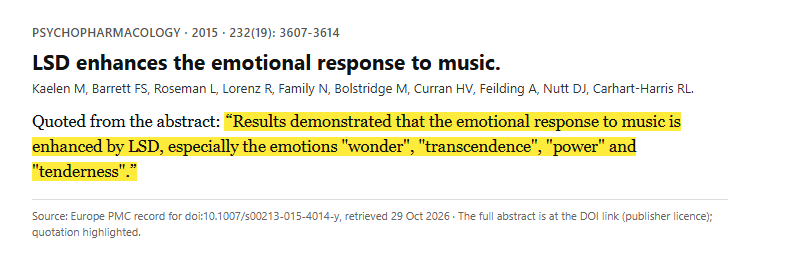
Quotation from the abstract of the published study (text from Europe PMC), highlighted in yellow. Source: Kaelen M, Barrett FS, Roseman L, et al. LSD enhances the emotional response to music. Psychopharmacology (Berl). 2015;232(19):3607-3614. https://doi.org/10.1007/s00213-015-4014-y
Study 6. Placebo-controlled brain imaging of LSD and music listening in twelve healthy volunteers (Kaelen, 2016)
LSD plus music increased information flow from the parahippocampal cortex to the visual cortex in twelve healthy volunteers, tracking enhanced autobiographical imagery!
Twelve healthy volunteers received LSD and, on a separate occasion, placebo, and were scanned with fMRI at eyes-closed rest with and without music. Researchers found increased parahippocampal–visual cortex functional connectivity and information flow in the interaction between music and LSD. Remarkably, this information flow correlated positively with ratings of enhanced eyes-closed visual imagery, including autobiographical imagery, suggesting a plausible brain mechanism by which LSD and music work together to enhance subjective experiences that may be useful in therapy.
“Results revealed increased PHC-visual cortex (VC) functional connectivity and PHC to VC information flow in the interaction between music and LSD. This latter result correlated positively with ratings of enhanced eyes-closed visual imagery, including imagery of an autobiographical nature.”
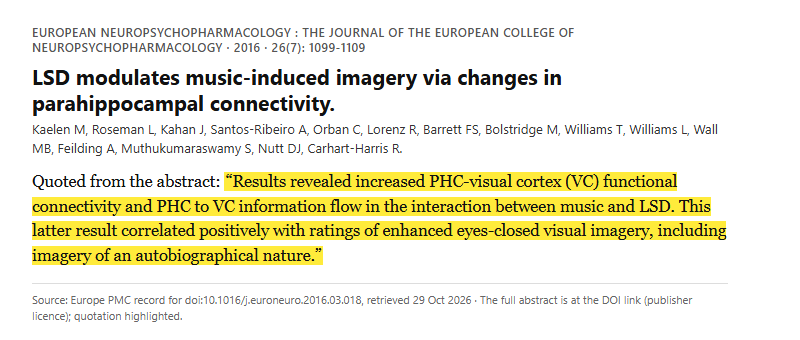
Quotation from the abstract of the published study (text from Europe PMC), highlighted in yellow. Source: Kaelen M, Roseman L, Kahan J, et al. LSD modulates music-induced imagery via changes in parahippocampal connectivity. Eur Neuropsychopharmacol. 2016;26(7):1099-1109. https://doi.org/10.1016/j.euroneuro.2016.03.018
Study 7. Canadian Psychedelic Survey of music and psychedelic use in over 2,000 participants (Gloeckler, 2024)
A substantial majority of more than 2,000 survey participants experienced both therapeutic benefits and enjoyment from combining music with psychedelics!
Drawing on data from over 2,000 participants in the Canadian Psychedelic Survey, researchers explored how music interacts with 11 classical and non-classical psychedelic substances in mostly non-clinical settings. A substantial majority of respondents experienced both therapeutic benefits and enjoyment from integrating music with psychedelic substances. The findings also showed that only 10% and 22% of respondents agreed that music for psychedelic experiences should be unfamiliar and without understandable lyrics, giving valuable real-world guidance for music selection in psychedelic therapies.
“Our findings reveal that a substantial majority of respondents experienced both therapeutic benefits and enjoyment from integrating music with psychedelic substances, although the extent of these benefits varied significantly across different substances.”
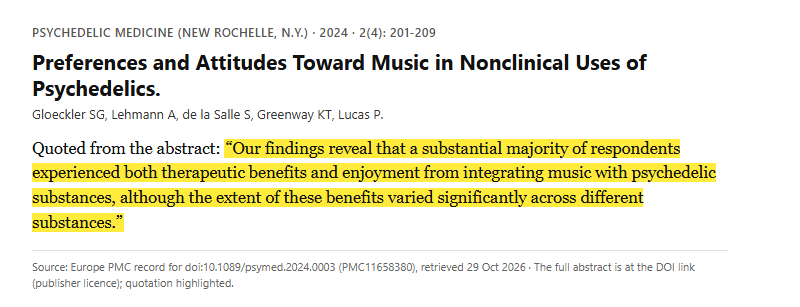
Quotation from the abstract of the published study (text from Europe PMC), highlighted in yellow. Source: Gloeckler SG, Lehmann A, de la Salle S, et al. Preferences and Attitudes Toward Music in Nonclinical Uses of Psychedelics. Psychedelic Med (New Rochelle). 2024;2(4):201-209. https://doi.org/10.1089/psymed.2024.0003
Study 8. Rapid review of participants' music experiences across 10 psychedelic therapy studies with 180 people (O'Callaghan, 2020)
Across 10 studies and 180 participants, music was widely considered integral to meaningful emotional experiences in psychedelic therapy!
Researchers screened 406 articles and included 10 qualitative and quantitative studies covering 180 participants aged 18-69 to understand how people experienced music in psychedelic therapy research. Music was widely considered integral for meaningful emotional and imagery experiences and self-exploration, and could convey love, inspire, and elicit a deep sense of embodied transformation. Participant openness to music and the provision of participant-centered music were associated with optimal immediate and longer-term outcomes.
“Music was widely considered integral for meaningful emotional and imagery experiences and self-exploration during psychedelic therapy.”
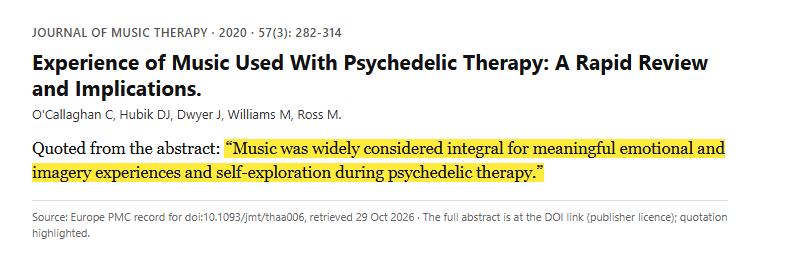
Quotation from the abstract of the published study (text from Europe PMC), highlighted in yellow. Source: O'Callaghan C, Hubik DJ, Dwyer J, et al. Experience of Music Used With Psychedelic Therapy: A Rapid Review and Implications. J Music Ther. 2020;57(3):282-314. https://doi.org/10.1093/jmt/thaa006
Study 9. Survey of experienced psilocybin session guides on music that supports peak mystical experiences (Barrett, 2017)
Experienced psilocybin guides recommended 24 unique pieces of music supportive of peak mystical experiences!
Researchers surveyed ten people with extensive experience administering psilocybin under research or therapeutic conditions about the music they found supportive of mystical experiences. Respondents gave 24 unique recommendations for the peak period and 24 for the period leading up to it, and qualitative and signal-processing analysis of 22 of these pieces described peak-period music as regular and predictable in structure, with a feeling of continuous forward motion that slowly builds over time. The authors present this as a guide for selecting and composing music for future psychedelic research and therapy sessions.
“These results provide a description of music that may be optimally supportive of peak psychedelic experiences. This description can be used to guide the selection and composition of music for future psychedelic research and therapy sessions.”
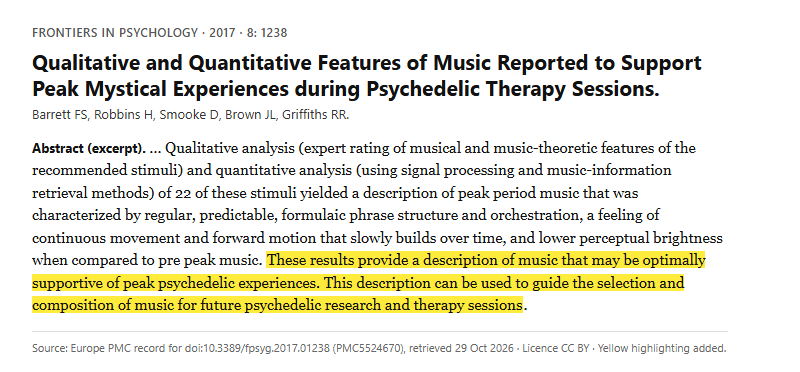
Abstract of the published study (text from Europe PMC), key sentence highlighted in yellow. Source: Barrett FS, Robbins H, Smooke D, et al. Qualitative and Quantitative Features of Music Reported to Support Peak Mystical Experiences during Psychedelic Therapy Sessions. Front Psychol. 2017;8:1238. https://doi.org/10.3389/fpsyg.2017.01238
Related pages on this site
Set and Setting · Treatment-Resistant Depression · Brain Imaging Research · Creativity · Spiritual Wellness
This page summarizes published research for education only. It is not medical advice. Any change to a medication remains the decision of that person’s own prescriber.
Keep reading
All Educational Resources · About This Archive · For Practicum Supervisors