


Psychedelic medicine is reaching the operating room! In a trial of 142 patients having cardiac valve surgery, only 7.0% of esketamine patients had depression on postoperative day 7, versus 31.0% on saline (Zhang, 2025). In 435 major-surgery patients with moderate-to-severe depressive symptoms, 28.3% reached remission three days after surgery with esketamine, versus 11.3% on placebo (Zhou, 2026). A meta-analysis of 16 studies and 1161 esketamine patients found depression scores stayed lower more than 4 weeks after surgery (Wen, 2025), and after wound-repair surgery 73.8% responded by day 3, versus 53.8% on placebo (Yu, 2026). Encouraging to see surgical teams studying how to make recovery brighter!
Key studies
Study 1. Esketamine at anaesthesia induction compared with saline in 142 patients undergoing cardiac valve surgery (Zhang, 2025)
Only 7.0% of esketamine patients had depression on postoperative day 7, versus 31.0% on saline!
In a randomised, double-blind, placebo-controlled trial across three centers, 142 patients undergoing cardiac valve surgery received a single intravenous dose of esketamine or saline at anaesthesia induction. Researchers reported strikingly lower rates of depression (7.0% vs. 31.0%) and anxiety (11.3% vs. 35.2%) at postoperative day 7, along with reduced delirium (9.8% vs. 22.5%). Pain, sleep and quality of recovery also improved, and mechanistic analyses showed lower inflammatory markers (IL-6, CRP) and higher brain-derived neurotrophic factor (BDNF).
“Results showed that the esketamine group had significantly lower rates of depression (7.0 % vs. 31.0 %; P < 0.001) and anxiety (11.3 % vs. 35.2 %; P < 0.001) at POD 7, along with reduced delirium incidence (9.8 % vs. 22.5 %; P = 0.040). Improvements were also observed in pain, sleep, and recovery quality.”
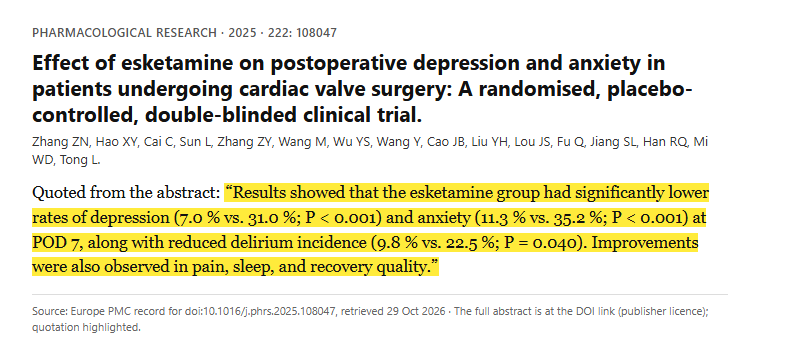
Quotation from the abstract of the published study (text from Europe PMC), highlighted in yellow. Source: Zhang ZN, Hao XY, Cai C, et al. Effect of esketamine on postoperative depression and anxiety in patients undergoing cardiac valve surgery: A randomised, placebo-controlled, double-blinded clinical trial. Pharmacol Res. 2025;222:108047. https://doi.org/10.1016/j.phrs.2025.108047
Study 2. Double-blind randomized trial of esketamine added to standard anesthesia in 133 patients having laparoscopic gastric cancer surgery (Lin, 2024)
In 133 patients after stomach-cancer surgery, esketamine significantly lowered fatigue scores on day 3!
Researchers randomly assigned 133 patients with gastric cancer undergoing laparoscopic radical gastrectomy to standardized anesthesia alone (n = 66) or standardized anesthesia plus esketamine (n = 67) in a double-blind trial. On the third day after surgery, Christensen fatigue scores were significantly lower in the esketamine group than in the control group (estimated difference, -0.70; P = 0.040). The esketamine group also showed a significant decrease in the occurrence of fatigue on both the first and third days after surgery. The authors concluded that perioperative esketamine can improve postoperative fatigue syndrome after laparoscopic radical gastrectomy.
“In the group receiving esketamine, the fatigue scores of Christensen on the third day after surgery were significantly lower compared to the Group C (estimated difference, -0.70; 95% CI, -1.37 to -0.03; P = 0.040).”
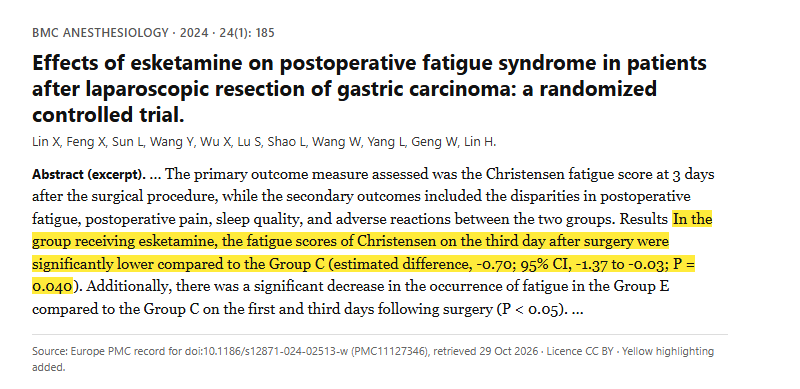
Abstract of the published study (text from Europe PMC), key sentence highlighted in yellow. Source: Lin X, Feng X, Sun L, et al. Effects of esketamine on postoperative fatigue syndrome in patients after laparoscopic resection of gastric carcinoma: a randomized controlled trial. BMC Anesthesiol. 2024;24(1):185. https://doi.org/10.1186/s12871-024-02513-w
Study 3. Intraoperative esketamine compared with placebo in 435 major-surgery patients with moderate-to-severe depressive symptoms (Zhou, 2026)
28.3% of surgery patients with depressive symptoms reached remission 3 days after esketamine, versus 11.3% on placebo!
In a multicenter, randomized, placebo-controlled, double-blinded trial, 435 patients with moderate-to-severe perioperative depressive symptoms undergoing major surgery received esketamine (n = 218) or placebo (n = 217) during their operation. Researchers reported a striking difference in the primary outcome, remission (a Montgomery-Åsberg score of 10 or less) 3 days after surgery: 28.3% with esketamine versus 11.3% with placebo, an odds ratio of 3.12. Intraoperative esketamine gave a greater proportion of participants whose depressive symptoms improved.
“The remission rate was greater in the esketamine group than in the placebo group at 3 days post-surgery (28.3% vs. 11.3%; OR 3.12 [95% CI, 1.79-5.55]; P < 0.001).”
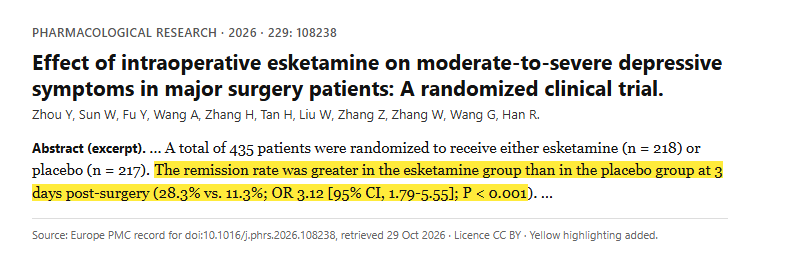
Abstract of the published study (text from Europe PMC), key sentence highlighted in yellow. Source: Zhou Y, Sun W, Fu Y, et al. Effect of intraoperative esketamine on moderate-to-severe depressive symptoms in major surgery patients: A randomized clinical trial. Pharmacol Res. 2026;229:108238. https://doi.org/10.1016/j.phrs.2026.108238
Study 4. Systematic review of nine randomized trials of ketamine and esketamine for mood after orthopaedic surgery (Dabbagh, 2026)
Four of five trials that measured anxiety found lower scores with ketamine or esketamine after orthopaedic surgery!
Researchers systematically reviewed nine randomized controlled trials in adults having major orthopaedic surgery, comparing perioperative ketamine or esketamine with placebo or no ketamine-class agent, with follow-up from 24 hours to 12 months. Of the five trials that measured postoperative anxiety on validated scales, four reported significantly lower anxiety scores with ketamine or esketamine at early postoperative time points. Across the included trials, perioperative ketamine and esketamine were linked with lower early postoperative anxiety and depressive symptom scores in orthopaedic patients.
“Five trials assessed postoperative anxiety using validated scales; four reported significantly lower anxiety scores with ketamine or esketamine at early postoperative time points, whereas one trial using a single preoperative dose of ketamine found no significant anxiolytic effect.”
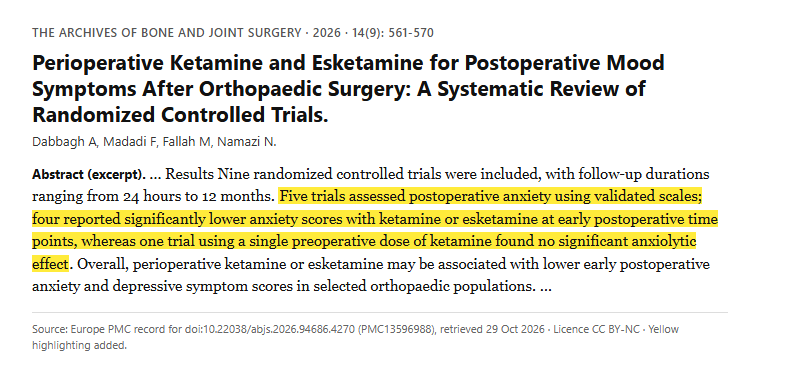
Abstract of the published study (text from Europe PMC), key sentence highlighted in yellow. Source: Dabbagh A, Madadi F, Fallah M, Namazi N. Perioperative Ketamine and Esketamine for Postoperative Mood Symptoms After Orthopaedic Surgery: A Systematic Review of Randomized Controlled Trials. Arch Bone Jt Surg. 2026;14(9):561-570. https://doi.org/10.22038/abjs.2026.94686.4270
Study 5. Meta-analysis of 16 randomized studies of perioperative esketamine for postoperative depression, with 1161 esketamine-treated patients and 1106 controls (Wen, 2025)
Across 16 studies and 1161 esketamine patients, depression scores stayed lower more than 4 weeks after surgery!
This meta-analysis of randomized controlled studies pooled 16 studies in which 1161 patients received perioperative intravenous esketamine and 1106 patients served as controls. Researchers found that esketamine was efficacious in reducing postoperative depression scores, and that the esketamine group kept a lower depression score than the control group more than 4 weeks after surgery. Esketamine also lowered postoperative pain scores.
“Esketamine was efficacious in reducing postoperative depression scores when administered perioperatively, and the esketamine group maintained a lower postoperative depression score than the control group more than 4 weeks after surgery.”
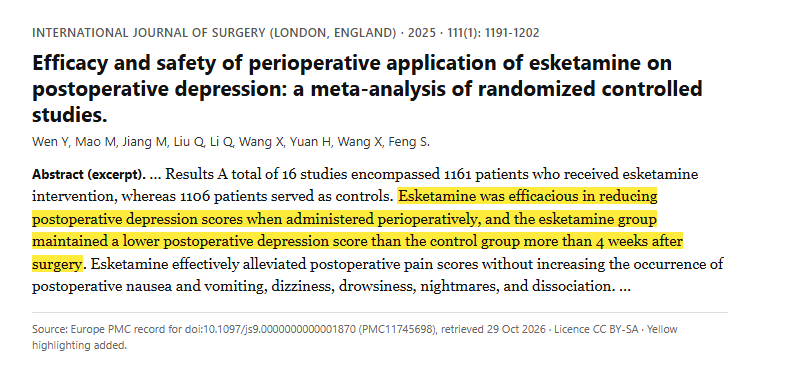
Abstract of the published study (text from Europe PMC), key sentence highlighted in yellow. Source: Wen Y, Mao M, Jiang M, et al. Efficacy and safety of perioperative application of esketamine on postoperative depression: a meta-analysis of randomized controlled studies. Int J Surg. 2025;111(1):1191-1202. https://doi.org/10.1097/js9.0000000000001870
Study 6. Randomized trial of esketamine, magnesium sulfate or saline in 137 patients having sinus surgery (Wang, 2026)
Esketamine lowered anxiety and depression scores after sinus surgery in a 137-patient randomized trial, and outperformed magnesium sulfate by day 2!
In this randomized controlled trial, 137 patients scheduled for endoscopic sinus surgery received esketamine, magnesium sulfate or a saline control before induction, with mood measured on the Hospital Anxiety and Depression Scale and the Self-rating Anxiety and Depression Scales on postoperative days 1 and 2. Researchers reported that on day 1 all three mood scores were significantly lower with esketamine and with magnesium sulfate than with saline. Esketamine went further, showing superior efficacy over magnesium sulfate on postoperative day 2.
“Intravenous esketamine or magnesium sulfate effectively alleviated negative emotions and pain on POD1 in patients undergoing ESS.Esketamine demonstrated superior efficacy over magnesium sulfate on POD2.”
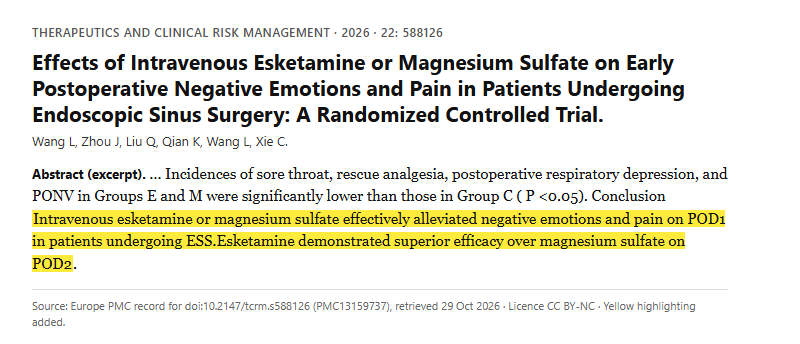
Abstract of the published study (text from Europe PMC), key sentence highlighted in yellow. Source: Wang L, Zhou J, Liu Q, et al. Effects of Intravenous Esketamine or Magnesium Sulfate on Early Postoperative Negative Emotions and Pain in Patients Undergoing Endoscopic Sinus Surgery: A Randomized Controlled Trial. Ther Clin Risk Manag. 2026;22:588126. https://doi.org/10.2147/tcrm.s588126
Study 7. Meta-analysis of fifteen randomized trials of perioperative esketamine in 1,515 breast cancer surgery patients (Ji, 2026)
Fifteen randomized trials in 1,515 breast cancer surgery patients linked esketamine to lower depressive symptom scores at every time point, out to long-term follow-up (SMD = -1.16)!
This meta-analysis pooled fifteen randomized controlled trials involving 1,515 patients undergoing breast cancer surgery, comparing perioperative esketamine with control interventions. Researchers reported significantly lower postoperative depressive symptom scores at postoperative day 1 (SMD = -0.78), day 3 (SMD = -1.07), day 7 (SMD = -0.79) and long-term follow-up (SMD = -1.16). Esketamine was also associated with lower pain scores at day 1 and day 3 (MD = -0.66 at each).
“Perioperative esketamine was associated with significantly lower postoperative depressive symptom scores at postoperative day 1 (SMD = -0.78, 95% CI: -1.08 to -0.48), postoperative day 3 or 48-72 h (SMD = -1.07, 95% CI: -1.63 to -0.51), postoperative day 7 (SMD = -0.79, 95% CI: -1.10 to -0.49), and long-term follow-up (SMD = -1.16, 95% CI: -1.68 to -0.64).”
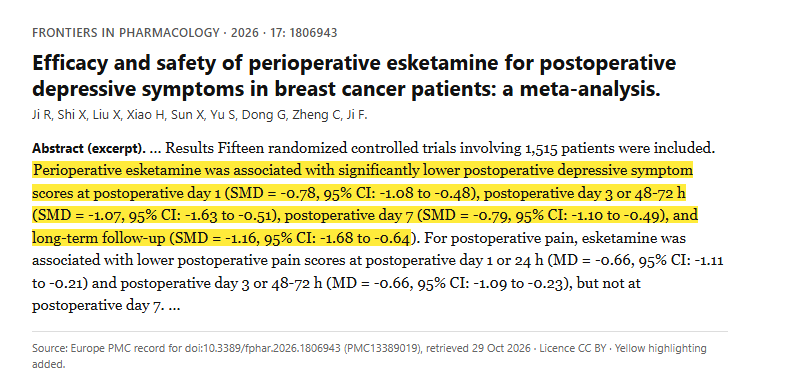
Abstract of the published study (text from Europe PMC), key sentence highlighted in yellow. Source: Ji R, Shi X, Liu X, et al. Efficacy and safety of perioperative esketamine for postoperative depressive symptoms in breast cancer patients: a meta-analysis. Front Pharmacol. 2026;17:1806943. https://doi.org/10.3389/fphar.2026.1806943
Study 8. Double-blind randomized trial of three intraoperative esketamine doses versus saline in 132 elderly patients having knee arthroplasty (Fang, 2026)
Esketamine lifted recovery quality and emotional state in a dose-dependent way in a 132-patient knee-replacement trial!
In this single-centre, double-blind controlled trial, 132 elderly patients having knee arthroplasty were randomized to one of three esketamine infusion levels or a saline control. Researchers found that esketamine increased the QoR-40 quality-of-recovery score on postoperative day 1 in a dose-dependent way. The same dose-dependent pattern lifted emotional state and psychological support while reducing pain, analgesic consumption and insomnia on postoperative days 1 and 2.
“A similar and dose-dependent effect was observed on emotion state and psychological support (improved), and on pain, analgesic consumption and insomnia (reduced), both at POD1 and 2.”
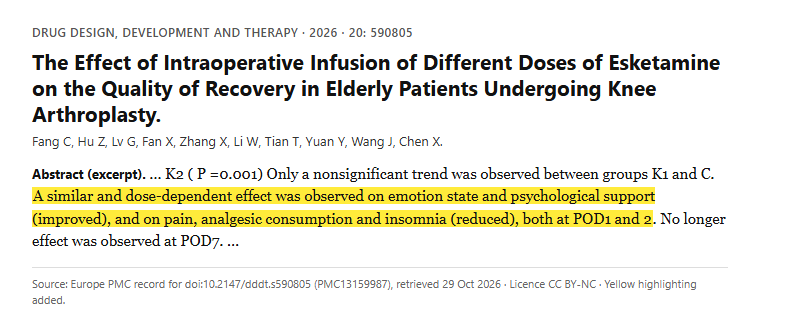
Abstract of the published study (text from Europe PMC), key sentence highlighted in yellow. Source: Fang C, Hu Z, Lv G, et al. The Effect of Intraoperative Infusion of Different Doses of Esketamine on the Quality of Recovery in Elderly Patients Undergoing Knee Arthroplasty. Drug Des Devel Ther. 2026;20:590805. https://doi.org/10.2147/dddt.s590805
Study 9. Systematic review and meta-analysis of 8 randomized trials of perioperative esketamine for postoperative depression in 1724 patients (Li, 2025)
8 randomized trials with 1724 patients: esketamine significantly reduced postoperative depression compared with control groups!
This systematic review and meta-analysis included 8 randomized controlled trials involving 1724 surgical patients. Researchers found that esketamine, compared with control groups, significantly reduced postoperative depression, with improvements observed at 1 week (RD -0.09). The authors concluded that esketamine demonstrates efficacy in reducing both the incidence and the severity of postoperative depression.
“The meta-analysis revealed that esketamine treatment, compared with control groups, significantly reduced POD.”
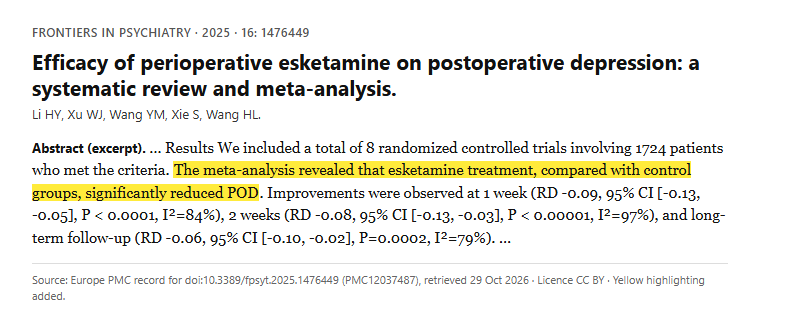
Abstract of the published study (text from Europe PMC), key sentence highlighted in yellow. Source: Li HY, Xu WJ, Wang YM, et al. Efficacy of perioperative esketamine on postoperative depression: a systematic review and meta-analysis. Front Psychiatry. 2025;16:1476449. https://doi.org/10.3389/fpsyt.2025.1476449
Study 10. Intraoperative esketamine compared with placebo in 130 patients with moderate-to-severe depressive symptoms undergoing multiple wound repair surgeries (Yu, 2026)
73.8% of wound-repair surgery patients responded to esketamine by day 3, versus 53.8% on placebo!
In a multi-centre, randomized, double-blind, placebo-controlled trial, 130 adults facing repeated wound repair surgeries (65 per group) received esketamine or saline during surgery. Response (a 50% or greater drop in MADRS score) was significantly higher with esketamine on every one of postoperative days 1 to 3: 53.8% vs 26.2% on day 1, 60.0% vs 40.0% on day 2 and 73.8% vs 53.8% on day 3. Remission rates were also remarkable, reaching 56.9% vs 23.1% on day 3, and the authors concluded that low-dose esketamine can rapidly and effectively alleviate moderate-to-severe anxiety and depressive symptoms in the early postoperative period.
“The esketamine group showed a significantly higher response rate than the placebo group on POD 1-3. (POD 1: 53.8% vs. 26.2%, p = 0.001; POD 2: 60.0% vs. 40.0%, p = 0.009; POD 3: 73.8% vs. 53.8%, p = 0.018).”
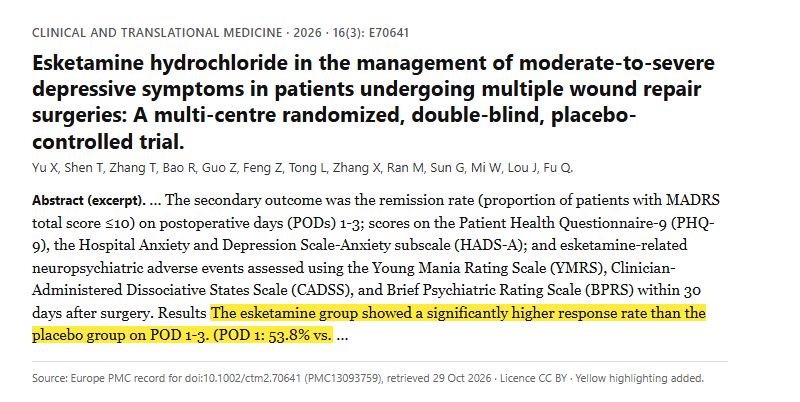
Abstract of the published study (text from Europe PMC), key sentence highlighted in yellow. Source: Yu X, Shen T, Zhang T, et al. Esketamine hydrochloride in the management of moderate-to-severe depressive symptoms in patients undergoing multiple wound repair surgeries: A multi-centre randomized, double-blind, placebo-controlled trial. Clin Transl Med. 2026;16(3):e70641. https://doi.org/10.1002/ctm2.70641
Study 11. Randomized non-inferiority trial of esketamine versus a nerve block in one hundred twelve patients having thoracoscopic surgery (Liu, 2026)
Esketamine was non-inferior to a nerve block for recovery quality in one hundred twelve chest-surgery patients, with lower anxiety and depression scores!
In this randomized controlled non-inferiority trial, one hundred twelve patients undergoing video-assisted thoracoscopic surgery received either intravenous esketamine with a sham erector spinae plane block or an active block with intravenous saline. Recovery quality on the 15-item QoR-15 scale met the non-inferiority criterion on postoperative days 1 and 2. The esketamine group had lower Hospital Anxiety and Depression Scale scores, and the authors credited its recovery quality primarily to its beneficial effects on mood, describing it as an adjunct with anxiolytic and antidepressant effects.
“Intravenous esketamine provides postoperative recovery quality that is non-inferior to ESPB after VATS, primarily because of its beneficial effects on mood, which compensates for its weaker early analgesia.”
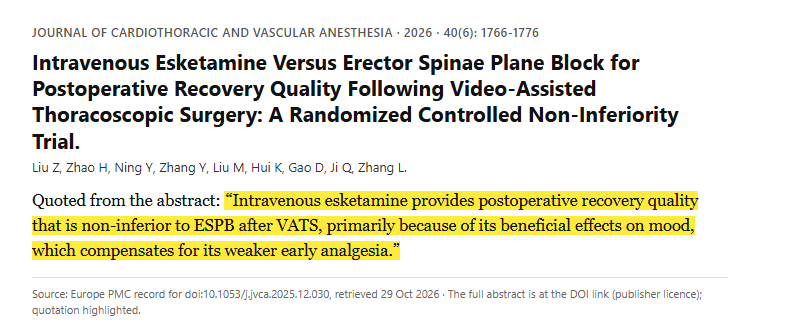
Quotation from the abstract of the published study (text from Europe PMC), highlighted in yellow. Source: Liu Z, Zhao H, Ning Y, et al. Intravenous Esketamine Versus Erector Spinae Plane Block for Postoperative Recovery Quality Following Video-Assisted Thoracoscopic Surgery: A Randomized Controlled Non-Inferiority Trial. J Cardiothorac Vasc Anesth. 2026;40(6):1766-1776. https://doi.org/10.1053/j.jvca.2025.12.030
Study 12. Secondary analysis of a four-arm randomized trial of lidocaine plus esketamine, lidocaine, esketamine or saline in 140 adults having endoscopic sinus surgery (Zheng, 2026)
Lidocaine plus esketamine lowered next-day anxiety and depression scores by 4.9 and 5.7 points versus saline after sinus surgery!
This secondary analysis of a single-center randomized four-arm study included 140 adults (35 per group) having functional endoscopic sinus surgery, comparing lidocaine plus esketamine, lidocaine, esketamine and saline infusions. Lidocaine plus esketamine was associated with higher patient-reported recovery than saline on postoperative day 1 (adjusted mean difference 10.5) and day 2 (8.2). It also brought lower day-1 anxiety and depression scores (-4.9 and -5.7 points) and lower inflammatory markers at 24 h.
“In this secondary analysis, perioperative lidocaine plus esketamine during FESS was associated with higher QoR-40-assessed patient-reported recovery on POD1 and POD2, lower early anxiety/depression symptom scores, and lower postoperative inflammatory biomarkers.”
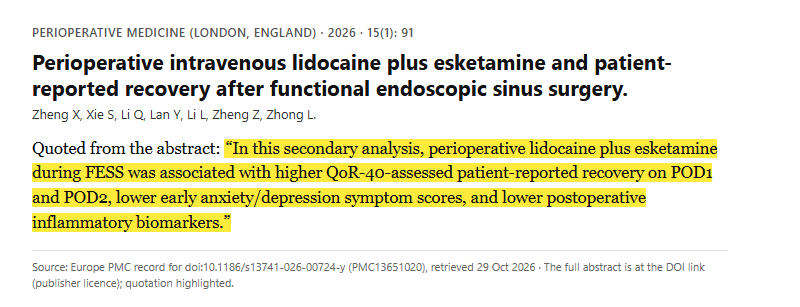
Quotation from the abstract of the published study (text from Europe PMC), highlighted in yellow. Source: Zheng X, Xie S, Li Q, et al. Perioperative intravenous lidocaine plus esketamine and patient-reported recovery after functional endoscopic sinus surgery. Perioper Med (Lond). 2026;15(1):91. https://doi.org/10.1186/s13741-026-00724-y
Study 13. Randomized trial of an esketamine-containing opioid-free anaesthesia regimen in 106 patients having mastectomy for breast cancer (Deng, 2026)
Postoperative anxiety scores were 41 vs. 48 with an esketamine-containing opioid-free regimen after mastectomy!
In this participant- and assessor-blinded randomized trial, 106 patients undergoing modified radical mastectomy received either an opioid-free regimen using dexmedetomidine and esketamine during surgery and esketamine-based analgesia afterwards (n = 53), or opioid-based anaesthesia (n = 53). Researchers reported that State Anxiety Inventory scores 24 hours after surgery were significantly lower with the opioid-free regimen, at a median of 41 versus 48. The multicomponent regimen reduced early postoperative state anxiety compared with the opioid-based regimen.
“The evaluated multicomponent opioid-free perioperative regimen reduced early postoperative state-anxiety scores compared with the opioid-based regimen.”
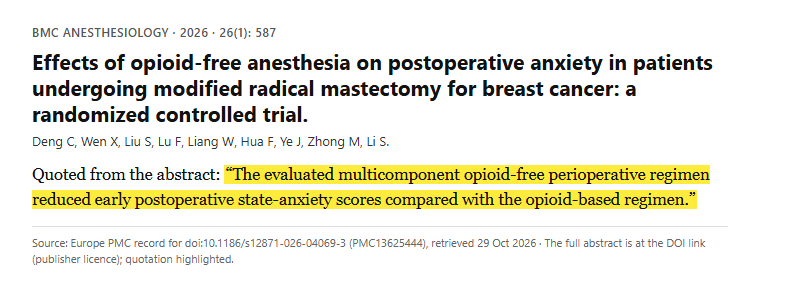
Quotation from the abstract of the published study (text from Europe PMC), highlighted in yellow. Source: Deng C, Wen X, Liu S, et al. Effects of opioid-free anesthesia on postoperative anxiety in patients undergoing modified radical mastectomy for breast cancer: a randomized controlled trial. BMC Anesthesiol. 2026;26(1):587. https://doi.org/10.1186/s12871-026-04069-3
Study 14. Esketamine at induction and in patient-controlled analgesia compared with placebo in patients having laparoscopic colorectal cancer surgery (He, 2026)
Esketamine lowered anxiety and depression scores on postoperative days 1 and 3 and raised patient satisfaction!
In this prospective, randomized, placebo-controlled study, adults having elective laparoscopic radical resection for colorectal cancer received conventional anesthesia or esketamine at induction plus esketamine in their patient-controlled analgesia. Researchers reported significantly lower HADS anxiety and depression scores on postoperative days 1 and 3 with esketamine, along with lower 24 h interleukin-6 and higher patient satisfaction.
“Esketamine given during induction and in PCIA reduced early-stage postoperative HADS scores and improved patient satisfaction in colorectal cancer patients.”
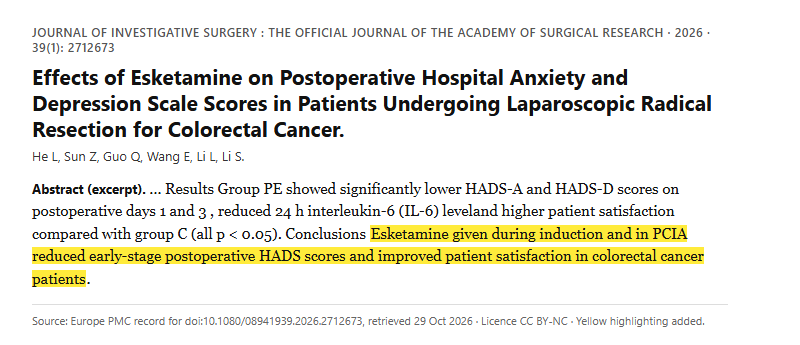
Abstract of the published study (text from Europe PMC), key sentence highlighted in yellow. Source: He L, Sun Z, Guo Q, et al. Effects of Esketamine on Postoperative Hospital Anxiety and Depression Scale Scores in Patients Undergoing Laparoscopic Radical Resection for Colorectal Cancer. J Invest Surg. 2026;39(1):2712673. https://doi.org/10.1080/08941939.2026.2712673
Study 15. Retrospective study of preoperative esketamine in 105 middle-aged and elderly patients having lumbar fusion surgery (Lu, 2026)
Postoperative fatigue syndrome fell to 46.67% with higher-dose esketamine, versus 92.50% in controls!
This retrospective study analysed 105 middle-aged and elderly patients having posterior lumbar interbody fusion, grouped as higher-dose esketamine, lower-dose esketamine or control, with fatigue, depression and anxiety assessed before surgery and on postoperative days 3 and 5. Researchers reported a striking drop in postoperative fatigue syndrome with the higher-dose regimen: 46.67%, compared with 88.57% in the lower-dose group and 92.50% in controls. The authors concluded that preoperative esketamine effectively prevents postoperative fatigue syndrome, with the higher dose showing superior efficacy in reducing postoperative anxiety, depression and pain.
“Preoperative intravenous esketamine administration effectively prevents POFS in middle-aged and elderly patients undergoing PLIF under general anesthesia in the prone position. An esketamine dose of 0.5 mg/kg shows superior efficacy in reducing postoperative anxiety, depression, and pain levels.”
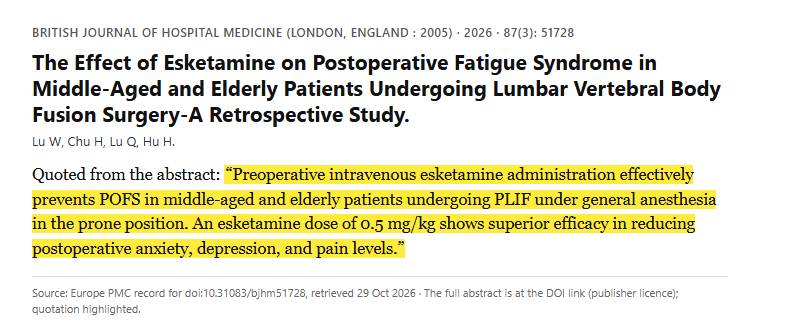
Quotation from the abstract of the published study (text from Europe PMC), highlighted in yellow. Source: Lu W, Chu H, Lu Q, Hu H. The Effect of Esketamine on Postoperative Fatigue Syndrome in Middle-Aged and Elderly Patients Undergoing Lumbar Vertebral Body Fusion Surgery-A Retrospective Study. Br J Hosp Med (Lond). 2026;87(3):51728. https://doi.org/10.31083/bjhm51728
Related pages on this site
Depressive Disorders · Anxiety Disorders · Acute Pain · Major Depressive Disorder · Physical Well Being
This page summarizes published research for education only. It is not medical advice. Any change to a medication remains the decision of that person’s own prescriber.
Keep reading
All Educational Resources · About This Archive · For Practicum Supervisors