

Big news for obsessive-compulsive disorder (OCD) research! In a randomized trial of 15 people, psilocybin but not placebo significantly reduced OCD severity scores, with 73.3% responders and 40% in remission at the end of treatment, and substantial effects still present at six months. A ketamine crossover study reported greater, dose-related score reductions than an active control; psilocybin brought a rapid-onset, moderate to large effect on compulsive symptoms in 19 adults; and an earlier study reported marked symptom decreases in all nine participants. Encouraging to see careful research bringing such promising results for people living with OCD.
Key studies
Study 1. Repeated psilocybin or active placebo in 15 people with OCD (Moreno, 2026)
Psilocybin, but not placebo, significantly reduced OCD scores, with 73.3% of people responders and 40% in remission!
In a randomized trial of 15 people with OCD, researchers reported that psilocybin, but not placebo, significantly reduced OCD severity scores (YBOCS): at the end of the 8-week treatment 73.3% were responders (at least a 35% reduction) and 40% were in remission, with effects that diminished but remained substantial at six months! Participants were randomized to four weekly sessions of high-dose psilocybin, low-dose psilocybin or an active placebo (lorazepam), five per group under double-blind conditions, then received four more high-dose sessions.
“Psilocybin but not placebo significantly reduced YBOCS scores.”
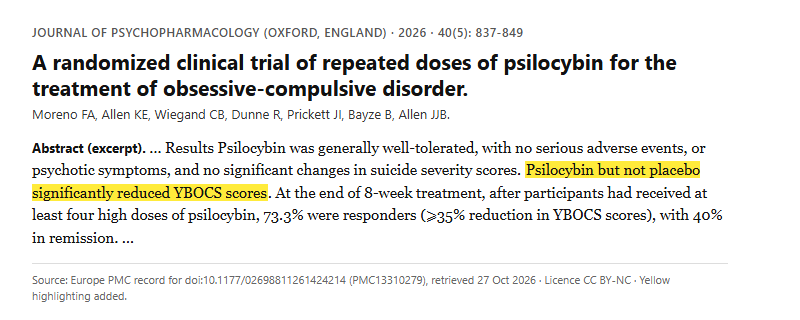
Abstract of the published study (text from Europe PMC), key sentence highlighted in yellow. Source: Moreno FA, Allen KE, Wiegand CB, et al. A randomized clinical trial of repeated doses of psilocybin for the treatment of obsessive-compulsive disorder. J Psychopharmacol. 2026;40(5):837-849. https://doi.org/10.1177/02698811261424214
Study 2. Psilocybin in 19 adults with OCD (Pellegrini, 2025)
A rapid-onset, moderate to large effect on compulsive symptoms after psilocybin, lasting up to one week (d = 0.74, p = 0.003)!
In a study of 19 adults with at least moderate OCD (18 completed all assessments), researchers reported that OCD scores (YBOCS) improved significantly more one week after the higher psilocybin dose than after the lower dose (Cohen's d = 0.82, p = 0.002), mainly for compulsions (d = 0.74, p = 0.003). Participants had psychological support and experienced clinicians present, and psilocybin was reported as well tolerated!
“Psilocybin produced a rapid-onset, moderate to large effect on compulsive symptoms, which lasted up to one week after dosing.”
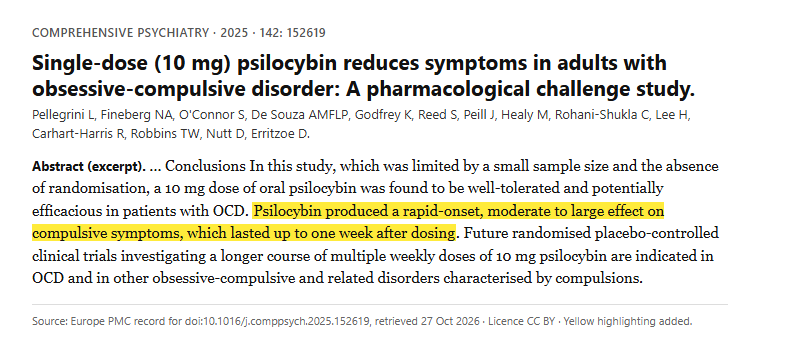
Abstract of the published study (text from Europe PMC), key sentence highlighted in yellow. Source: Pellegrini L, Fineberg NA, O'Connor S, et al. Single-dose (10 mg) psilocybin reduces symptoms in adults with obsessive-compulsive disorder: A pharmacological challenge study. Compr Psychiatry. 2025;142:152619. https://doi.org/10.1016/j.comppsych.2025.152619
Study 3. Ketamine or an active control in 12 people with treatment-resistant OCD (Beaglehole, 2025)
Ketamine's OCD-score reductions were greater than the active control's, dose-related and still separating out to 168 hours!
In a randomized, double-blind crossover study of 12 adults with severe treatment-resistant OCD (10 completed), researchers reported that reductions in OCD scores (Y-BOCS) were greater and statistically dose-related with ketamine, a dissociative anesthetic given by injection into muscle, than with fentanyl as a psychoactive control (dose linear trend p = 0.031). Score changes were largest at one to two hours with a steady separation from the control out to 168 hours, and the authors described the findings as encouraging!
“The reductions in Y-BOCS scores were greater and statistically dose-related for both ketamine doses than fentanyl”
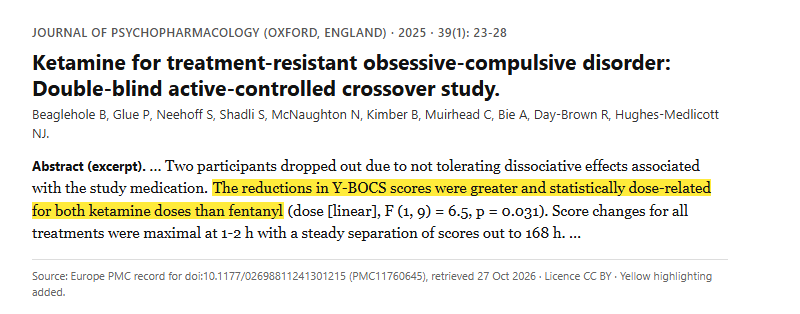
Abstract of the published study (text from Europe PMC), key sentence highlighted in yellow. Source: Beaglehole B, Glue P, Neehoff S, et al. Ketamine for treatment-resistant obsessive-compulsive disorder: Double-blind active-controlled crossover study. J Psychopharmacol. 2025;39(1):23-28. https://doi.org/10.1177/02698811241301215
Study 4. Psilocybin in 9 people with OCD (Moreno, 2006)
All 9 people with OCD had marked symptom decreases after psilocybin: 23% to 100% drops in YBOCS scores!
In a modified double-blind study of nine people with OCD and no other current major psychiatric disorder, researchers reported marked decreases in OCD symptoms in all participants during one or more sessions (YBOCS decreases of 23% to 100%), with improvement that generally lasted past 24 hours! Participants took part in up to four single psilocybin sessions, each followed by overnight observation, and the researchers concluded psilocybin was associated with acute reductions in core OCD symptoms in several subjects.
“Marked decreases in OCD symptoms of variable degrees were observed in all subjects during 1 or more of the testing sessions”
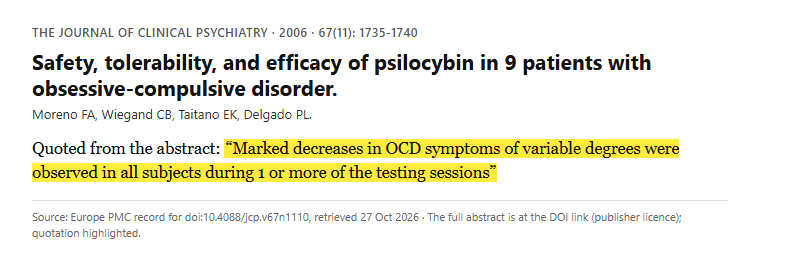
Abstract of the published study (text from Europe PMC), key sentence highlighted in yellow. Source: Moreno FA, Wiegand CB, Taitano EK, Delgado PL. Safety, tolerability, and efficacy of psilocybin in 9 patients with obsessive-compulsive disorder. J Clin Psychiatry. 2006;67(11):1735-1740. https://doi.org/10.4088/jcp.v67n1110
Related reading
- Collins HM. Psychedelics for the Treatment of Obsessive-Compulsive Disorder: Efficacy and Proposed Mechanisms. Int J Neuropsychopharmacol. 2024;27(12):pyae057. https://doi.org/10.1093/ijnp/pyae057 — Reviews the evidence that psilocybin can reduce OCD symptoms, including the 2006 study that found significant symptom reductions, and the ongoing psilocybin trials building on it.
- Eghdami S, Boroon M, Keshavarz-Akhlaghi AA, Shalbafan M. Efficacy and tolerability of ketamine in moderate to severe obsessive-compulsive disorder: a systematic review. Psychopharmacology (Berl). 2026. https://doi.org/10.1007/s00213-026-07155-z — A systematic review of 15 ketamine studies in OCD reporting rapid response rates of 50-60% in randomized trials and sustained remission lasting weeks to months when paired with exposure and response prevention.
Related pages on this site
Depressive Disorders · Major Depressive Disorder · Treatment-Resistant Depression · Bipolar Disorder · Introduction: A New Era · End of Life Distress
This page summarizes published research for education only. It is not medical advice. Any change to a medication remains the decision of that person’s own prescriber.
Keep reading
All Educational Resources · About This Archive · For Practicum Supervisors