

Hopeful news on suicidal thoughts! A systematic review reported significant reductions in suicidal ideation in four randomized trials of psilocybin and MDMA-assisted therapy (Cohen's d 0.52 to 1.25, no safety issues reported), with five more randomized trials also showing reductions. A review of 114 studies (3,504 participants) found no reports of deaths by suicide after high-dose classic psychedelics in contemporary research settings, a 233-person trial found the highest psilocybin dose group's depression scores fell 6.6 points more than the control group's, and ayahuasca showed large within-group decreases in suicidality. Encouraging to see careful research, with close follow-up at its center, bringing such promising results.
Key studies
Study 1. Psilocybin in 233 people with treatment-resistant depression (Goodwin, 2022)
Depression scores fell 12.0 points at three weeks on the highest psilocybin dose, versus 5.4 on the lowest, in 233 people (P < .001)!
In a phase 2, double-blind trial of 233 adults with treatment-resistant depression, researchers reported that the highest-dose psilocybin group's depression scores (MADRS, 0 to 60) fell by 12.0 points at three weeks versus 5.4 points in the lowest-dose control group, a difference of 6.6 points (95% CI -10.2 to -2.9; P<0.001), with response and remission rates at three weeks generally supportive of that result! Participants were randomly assigned to a single dose of psilocybin at one of three levels, the lowest serving as the control, each with psychological support.
“psilocybin at a single dose of 25 mg, but not 10 mg, reduced depression scores significantly more than a 1-mg dose over a period of 3 weeks”
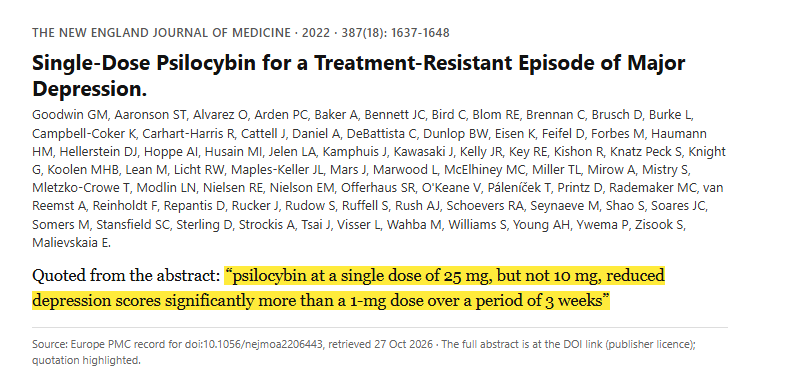
Abstract of the published study (text from Europe PMC), key sentence highlighted in yellow. Source: Goodwin GM, Aaronson ST, Alvarez O, et al. Single-Dose Psilocybin for a Treatment-Resistant Episode of Major Depression. N Engl J Med. 2022;387(18):1637-1648. https://doi.org/10.1056/nejmoa2206443
Study 2. Ayahuasca or placebo in 29 people with treatment-resistant depression (Zeifman, 2019)
Suicidality fell with ayahuasca: large within-group effects (d = 1.19 to 1.42) and medium between-group effects at every time point!
Researchers re-analyzed a randomized, placebo-controlled trial of 29 people with treatment-resistant depression, none at imminent risk of suicide (14 given ayahuasca, 15 placebo), and reported a significant effect of time on psychiatrist-rated suicidality (p < .05; the ayahuasca-versus-placebo effect trended toward significance, p = .088), with medium between-group effect sizes favoring ayahuasca at every time point (Cohen's d = 0.58, 0.56 and 0.67 at days 1, 2 and 7) and large within-group effect sizes in the ayahuasca group (d = 1.19 to 1.42). This was the first research to explore ayahuasca and suicidality, and the authors concluded ayahuasca may show potential as an intervention for suicidality!
“Furthermore, within the ayahuasca group, we found large effect sizes for decreases in suicidality at all time points.”
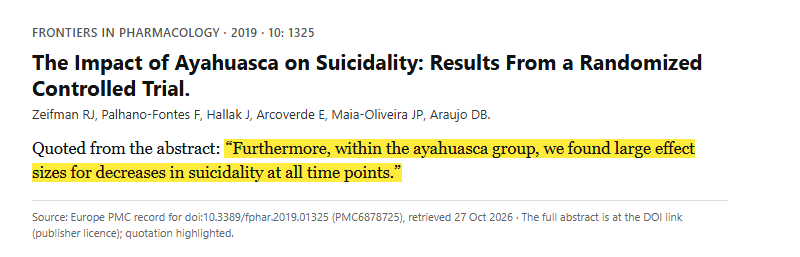
Abstract of the published study (text from Europe PMC), key sentence highlighted in yellow. Source: Zeifman RJ, Palhano-Fontes F, Hallak J, Arcoverde E, Maia-Oliveira JP, Araujo DB. The Impact of Ayahuasca on Suicidality: Results From a Randomized Controlled Trial. Front Pharmacol. 2019;10:1325. https://doi.org/10.3389/fphar.2019.01325
Study 3. Classic psychedelics in 3,504 participants across 114 studies (Hinkle, 2024)
No reports of deaths by suicide in contemporary research settings, in a review of 114 studies with analyzable safety data (3,504 participants)!
In a systematic review and meta-analysis of LSD, psilocybin, DMT and 5-MeO-DMT given in clinical or research settings (214 studies, 114 with analyzable safety data on 3,504 participants), researchers reported that classic psychedelics were generally well tolerated: serious events were reported for no healthy participants, and in contemporary research settings there were no reports of deaths by suicide, persistent psychotic disorders or hallucinogen persisting perception disorders after high-dose sessions! Nonserious events needing medical intervention were similarly rare, and common effects such as headache and nausea were comparable for psilocybin and LSD.
“In contemporary research settings, there were no reports of deaths by suicide, persistent psychotic disorders, or hallucinogen persisting perception disorders”
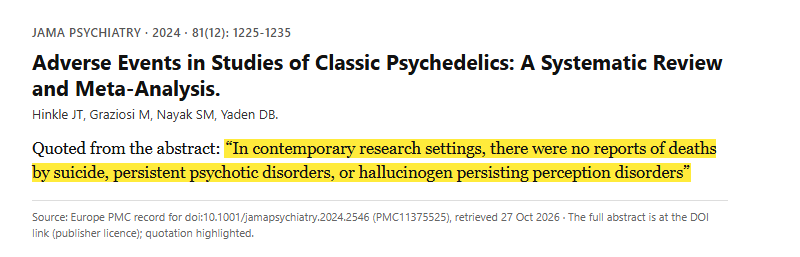
Abstract of the published study (text from Europe PMC), key sentence highlighted in yellow. Source: Hinkle JT, Graziosi M, Nayak SM, Yaden DB. Adverse Events in Studies of Classic Psychedelics: A Systematic Review and Meta-Analysis. JAMA Psychiatry. 2024;81(12):1225-1235. https://doi.org/10.1001/jamapsychiatry.2024.2546
Study 4. Psychedelics and suicide-related outcomes in 9 randomized trials and 24 other studies (Meshkat, 2025)
Significant reductions in suicidal ideation in 4 randomized trials of psilocybin and MDMA-assisted therapy (d = 0.52 to 1.25), with reductions in 5 more!
In a systematic review searching to November 2024, researchers reported significant reductions in suicidal ideation in four randomized trials of psilocybin (three studies) or MDMA-assisted therapy (one study) that measured suicidality as a secondary or safety outcome, with Cohen's d of 0.52 to 1.25 (p = 0.01 to 0.005) and no safety issues reported! Five more randomized trials found reductions in suicidal ideation with psilocybin (two studies) and MDMA-assisted therapy (three studies; p = 0.02 to 0.04), and across non-randomized studies psilocybin reduced suicidal ideation (odds ratios 0.40 to 0.75) while MDMA-assisted therapy studies in PTSD pooled d = 0.61.
“Four randomized controlled trials (RCTs) evaluated suicidality as a secondary outcome or safety measure, showing significant reductions in suicidal ideation with psilocybin (three studies)”
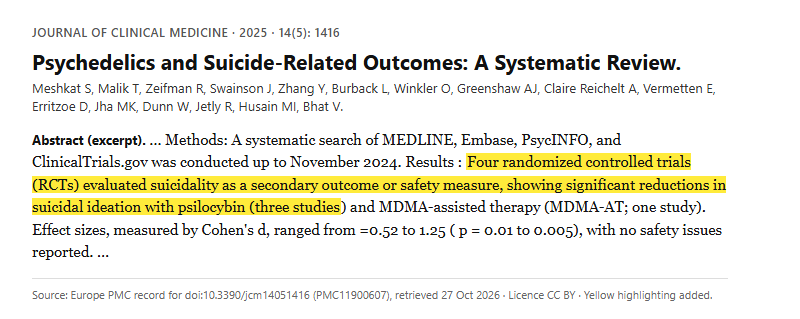
Abstract of the published study (text from Europe PMC), key sentence highlighted in yellow. Source: Meshkat S, Malik T, Zeifman R, et al. Psychedelics and Suicide-Related Outcomes: A Systematic Review. J Clin Med. 2025;14(5):1416. https://doi.org/10.3390/jcm14051416
Related reading
- Mallevays M, Berkovitch L. Psychedelics and suicidality: A double-edged sword - risks, mechanisms, and moving forward. Eur Neuropsychopharmacol. 2026;113:113878. https://doi.org/10.1016/j.euroneuro.2026.113878 — Explains how screening, preparation, in-session guidance and integration seem essential to shifting outcomes toward benefit, and notes rare clinical-setting reports of increased suicidal ideation showed no significant difference from placebo groups.
Related pages on this site
Depressive Disorders · Major Depressive Disorder · Treatment-Resistant Depression · Bipolar Disorder · Introduction: A New Era · End of Life Distress
This page summarizes published research for education only. It is not medical advice. Any change to a medication remains the decision of that person’s own prescriber.
Keep reading
All Educational Resources · About This Archive · For Practicum Supervisors