


Psychedelic research is turning toward the harm that racism leaves behind! In a survey of 313 Black, Indigenous and people of color across the US and Canada, stronger acute effects on psilocybin, LSD or MDMA went with bigger decreases in traumatic stress, depression, anxiety and stress (Williams, 2021). A further analysis of the same 313 people found that gains in psychological flexibility helped explain the decreases in racial trauma symptoms (Davis, 2021). In the first clinical data on a validated discrimination-trauma scale, trauma symptoms of discrimination fell by 38% after MDMA-assisted therapy, a large effect (Cohen's d = 1.28) (Williams, 2026). Encouraging to see this research growing!
Key studies
Study 1. Survey of psilocybin, LSD and MDMA experiences in 313 people of color who had faced racism (Williams, 2021)
Among 313 people of color, stronger acute psychedelic effects on psilocybin, LSD or MDMA went with bigger decreases in traumatic stress, depression, anxiety and stress!
Researchers surveyed 313 diverse Black, Indigenous and people of color in the US and Canada, asking them to report their mental health symptoms in the 30 days before and the 30 days after an experience with psilocybin, LSD or MDMA. They found a significant relationship (c = 0.52, p < .001) between acute psychedelic effects (mystical-type, insight and challenging experiences) and decreases in a cluster of traumatic stress, depression, anxiety and stress, even after controlling for how often participants had faced discrimination and the time since the experience. The authors concluded that psychedelics may decrease the negative impact of racial trauma.
“Psychedelics may decrease the negative impact of racial trauma.”
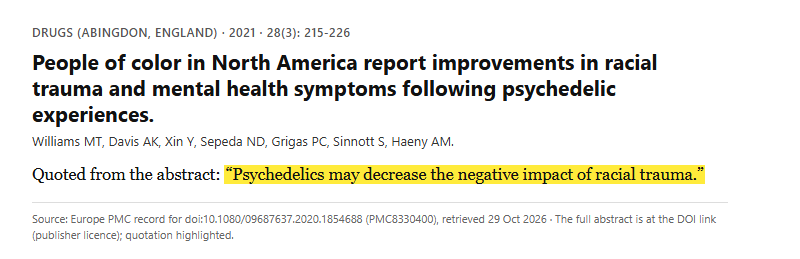
Quotation from the abstract of the published study (text from Europe PMC), highlighted in yellow. Source: Williams MT, Davis AK, Xin Y, et al. People of color in North America report improvements in racial trauma and mental health symptoms following psychedelic experiences. Drugs (Abingdon Engl). 2021;28(3):215-226. https://doi.org/10.1080/09687637.2020.1854688
Study 2. MDMA-assisted therapy for discrimination-related trauma in 5 people with PTSD (Williams, 2026)
Trauma symptoms of discrimination fell by 38% after MDMA-assisted therapy, with a large effect size!
Researchers assessed five diverse participants who had experienced multiple types of discrimination (including racial/ethnic, gender, social class, age and sexual orientation) before and after MDMA-assisted therapy for PTSD, using the Trauma Symptoms of Discrimination Scale. Mean scores fell by a striking 38%, a large effect (Cohen's d = 1.28). All participants reported marked improvements in discrimination-related trauma symptoms, across different racial/ethnic identities and discrimination histories.
“A paired-samples t-test indicated a significant reduction in TSDS scores following therapy, with mean scores decreasing by 38% (t(4) = 2.85, p = .046).”
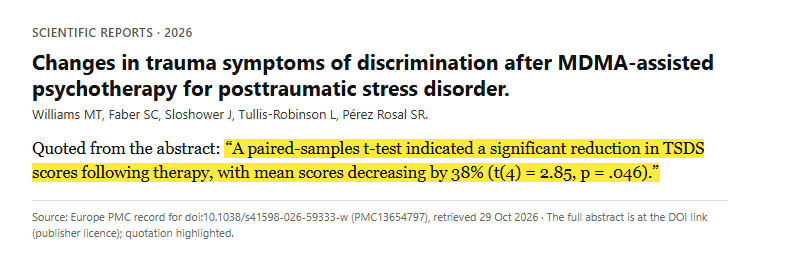
Quotation from the abstract of the published study (text from Europe PMC), highlighted in yellow. Source: Williams MT, Faber SC, Sloshower J, et al. Changes in trauma symptoms of discrimination after MDMA-assisted psychotherapy for posttraumatic stress disorder. Sci Rep. 2026. https://doi.org/10.1038/s41598-026-59333-w
Study 3. Mediation analysis of the same 313-person people-of-color psychedelic survey: psychological flexibility (Davis, 2021)
In 313 people of color, gains in psychological flexibility helped explain the decreases in racial trauma symptoms after a psychedelic experience!
This is a further analysis of the same survey of people of color reported by Williams and colleagues, covering 313 Black, Indigenous and people of color (mean age 33.1; 57% female). It examined how acute psychedelic effects relate to decreases in racial trauma symptoms, using a path analysis to explore whether changes in psychological flexibility from before to after the psychedelic experience mediated this relationship. The researchers concluded that psychedelics confer potential benefits in decreasing racial trauma symptoms among BIPOC, with psychological flexibility an important pathway for these effects.
“This research suggests psychedelics confer potential benefits in decreasing RT symptoms among BIPOC and psychological flexibility may be an important mediator of these effects.”
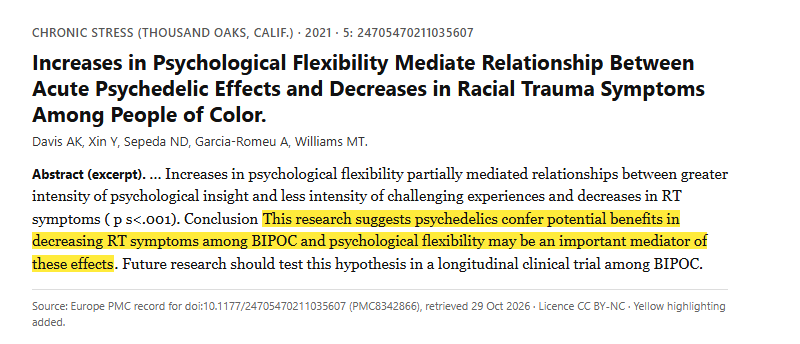
Abstract of the published study (text from Europe PMC), key sentence highlighted in yellow. Source: Davis AK, Xin Y, Sepeda ND, et al. Increases in Psychological Flexibility Mediate Relationship Between Acute Psychedelic Effects and Decreases in Racial Trauma Symptoms Among People of Color. Chronic Stress (Thousand Oaks). 2021;5:24705470211035607. https://doi.org/10.1177/24705470211035607
Related pages on this site
PTSD · Equity and Ethics · Anxiety Disorders · Depressive Disorders · Social Connection and Relationships
This page summarizes published research for education only. It is not medical advice. Any change to a medication remains the decision of that person’s own prescriber.
Keep reading
All Educational Resources · About This Archive · For Practicum Supervisors