


Psychedelic research is shining a hopeful light on shame and self-compassion! In a randomized, double-blind, placebo-controlled crossover trial of 28 healthy volunteers, an ayahuasca-inspired DMT-harmine formulation significantly reduced embarrassment and shame as people listened to their own singing (Aicher, 2026). In a prospective survey of 679 adults, trait shame decreased after psilocybin use and the drop was maintained 2-3 months later (Mathai, 2026). After psilocybin-assisted group therapy, HIV-related shame fell by a median of 5.5 points at 3-months follow-up in 12 people living with HIV (Mehtani, 2024). A scoping review of ten studies reported rapid, increasing and sustained self-compassion (Kurkova, 2025). Encouraging to see kindness toward oneself becoming a measurable outcome!
Key studies
Study 1. Ayahuasca-inspired DMT-harmine formulation compared with placebo in 28 healthy volunteers facing their own singing (Aicher, 2026)
An ayahuasca-inspired DMT-harmine formulation significantly reduced embarrassment and shame compared with placebo in 28 healthy volunteers!
In a randomized, double-blind, placebo-controlled crossover trial, 28 healthy men listened to recordings of their own singing in a karaoke paradigm designed to provoke embarrassment and shame. Researchers reported that the combined harmine and DMT formulation significantly reduced embarrassment when participants heard themselves (EMM=-16.83, p=.001) compared with placebo. The formulation also lowered the Experiential Shame Scale global score (p=.019) and its emotional subscale (p=.009), pointing to a remarkable acute easing of negative self-referential emotions.
“HAR/DMT compared to placebo reduced ESS global score (F(df)= 4.26(2, 54); p=.019) and ESS emotional subscale (F(df)=5.11(2, 54); p=.009), while harmine alone showed no significant effects.”
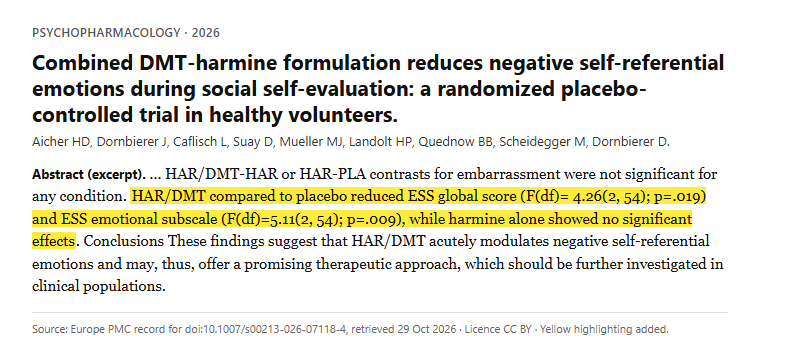
Abstract of the published study (text from Europe PMC), key sentence highlighted in yellow. Source: Aicher HD, Dornbierer J, Caflisch L, et al. Combined DMT-harmine formulation reduces negative self-referential emotions during social self-evaluation: a randomized placebo-controlled trial in healthy volunteers. Psychopharmacology (Berl). 2026. https://doi.org/10.1007/s00213-026-07118-4
Study 2. Scoping review of ten psilocybin, MDMA and LSD therapy studies relevant to moral injury (Kurkova, 2025)
Studies gathered from 11,734 publications reported rapid, increasing, and sustained self-compassion with psychedelic-assisted psychotherapy!
Researchers screened 11,734 publications and included ten studies of psilocybin, MDMA or LSD across conditions including PTSD, alcohol use disorder, major depression and anxiety linked to life-threatening illness. The studies reported rapid, increasing and sustained self-compassion over time, together with gains in self-forgiveness and self-acceptance and a reduction in demoralization. The authors concluded that psychedelic-assisted psychotherapy holds promise as an intervention for moral injury, the profound distress that arises from morally challenging experiences.
“Studies reported rapid, increasing, and sustained self-compassion over time, alongside increases in self-forgiveness and self-acceptance, reduction in demoralization, and decreased drinking scores. Though in other diagnostic contexts, PAP has shown efficacy in addressing symptoms commonly associated with moral injury, particularly within the context of PTSD.”
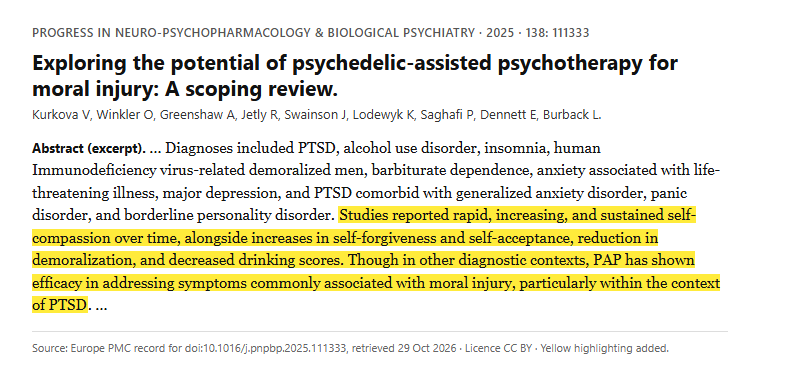
Abstract of the published study (text from Europe PMC), key sentence highlighted in yellow. Source: Kurkova V, Winkler O, Greenshaw A, et al. Exploring the potential of psychedelic-assisted psychotherapy for moral injury: A scoping review. Prog Neuropsychopharmacol Biol Psychiatry. 2025;138:111333. https://doi.org/10.1016/j.pnpbp.2025.111333
Study 3. Prospective longitudinal survey of real-world psilocybin use in 679 adults (Mathai, 2026)
Trait shame decreased after psilocybin use and the drop was maintained 2-3 months later in a study of 679 adults!
This prospective, longitudinal study followed 679 adults with validated shame and guilt measures before and after they used psilocybin in naturalistic settings. Researchers reported that psilocybin produced a significant decrease in trait shame that was still present 2-3 months after use (Cohen's dz = 0.37). Participants' ability to constructively work through feelings of shame or guilt during the experience predicted their wellbeing 2-4 weeks later.
“Ratings of participant ability to constructively work through these feelings predicted wellbeing 2-4 weeks after psilocybin use. Psilocybin on average produced a small but significant decrease in trait shame that was maintained 2-3 months after use (Cohen's dz = 0.37).”
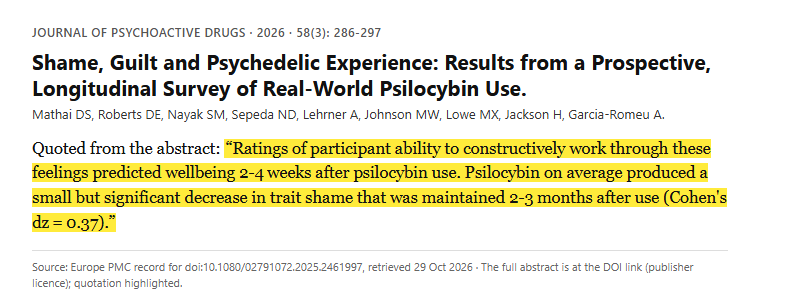
Quotation from the abstract of the published study (text from Europe PMC), highlighted in yellow. Source: Mathai DS, Roberts DE, Nayak SM, et al. Shame, Guilt and Psychedelic Experience: Results from a Prospective, Longitudinal Survey of Real-World Psilocybin Use. J Psychoactive Drugs. 2026;58(3):286-297. https://doi.org/10.1080/02791072.2025.2461997
Study 4. In-depth interviews on naturalistic psychedelic experiences with 20 transgender and gender-expansive people (Gaughan, 2025)
Many of the 20 transgender and gender-expansive participants said psychedelic experiences brought increased self-acceptance via increased self-compassion!
Researchers conducted 20 in-depth, hour-long interviews with transgender and gender-expansive people about their naturalistic psychedelic experiences and their gender journey. A remarkable theme emerged: many participants reported that these experiences facilitated increased self-acceptance of their gender identity through increased self-compassion and an expanded concept of gender. Some participants also described mental health benefits such as gender euphoria, and the authors offered guidance to help clinicians support shifts in self-acceptance after psychedelic use.
“Second, many participants reported that naturalistic psychedelic experiences facilitated increased self-acceptance of their gender identity via increased self-compassion and an expanded concept of gender.”
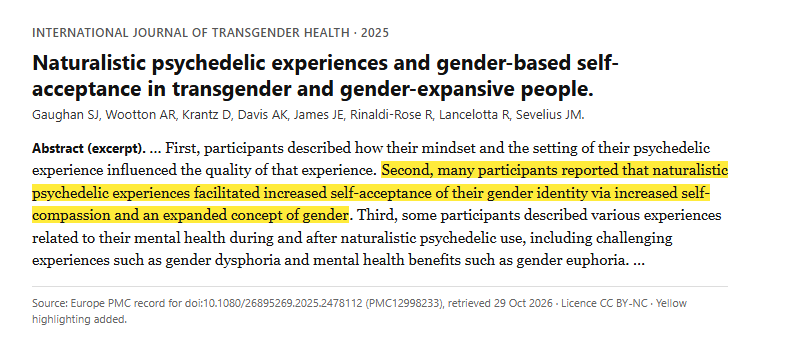
Abstract of the published study (text from Europe PMC), key sentence highlighted in yellow. Source: Gaughan SJ, Wootton AR, Krantz D, et al. Naturalistic psychedelic experiences and gender-based self-acceptance in transgender and gender-expansive people. Int J Transgend Health. 2025. https://doi.org/10.1080/26895269.2025.2478112
Study 5. Psilocybin-assisted group therapy in 12 people with HIV (Mehtani, 2024)
HIV-related shame fell by a median of 5.5 points from baseline to 3-months follow-up after psilocybin-assisted group therapy!
In a pilot clinical trial, 12 people living with HIV received psilocybin-assisted group therapy, and HIV-related shame was measured with the HIV and Abuse Related Shame Inventory. Researchers reported a large decrease in HIV-related shame, with a median change of -5.5 points from baseline to 3-months follow-up (p = 0.009, r = -0.75). The authors note that this finding carries potential significance for the future of HIV care, where shame has been hard to reach with conventional psychotherapies.
“In a pilot clinical trial (N = 12), receipt of psilocybin-assisted group therapy was associated with a large pre-post decrease in HIV-related shame as measured by the HIV and Abuse Related Shame Inventory, with a median (IQR) change of - 5.5 (- 6.5, - 3.5) points from baseline to 3-months follow-up (Z = - 2.6, p = 0.009, r = - 0.75).”
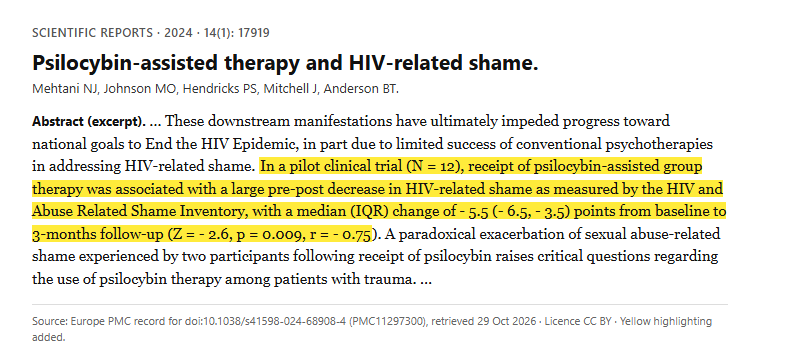
Abstract of the published study (text from Europe PMC), key sentence highlighted in yellow. Source: Mehtani NJ, Johnson MO, Hendricks PS, et al. Psilocybin-assisted therapy and HIV-related shame. Sci Rep. 2024;14(1):17919. https://doi.org/10.1038/s41598-024-68908-4
Study 6. Naturalistic study of psilocybin after compassion-imagery or breath-attention priming, with fMRI, in 105 participants (Pallavicini, 2026)
Self-compassion and decentering increased after psilocybin in a naturalistic study of 105 participants, with lasting gains in absorption strongest after high-dose compassion imagery priming!
This naturalistic study followed 105 participants who were primed with either compassion imagery or attention to breathing before taking psilocybin, using questionnaires and fMRI over time. Researchers observed sustained increases in absorption over time, particularly in the high-dose compassion imagery condition, and additional within-group increases in decentering and self-compassion. The authors highlight the potential role of compassion-based practices as preparation for psychedelic experiences.
“We observed sustained increases in absorption over time, particularly in the high-dose compassion imagery condition. Additional within-group increases were found in measures of decentering and self-compassion.”
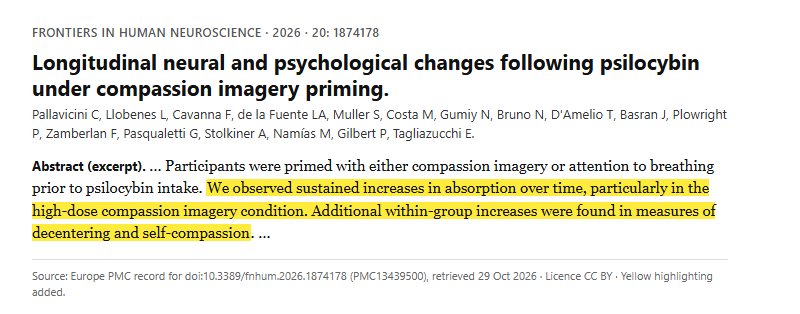
Abstract of the published study (text from Europe PMC), key sentence highlighted in yellow. Source: Pallavicini C, Llobenes L, Cavanna F, et al. Longitudinal neural and psychological changes following psilocybin under compassion imagery priming. Front Hum Neurosci. 2026;20:1874178. https://doi.org/10.3389/fnhum.2026.1874178
Related pages on this site
Social Connection and Relationships · Personality and Traits · PTSD · Set and Setting · Wellness of the 'Well'
This page summarizes published research for education only. It is not medical advice. Any change to a medication remains the decision of that person’s own prescriber.
Keep reading
All Educational Resources · About This Archive · For Practicum Supervisors