


Psychedelic research is opening real new doors for stimulant use disorder! In a randomized crossover trial, a single ketamine infusion cut cocaine self-administration by 67% relative to baseline (Dakwar, 2017). In propensity-matched health records, people with cocaine use disorder given ketamine for depression showed a remission hazard ratio of 4.39 versus antidepressants or midazolam (Gao, 2023). In a Sydney pilot of psilocybin-assisted psychotherapy, median methamphetamine use fell from 12 days to 0 days in the prior 28 days (Knock, 2025). Among 214,505 US adults, lifetime peyote use was linked to over 50% lower odds of cocaine use disorder (Jones, 2022). Encouraging to see these studies growing for people who have waited a long time for new options!
Key studies
Study 1. Ketamine compared with matched controls in two electronic health record cohorts of people with cocaine use disorder (Gao, 2023)
Cocaine use disorder remission came with a hazard ratio of 4.39 for ketamine versus antidepressants or midazolam!
Researchers combined artificial intelligence-based drug prediction and expert review, ranked ketamine as the top repurposing candidate for cocaine use disorder, and then tested it in electronic health records from more than 90 million patients. After propensity score-matching, 7742 patients receiving anesthesia and 7910 patients with depression were compared on cocaine use disorder remission within 1 year. Patients given ketamine for anesthesia showed a significantly higher remission rate than those given other anesthetics (HR = 1.98), and patients given ketamine for depression showed a striking remission advantage over those given antidepressants or midazolam (HR = 4.39). The authors concluded that ketamine appears to be a potential repurposed drug for treatment of cocaine use disorder.
“Patients with CUD prescribed ketamine for anesthesia displayed a significantly higher rate of CUD remission compared with matched individuals prescribed other anesthetics [hazard ratio (HR) = 1.98, 95% confidence interval (CI) = 1.42-2.78]. Similarly, CUD patients prescribed ketamine for depression evidenced a significantly higher CUD remission ratio compared with matched patients prescribed antidepressants or midazolam (HR = 4.39, 95% CI = 2.89-6.68).”
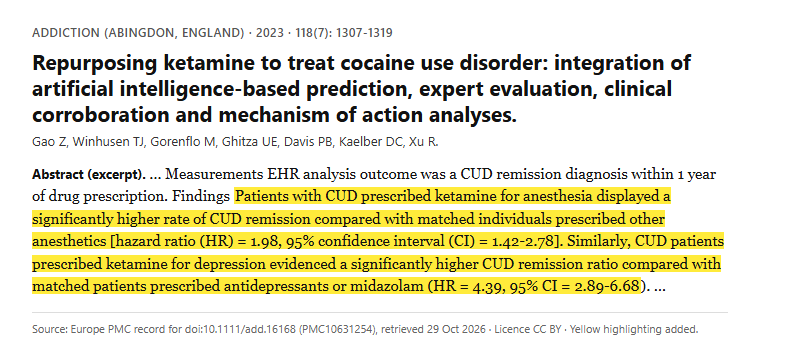
Abstract of the published study (text from Europe PMC), key sentence highlighted in yellow. Source: Gao Z, Winhusen TJ, Gorenflo M, et al. Repurposing ketamine to treat cocaine use disorder: integration of artificial intelligence-based prediction, expert evaluation, clinical corroboration and mechanism of action analyses. Addiction. 2023;118(7):1307-1319. https://doi.org/10.1111/add.16168
Study 2. AI drug-repurposing search with a health-record cohort study of ketamine in people with amphetamine-type stimulant use disorder (Gao, 2025)
Ketamine was linked to greater remission from amphetamine-type stimulant use disorder, with a hazard ratio of 1.58 compared with other anesthetics!
Researchers used an artificial-intelligence knowledge graph to rank FDA-approved drugs for amphetamine-type stimulant use disorder, a condition with no FDA-approved treatment, and ketamine emerged among the top 10 candidates. They then tested that prediction in US electronic health records of 3663 patients who received anesthesia and 4328 patients diagnosed with depression. Ketamine was associated with greater remission than other anesthetics (HR = 1.58), and the striking pattern held in patients with depression, where ketamine was associated with greater remission than antidepressants (HR 1.51) and bupropion/mirtazapine (HR 1.68). Functional analyses showed ketamine targets several pathways tied to the disorder, including neuroactive ligand-receptor interaction and amphetamine addiction.
“Ketamine for anesthesia in ATSUD patients was associated with greater ATSUD remission compared with other anesthetics: hazard ratio (HR) = 1.58, 95% confidence interval (CI) = 1.15-2.17. Similar results were found for ATSUD patients with depression when comparing ketamine with antidepressants and bupropion/mirtazapine with HRs of 1.51 (95% CI = 1.14-2.01) and 1.68 (95% CI = 1.18-2.38), respectively.”
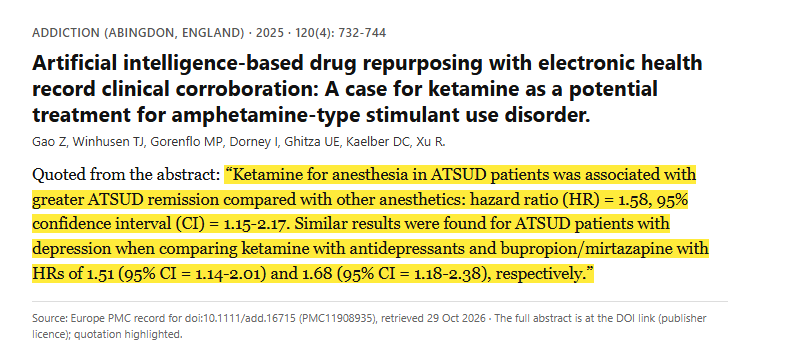
Quotation from the abstract of the published study (text from Europe PMC), highlighted in yellow. Source: Gao Z, Winhusen TJ, Gorenflo MP, et al. Artificial intelligence-based drug repurposing with electronic health record clinical corroboration: A case for ketamine as a potential treatment for amphetamine-type stimulant use disorder. Addiction. 2025;120(4):732-744. https://doi.org/10.1111/add.16715
Study 3. Randomized crossover laboratory trial of a single ketamine infusion in people who use cocaine (Dakwar, 2017)
Ketamine cut cocaine self-administration by 67% relative to baseline!
In a randomized crossover trial using an established laboratory model that pits cocaine now against money later, researchers compared a single ketamine infusion with a control infusion in cocaine users. Ketamine significantly decreased cocaine self-administration by 67% relative to baseline at more than 24 hours after the infusion. The authors described this as the most robust reduction observed to date in human cocaine users and the first to involve mechanisms other than stimulant or dopamine agonist effects.
“Using an established laboratory model aimed at evaluating behavioral shifts in the salience of cocaine now vs money later, we found that ketamine, as compared to the control, significantly decreased cocaine self-administration by 67% relative to baseline at greater than 24 h post-infusion, the most robust reduction observed to date in human cocaine users and the first to involve mechanisms other than stimulant or dopamine agonist effects.”
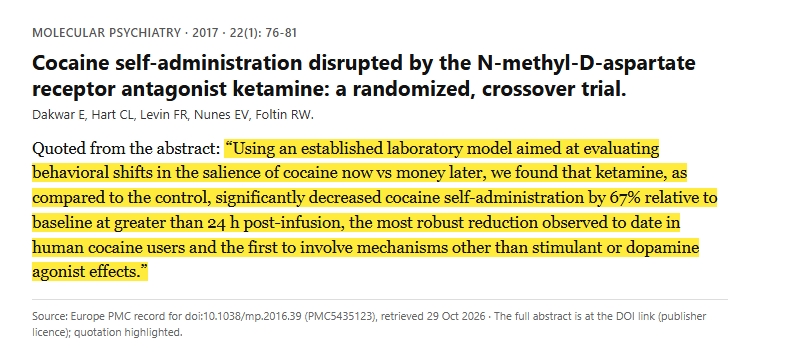
Quotation from the abstract of the published study (text from Europe PMC), highlighted in yellow. Source: Dakwar E, Hart CL, Levin FR, et al. Cocaine self-administration disrupted by the N-methyl-D-aspartate receptor antagonist ketamine: a randomized, crossover trial. Mol Psychiatry. 2017;22(1):76-81. https://doi.org/10.1038/mp.2016.39
Study 4. Double-blind crossover trial of ketamine compared with lorazepam in 8 people with cocaine dependence (Dakwar, 2014)
A single ketamine infusion raised motivation to quit cocaine by approximately 60%!
Eight volunteers with active cocaine dependence entered a double-blind crossover trial comparing ketamine infusions with the active control lorazepam, with assessments at baseline and 24 hours after each infusion. A single ketamine infusion produced a mean 3.9-point gain on the University of Rhode Island Change Assessment, corresponding to an approximately 60% increase in motivation to quit, with a reduction of comparable magnitude in cue-induced craving. A second ketamine infusion led to further reductions in cue-induced craving compared with the control.
“Compared with the active control lorazepam, a single ketamine infusion (.41 mg/kg) led to a mean 3.9-point gain in University of Rhode Island Change Assessment (p = .012), which corresponds to an approximately 60% increase over preceding values. There was a reduction of comparable magnitude in cue-induced craving (p = .012).”
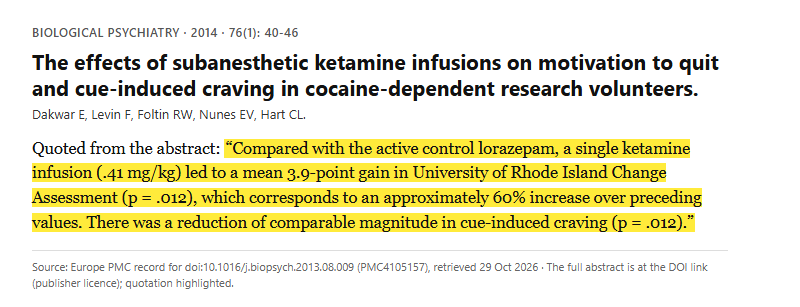
Quotation from the abstract of the published study (text from Europe PMC), highlighted in yellow. Source: Dakwar E, Levin F, Foltin RW, et al. The effects of subanesthetic ketamine infusions on motivation to quit and cue-induced craving in cocaine-dependent research volunteers. Biol Psychiatry. 2014;76(1):40-46. https://doi.org/10.1016/j.biopsych.2013.08.009
Study 5. Open-label pilot of psilocybin-assisted psychotherapy in 15 people with methamphetamine use disorder (Knock, 2025)
Median methamphetamine use fell from 12 days to 0 days in the prior 28 days after psilocybin-assisted psychotherapy!
In an outpatient public stimulant treatment program in Sydney, Australia, 15 people seeking treatment for methamphetamine use received three preparatory psychotherapy sessions, a single psilocybin session and two integration sessions drawing on motivational enhancement and acceptance and commitment therapy. Of the 15 enrolled, 14 completed the intervention and 13 completed the 90-day follow-up. Median days of methamphetamine use over the prior 28 days dropped from 12 at screening to 0 at day 28 and 2 at day 90, and methamphetamine craving was also lower at both follow-ups. The authors reported that the approach was feasible to implement in an outpatient setting.
“Methamphetamine use (over the prior 28 days) was observed to be lower at screening (median 12 days, IQR 7-16, n = 15) relative to day 28 (median 0 days, IQR 0-2, n = 13) and 90 (median 2 days, IQR 1-4, n = 14) post psilocybin.”
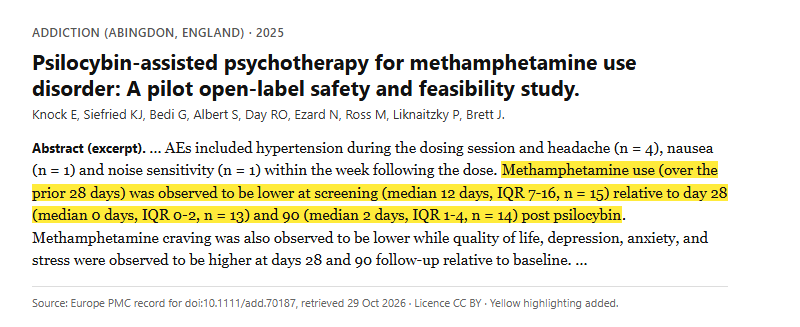
Abstract of the published study (text from Europe PMC), key sentence highlighted in yellow. Source: Knock E, Siefried KJ, Bedi G, et al. Psilocybin-assisted psychotherapy for methamphetamine use disorder: A pilot open-label safety and feasibility study. Addiction. 2025. https://doi.org/10.1111/add.70187
Study 6. Population survey of lifetime peyote use and cocaine use disorder in 214,505 US adults (Jones, 2022)
Lifetime peyote use was linked to over 50% lower odds of cocaine use disorder!
Using nationally representative data from the National Survey on Drug Use and Health (2015-2019), researchers examined lifetime use of classic psychedelics, including peyote, and cocaine use disorder and its 11 sub-criteria among 214,505 adults. Peyote use was associated with odds of cocaine use disorder reduced by over 50% (aOR: 0.47). Sensitivity analyses showed sharply lowered odds for seven of the 11 cocaine use disorder criteria as well (aOR range: 0.26-0.47).
“Peyote conferred lowered odds of CUD, reducing the odds of CUD by over 50% (aOR: 0.47).”
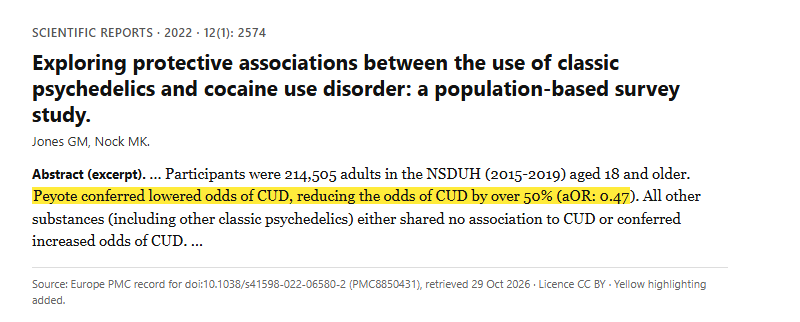
Abstract of the published study (text from Europe PMC), key sentence highlighted in yellow. Source: Jones GM, Nock MK. Exploring protective associations between the use of classic psychedelics and cocaine use disorder: a population-based survey study. Sci Rep. 2022;12(1):2574. https://doi.org/10.1038/s41598-022-06580-2
Study 7. Randomized controlled laboratory study of ketamine compared with midazolam in people with cocaine dependence (Dakwar, 2018)
Ketamine's mystical-type effects mediated its decreases in cocaine use and craving!
In a randomized controlled laboratory study, cocaine-dependent research volunteers received ketamine or the active control midazolam, and researchers tested which acute experiences explained ketamine's benefit. Ketamine produced significantly greater mystical-type effects than midazolam, and the mystical-type score mediated ketamine's effect on global improvement, meaning decreased cocaine use and craving, over the post-infusion period. The authors described this as the first controlled study to show that mystical-type phenomena may impact decision-making and behavior in a sustained manner.
“HMS score, but not the CADSS or NDES score, was found to mediate the effect of ketamine on global improvement (decreased cocaine use and craving) over the post-infusion period. This is the first controlled study to show that mystical-type phenomena, long considered to have therapeutic potential, may work to impact decision-making and behavior in a sustained manner.”
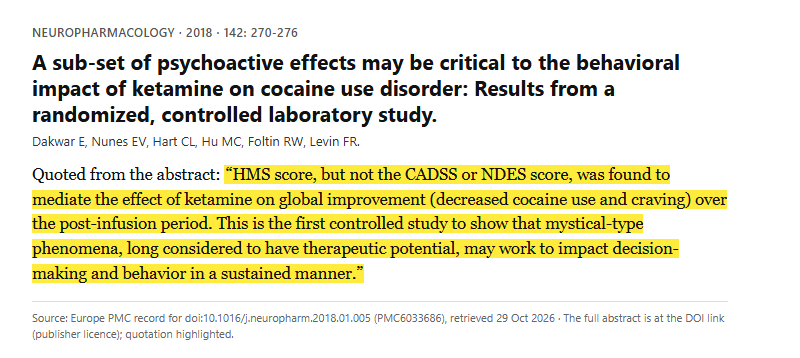
Quotation from the abstract of the published study (text from Europe PMC), highlighted in yellow. Source: Dakwar E, Nunes EV, Hart CL, et al. A sub-set of psychoactive effects may be critical to the behavioral impact of ketamine on cocaine use disorder: Results from a randomized, controlled laboratory study. Neuropharmacology. 2018;142:270-276. https://doi.org/10.1016/j.neuropharm.2018.01.005
Study 8. Double-blind randomized analysis of mystical-type effects of ketamine in 8 people with cocaine dependence (Dakwar, 2014)
Ketamine's mystical-type effects carried its boost to motivation to quit cocaine at 24 hours!
Eight cocaine-dependent individuals completed a double-blind, randomized inpatient study comparing two ketamine infusions with the active control lorazepam. Ketamine led to significantly greater acute mystical-type effects than lorazepam, with the higher ketamine infusion producing higher mystical-type scores. The mystical-type score mediated ketamine's effect on motivation to quit cocaine 24 hours after infusion, suggesting that psychological mechanisms may be involved in ketamine's anti-addiction benefits.
“Ketamine led to significantly greater acute mystical-type effects (by HMS) relative to the active control lorazepam; ketamine 0.71mg/kg was associated with significantly higher HMS scores than was the 0.41mg/kg dose. HMS score, but not CADSS score, was found to mediate the effect of ketamine on motivation to quit cocaine 24h postinfusion.”
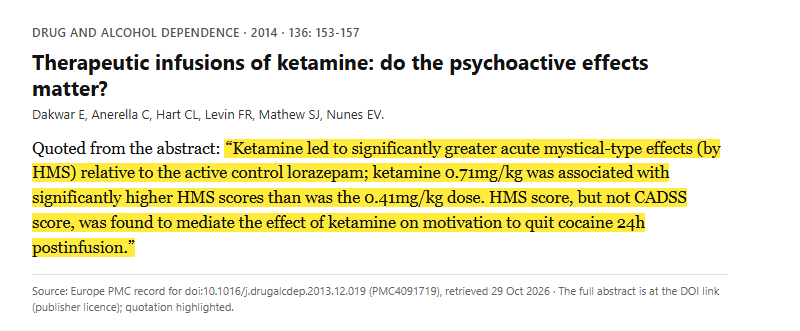
Quotation from the abstract of the published study (text from Europe PMC), highlighted in yellow. Source: Dakwar E, Anerella C, Hart CL, et al. Therapeutic infusions of ketamine: do the psychoactive effects matter? Drug Alcohol Depend. 2014;136:153-157. https://doi.org/10.1016/j.drugalcdep.2013.12.019
Study 9. Brain imaging before and after psilocybin-assisted psychotherapy in people with methamphetamine use disorder (Chaganti, 2026)
Greater reductions in methamphetamine use tracked recovery of frontostriatal and attentional connectivity after psilocybin!
In a prospective longitudinal study, people with methamphetamine use disorder underwent resting-state fMRI before and after psilocybin administration alongside psychotherapy. Researchers observed reorganization of functional connectivity within and between the attentional, default mode and salience networks, together with increases in local neural synchrony in frontal and sensorimotor regions. Greater reductions in methamphetamine use were associated with recovery of frontostriatal and attentional connectivity, and reductions in psychological distress correlated with strengthened integration of attentional and prefrontal-striatal circuits.
“Greater MA reductions in use were associated with recovery of frontostriatal and attentional connectivity, whereas reductions in psychological distress correlated with strengthened integration of attentional and prefrontal-striatal circuits.”
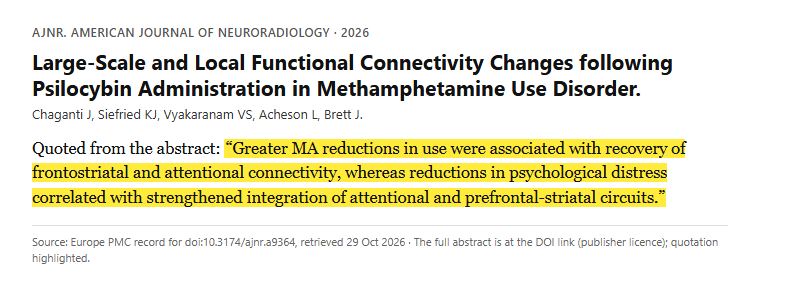
Quotation from the abstract of the published study (text from Europe PMC), highlighted in yellow. Source: Chaganti J, Siefried KJ, Vyakaranam VS, et al. Large-Scale and Local Functional Connectivity Changes following Psilocybin Administration in Methamphetamine Use Disorder. AJNR Am J Neuroradiol. 2026. https://doi.org/10.3174/ajnr.a9364
Study 10. Qualitative interview study of psilocybin-assisted psychotherapy in twelve people with methamphetamine use disorder (Brett, 2025)
Interviews with twelve participants linked psilocybin-assisted psychotherapy to a reduced salience of methamphetamine!
Twelve participants in an open-label outpatient pilot of psilocybin-assisted psychotherapy in Sydney, Australia, were interviewed before treatment and again one month after. Their experiences were often characterised by new understandings of themselves, their narrative histories and their relationships, and resolving challenging experiences was associated with a reduction in the salience of methamphetamine. Participants perceived the therapy as an acceptable intervention, with a strong therapeutic alliance seen as critical to positive outcomes.
“Interviewed participants in a study of psilocybin-assisted psychotherapy (PAT) for methamphetamine use disorder perceived PAT as an acceptable intervention. Transformation in understandings of self and interpersonal relationships and subsequent reduced salience of methamphetamine use often occurred through confronting psychic obstacles in the context of high levels of therapeutic support from study therapists.”
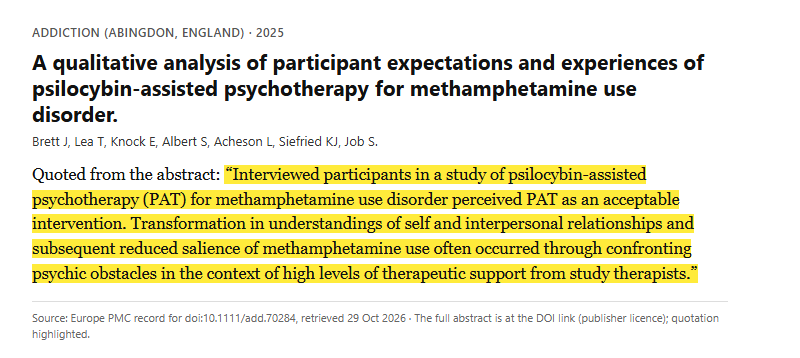
Quotation from the abstract of the published study (text from Europe PMC), highlighted in yellow. Source: Brett J, Lea T, Knock E, et al. A qualitative analysis of participant expectations and experiences of psilocybin-assisted psychotherapy for methamphetamine use disorder. Addiction. 2025. https://doi.org/10.1111/add.70284
Study 11. Qualitative interview study of ketamine-assisted psychotherapy in fourteen people with methamphetamine use disorder (Fletcher, 2026)
Fourteen participants described ketamine as creating a temporary state of reduced emotional and cognitive reactivity and enhanced receptivity!
Fourteen participants who completed an open-label pilot of ketamine-assisted psychotherapy for methamphetamine use disorder took part in semi-structured interviews after treatment. They described ketamine as creating a temporary state of reduced emotional and cognitive reactivity and enhanced receptivity, which the researchers called 'psychological space', and this state appeared to support engagement with psychotherapy. Acceptability was generally high within a supportive clinical environment.
“Acceptability was generally high within a supportive clinical environment.”
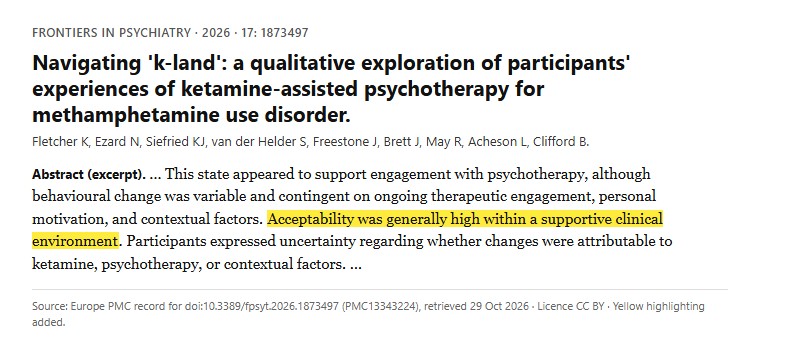
Abstract of the published study (text from Europe PMC), key sentence highlighted in yellow. Source: Fletcher K, Ezard N, Siefried KJ, et al. Navigating 'k-land': a qualitative exploration of participants' experiences of ketamine-assisted psychotherapy for methamphetamine use disorder. Front Psychiatry. 2026;17:1873497. https://doi.org/10.3389/fpsyt.2026.1873497
Related pages on this site
Substance Use Disorder · Opioid Use Disorder · Alcohol Use Disorder · Tobacco and Nicotine Use Disorder · Brain Imaging Research
This page summarizes published research for education only. It is not medical advice. Any change to a medication remains the decision of that person’s own prescriber.
Keep reading
All Educational Resources · About This Archive · For Practicum Supervisors